
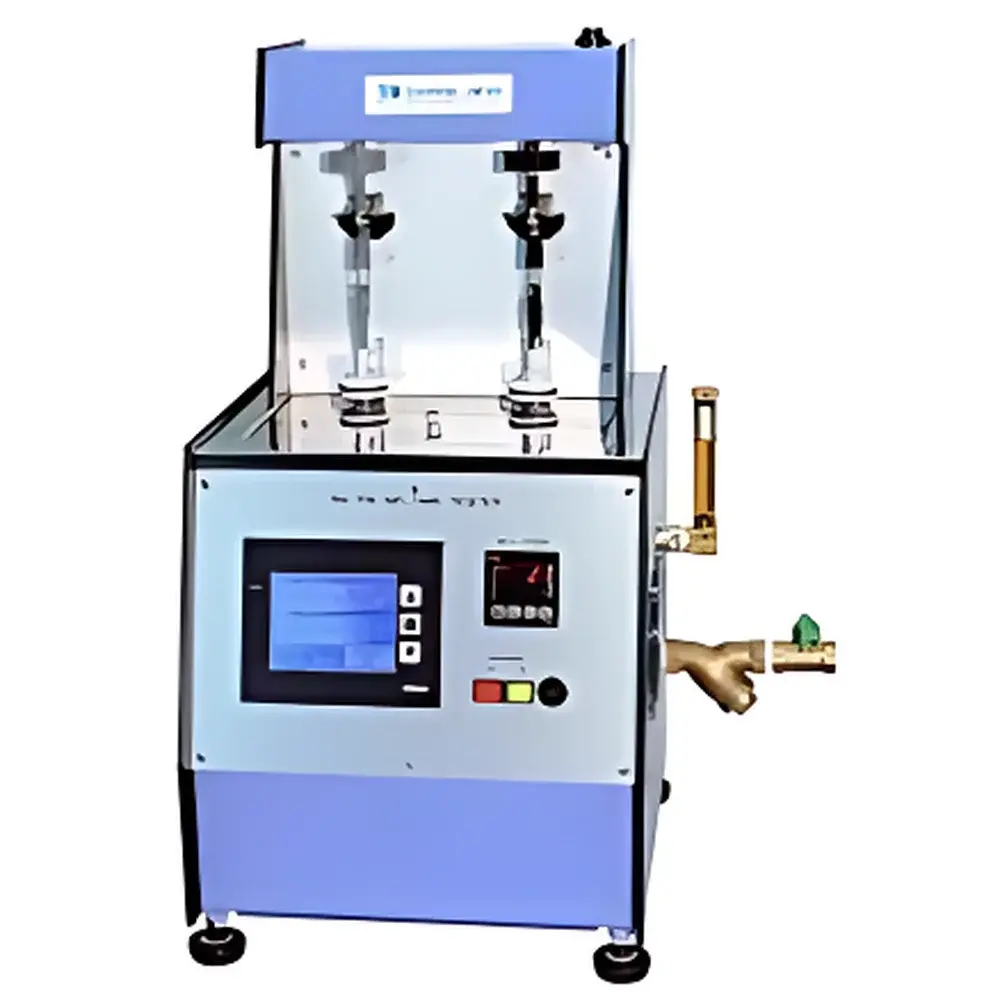
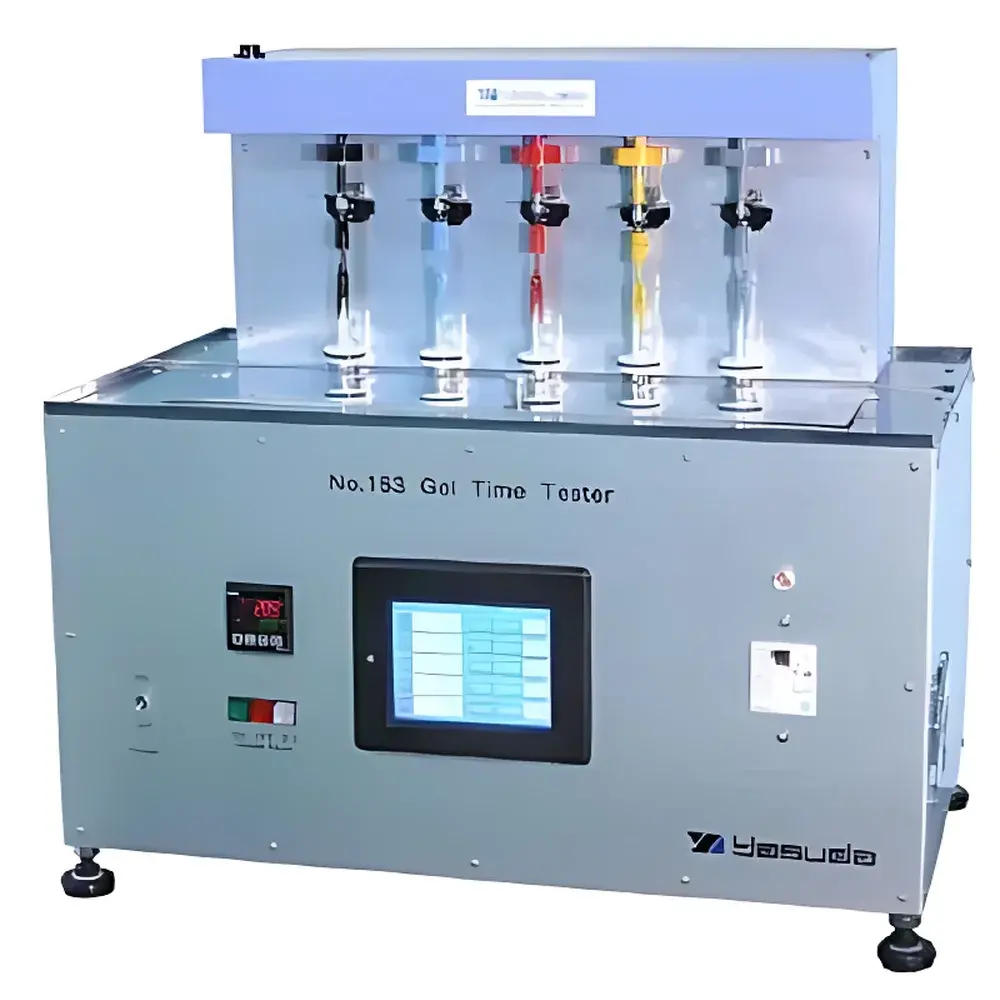
Yasuda No.153 Gel Time Tester
| Brand | Yasuda |
|---|---|
| Origin | Japan |
| Model | No.153 |
| Type | Import |
| Distributor Type | Authorized Distributor |
| Pricing | Upon Request |
Overview
The Yasuda No.153 Gel Time Tester is a precision mechanical instrument engineered for the standardized determination of gelation onset time in thermosetting resins—such as epoxies, phenolics, unsaturated polyesters, and vinyl esters—under controlled thermal conditions. It operates on the principle of torque-based rheological transition detection: a rotating magnetic rotor immersed in the sample induces shear while the resin undergoes crosslinking; as viscosity rises exponentially near the gel point, the increasing resistance to rotation triggers disengagement via a calibrated magnetic coupling mechanism. At the precise moment the rotor stalls, an integrated high-accuracy electronic timer halts automatically, recording the elapsed time from thermal initiation to gel point—defined herein as the time at which the material transitions from a viscous liquid to an elastic network with incipient structural integrity (G′ ≈ G″). This method aligns with widely accepted empirical protocols used in QC laboratories for batch release, formulation development, and cure kinetics validation.
Key Features
- Magnetic coupling-driven rotor arrest system ensures repeatable, contactless detection of gel point without mechanical slippage or sensor drift.
- Thermally stabilized test tube holder compatible with standard 16 × 100 mm borosilicate glass tubes, enabling consistent heat transfer and minimal thermal lag.
- Adjustable rotational speed (typically 60–120 rpm) to accommodate varying resin viscosities and sensitivity requirements.
- Dual-mode operation: manual start/stop for exploratory testing or auto-triggered timing synchronized with rotor stall event.
- Robust aluminum-alloy chassis with insulated thermal shielding, minimizing ambient interference during elevated-temperature tests (up to 200 °C when used with external heating mantles).
- No embedded electronics in the measurement zone—eliminates electromagnetic interference and supports use in explosion-proof or ESD-controlled environments.
Sample Compatibility & Compliance
The No.153 accommodates low-to-medium viscosity thermoset precursors (initial viscosity range: ~100–5,000 mPa·s), including solvent-free and filled systems. It is routinely employed in accordance with internal ASTM D2471-18 (Standard Test Method for Gel Time of Thermosetting Resins) and JIS K 6911 (Testing Methods for Epoxy Resins). While the instrument itself does not provide digital audit trails, its analog-timer output may be documented manually or interfaced via optional external data loggers compliant with GLP and ISO/IEC 17025 documentation requirements. For regulated environments (e.g., aerospace or medical device manufacturing), users are advised to implement procedural controls—including operator qualification, calibration against NIST-traceable stopwatch standards annually, and maintenance logs per manufacturer-recommended intervals.
Software & Data Management
The Yasuda No.153 is a stand-alone electromechanical instrument with no onboard firmware, microprocessor, or proprietary software. Timing output is delivered as a discrete analog signal (mechanical timer readout in seconds, resolution ±0.1 s) visible on a front-panel dial. To support digital data integrity and 21 CFR Part 11 compliance, laboratories commonly integrate the unit with validated third-party acquisition systems—such as National Instruments LabVIEW or Keysight PathWave—with hardware-triggered input modules that capture the timer stop signal. All raw timing values must be recorded in bound, numbered lab notebooks or LIMS-integrated electronic records with full metadata (operator ID, sample ID, temperature setpoint, resin lot number, ambient RH/T).
Applications
- Quality control of incoming resin batches prior to composite layup or molding operations.
- Accelerated aging studies correlating gel time shifts with storage duration or humidity exposure.
- Cure schedule optimization for autoclave, oven, or UV-thermal hybrid processes.
- Formulation screening of catalysts, accelerators, and inhibitors in R&D labs.
- Root cause analysis of premature gelation or extended pot life deviations in production environments.
- Supporting technical documentation for AS9100 or IATF 16949 process validation dossiers.
FAQ
Does the No.153 require electrical power for the timer function?
Yes—the integrated mechanical timer is spring-wound and requires manual winding before each test; no AC/DC power supply is needed for basic operation.
Can it measure gel time at temperatures above 100 °C?
The base unit is rated for ambient operation; elevated-temperature testing requires an externally controlled heating mantle or oil bath, with user-provided temperature monitoring per ASTM D2471 Annex A.
Is calibration traceable to national standards?
Timer calibration is performed using NIST-traceable time standards; Yasuda provides a factory calibration certificate valid for 12 months from date of shipment.
What maintenance is required?
Annual inspection of magnetic coupling alignment, rotor shaft lubrication (light silicone grease), and timer gear train cleaning—detailed in the English-language Operation & Maintenance Manual supplied with each unit.
Is the rotor material chemically resistant?
Rotors are manufactured from 316 stainless steel and PTFE-coated drive pins, offering compatibility with most organic solvents and acidic/basic resin systems encountered in composites manufacturing.





