
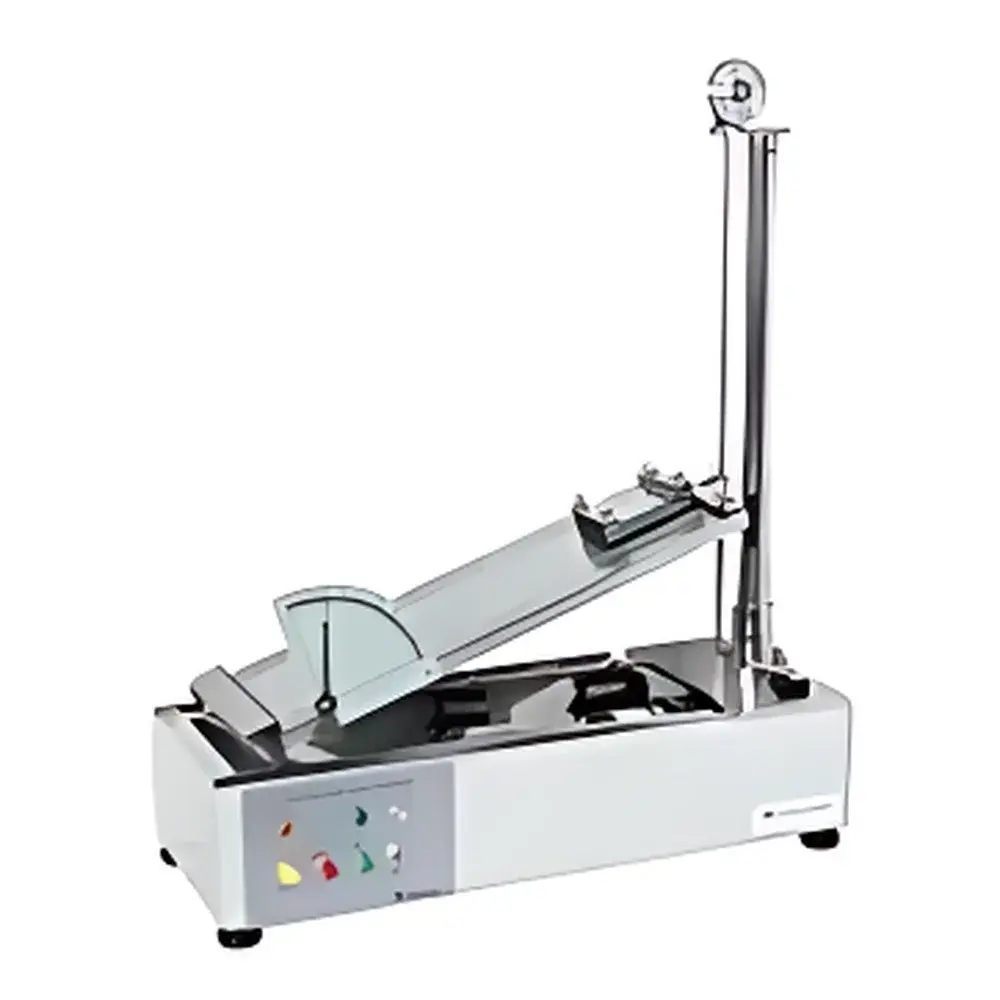
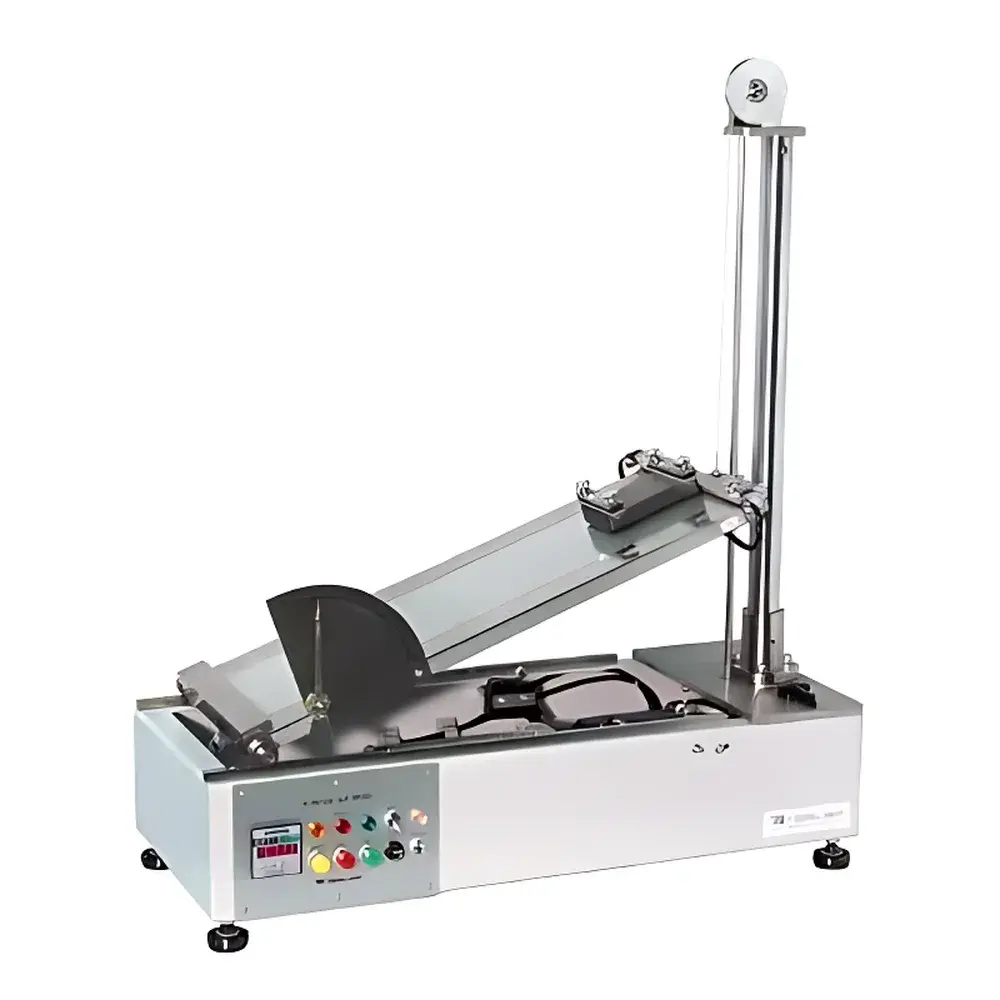
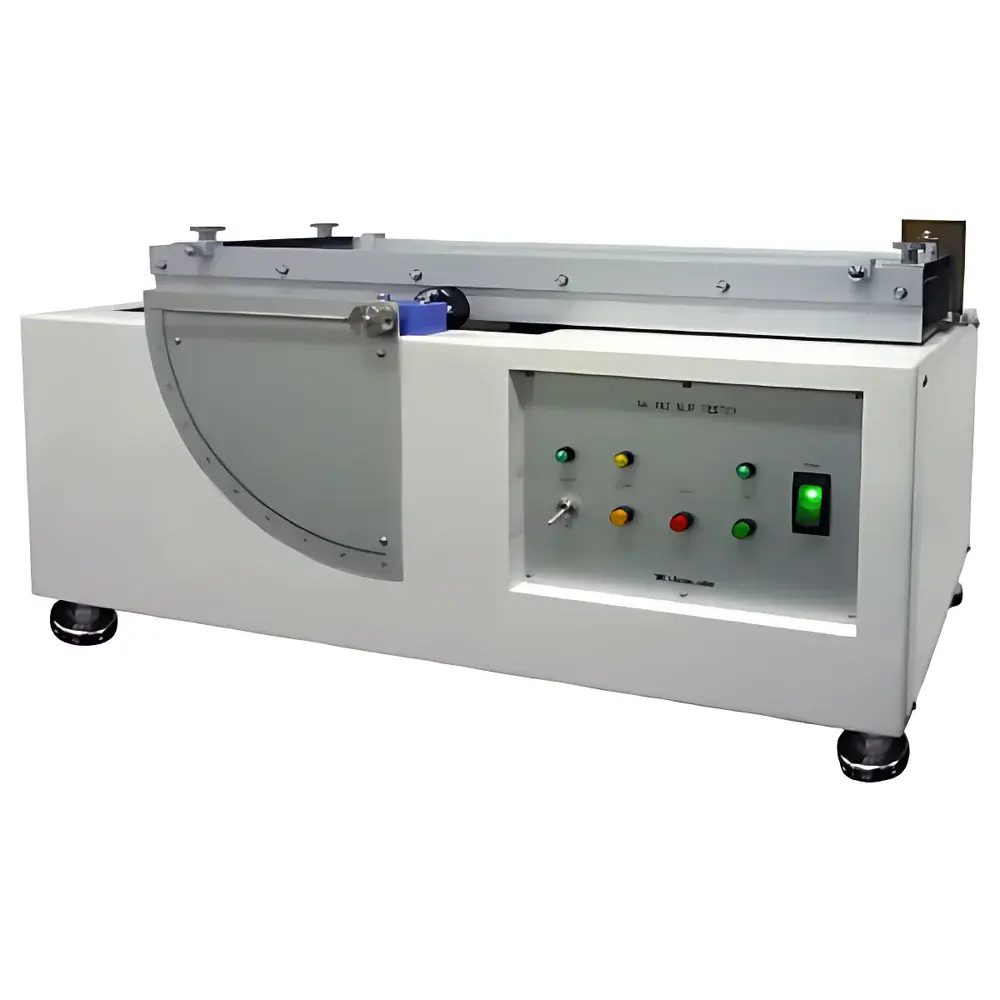
Yasuda No.162 Coefficient of Friction Tester (Slip Tester)
| Brand | Yasuda |
|---|---|
| Origin | Japan |
| Model | No.162 |
| Standard Compliance | JIS P8147, ASTM D1894, ASTM D3248, TAPPI T503, TAPPI T542, TAPPI T815 |
| Measurement Principle | Inclined-plane static/dynamic friction coefficient determination via tangent of slip initiation angle (tanθ) |
| Test Surface Length | 600 mm |
| Specimen Platform | Tempered glass top plate |
| Slider Dimensions | 60 mm × 100 mm |
| Slider Mass | 1000 g |
| Tilt Angle Range | 0–70° (graduated in 0.25° increments) |
| Tilt Speed | 1°/s (adjustable) |
| Power Supply | 220 V, single-phase, 3 A, 50/60 Hz |
| Dimensions (W×D×H) | 750 × 350 × 425 mm |
| Weight | ~29 kg |
Overview
The Yasuda No.162 Coefficient of Friction Tester (Slip Tester) is a precision-engineered inclined-plane instrument designed for the standardized measurement of static and kinetic coefficients of friction (COF) for flexible packaging materials—including plastic films, laminates, coated papers, and corrugated board substrates. It operates on the fundamental tribological principle that the static COF (μs) equals the tangent of the critical tilt angle (θ) at which a standardized slider begins to descend under gravity, i.e., μs = tanθ. For dynamic COF (μk), optional sensor-based slip detection enables real-time tracking of motion onset and sustained sliding behavior during controlled angular ramping. The device adheres strictly to internationally recognized test methodologies, including JIS P8147 (Japanese Industrial Standard for paper and board), ASTM D1894 (Standard Test Method for Static and Kinetic Coefficients of Friction of Plastic Film and Sheeting), ASTM D3248 (for coated papers), and multiple TAPPI standards (T503, T542, T815) governing surface slip performance in converting and packaging operations.
Key Features
- Calibrated inclined-plane mechanism with 0–70° angular range, precisely engraved at 0.25° intervals for high-resolution manual or sensor-assisted angle reading.
- Motor-driven tilt actuation at a constant, repeatable rate of 1°/s—fully compliant with ASTM D1894’s requirement for uniform angular acceleration during static COF determination.
- Dedicated 1000 g stainless-steel slider (60 mm × 100 mm contact area) with machined flat base and standardized edge geometry, ensuring consistent normal force and contact footprint across test cycles.
- Tempered glass upper platen provides a rigid, optically flat, and chemically inert test surface—minimizing thermal drift and surface wear while enabling long-term calibration stability.
- Effective sliding length of 600 mm accommodates full-travel observation and eliminates edge-effect interference during both static initiation and dynamic glide phases.
- Robust steel frame construction (W750 × D350 × H425 mm; ~29 kg) ensures mechanical rigidity and vibration damping—critical for reproducible angle-sensitive measurements in shared laboratory environments.
Sample Compatibility & Compliance
The No.162 supports a broad spectrum of planar, non-porous, and semi-porous sheet materials used in packaging manufacturing and quality control. Compatible substrates include biaxially oriented polypropylene (BOPP), polyethylene terephthalate (PET), low-density polyethylene (LDPE), metallized films, wax-coated kraft paper, and pressure-sensitive label stocks. All test procedures align with regulatory and industry audit requirements: data traceability meets GLP documentation expectations; physical setup satisfies ASTM and TAPPI apparatus specifications; and material handling protocols support routine IQ/OQ validation per ISO/IEC 17025-accredited labs. While the base configuration measures static COF per standard methods, optional dynamic friction modules integrate optical or capacitive slip-detection sensors—enabling automated μk capture and synchronization with digital angle encoders for enhanced repeatability.
Software & Data Management
The No.162 operates as a stand-alone electromechanical tester without embedded microprocessor control. However, its modular design permits integration with external data acquisition systems via analog voltage output (0–10 V) corresponding to real-time tilt angle position. When paired with PC-based DAQ hardware and validated software (e.g., LabVIEW or MATLAB-compatible drivers), users can log time-stamped angle, slider displacement, and slip-event timestamps—generating audit-ready CSV reports compliant with FDA 21 CFR Part 11 when configured with electronic signatures and audit trails. Raw angle readings are manually recorded per standard practice or captured digitally using calibrated inclinometer add-ons certified to ISO 10012 (metrological traceability of measuring instruments).
Applications
- QC release testing of roll-fed films prior to gravure or flexographic printing—ensuring optimal web tension control and minimizing registration errors.
- Form-fill-seal (FFS) line optimization: verifying COF values against machine-specific thresholds to prevent jamming, misfeeds, or pouch distortion.
- Development of anti-block or slip-additive formulations—quantifying additive efficacy across temperature and humidity gradients.
- Comparative evaluation of corona-treated vs. untreated film surfaces to validate surface energy modification.
- Supplier qualification and incoming inspection per contractual COF tolerances (e.g., μs = 0.20–0.40 ±0.03).
- Root-cause analysis of packaging line downtime linked to excessive or insufficient interlayer slip.
FAQ
Does the No.162 comply with ASTM D1894 Section 7.2 for slider mass tolerance?
Yes—the 1000 g slider conforms to the ±0.5% mass tolerance specified in ASTM D1894-22, verified by NIST-traceable calibration certificates available upon request.
Can the instrument be used for textured or embossed films?
It is suitable for macro-textured surfaces provided the slider maintains full-area contact; however, micro-roughness (<5 µm Ra) may require supplementary profilometry correlation per ISO 4287.
Is periodic recalibration required?
Annual verification of tilt angle graduation accuracy and slider mass is recommended; glass platen flatness should be assessed every 6 months using an optical interferometer per ISO 10110-7.
What environmental conditions affect measurement repeatability?
Relative humidity (45–55% RH) and ambient temperature (23 ±2°C) must be maintained per ASTM D618 and TAPPI T402 to minimize hygroscopic swelling effects on paper-based specimens.
Is operator training included with purchase?
Comprehensive SOP documentation and video-based procedural guidance are supplied; on-site technician training is available as a billable service.





