
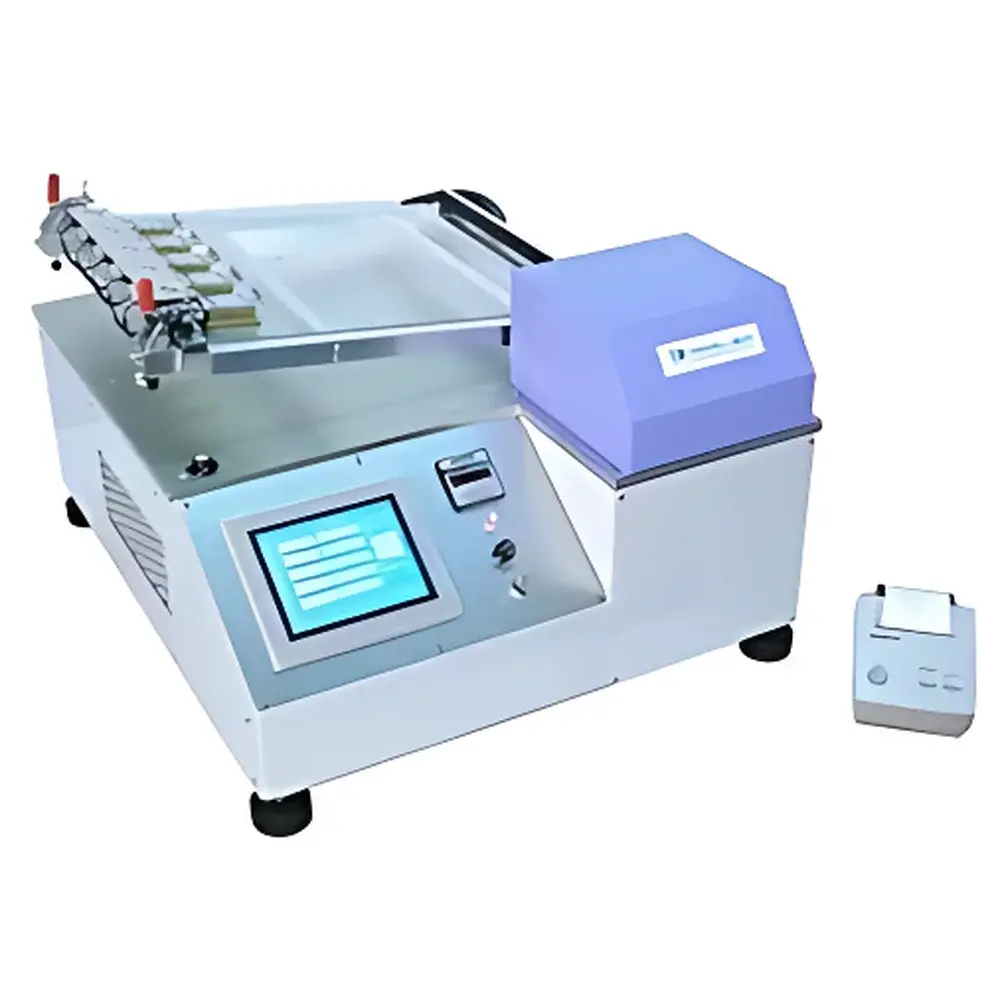
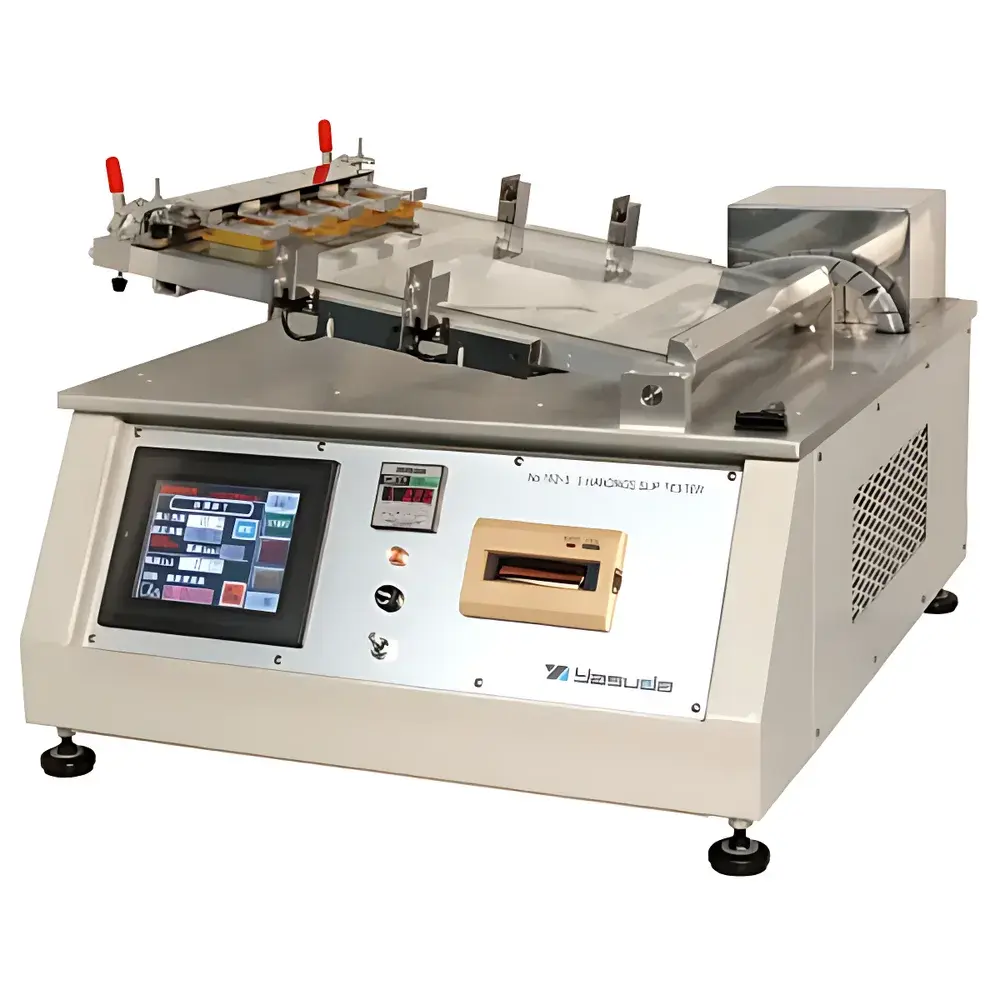
Yasuda No.162-S5 Five-Station Inclined-Plane Coefficient of Friction Tester
| Brand | Yasuda |
|---|---|
| Origin | Japan |
| Model | No.162-S5 |
| Test Method | Inclined-plane static/dynamic COF measurement |
| Standards | JIS P8147, ASTM D1894, ASTM D3248, TAPPI T503, T542, T815 |
| Stations | 5 parallel test positions |
| Display | Integrated LCD with print output |
| Data Output | Individual and averaged COF values |
| Compliance | Suitable for QC labs operating under ISO/IEC 17025, GLP, and packaging material validation per FDA 21 CFR Part 11 (when paired with compliant software) |
Overview
The Yasuda No.162-S5 Five-Station Inclined-Plane Coefficient of Friction Tester is an engineered solution for high-throughput static and kinetic coefficient of friction (COF) evaluation of flexible packaging materials—including plastic films, laminates, coated papers, and corrugated board substrates. Based on the fundamental inclined-plane principle defined in JIS P8147 and ASTM D1894, the instrument determines COF by measuring the critical angle at which a standardized sled begins to slide across a stationary sample surface under controlled normal force. This gravimetric method eliminates reliance on motorized drive systems or load cells, ensuring long-term mechanical stability, minimal calibration drift, and intrinsic reproducibility across operator shifts. Designed specifically for packaging R&D and quality control laboratories, the No.162-S5 supports routine batch verification, supplier qualification, and regulatory documentation required for ISO 9001, IATF 16949, and FDA-regulated packaging validation.
Key Features
- Five independent, identically configured inclined planes mounted on a rigid aluminum base—enabling simultaneous COF testing of up to five samples without cross-contamination or positional bias.
- Mechanically calibrated incline mechanism with precision-machined stainless-steel ramps and adjustable stop blocks; angular resolution ≤ 0.1°.
- Standardized 200 g sled (ASTM-compliant mass and footprint) with interchangeable sled bases for varying surface contact configurations (e.g., rubber, steel, or custom polymer).
- Integrated backlit LCD display showing individual station angles, calculated COF values (μs, μk), arithmetic mean, standard deviation, and pass/fail status against user-defined limits.
- Thermal-stable housing with anti-vibration feet minimizes environmental influence on angle repeatability—validated at ±0.02 COF over 8-hour continuous operation at 23 ± 2°C / 50 ± 5% RH.
- Direct thermal printer interface (RS-232 or USB) for real-time hardcopy generation of test reports compliant with internal QA record retention policies.
Sample Compatibility & Compliance
The No.162-S5 accommodates flat, non-porous specimens up to 150 mm × 150 mm, with thicknesses ranging from 25 µm (BOPP film) to 2.0 mm (corrugated linerboard). Sample clamping uses pneumatic-free dual-point edge fixation to prevent slippage while preserving native surface morphology. All test protocols adhere strictly to the procedural requirements of JIS P8147 (for paper and board), ASTM D1894 (plastic film), ASTM D3248 (laminated structures), and TAPPI T503/T542/T815 (paper industry standards). Instrument performance is traceable to NMIJ (National Metrology Institute of Japan) reference angle gauges. When integrated into validated laboratory workflows, the system satisfies data integrity expectations under 21 CFR Part 11 (with electronic signature-capable reporting software) and supports audit readiness for ISO/IEC 17025 accreditation.
Software & Data Management
While the No.162-S5 operates as a standalone benchtop instrument, optional PC connectivity enables export of raw angle and COF datasets (CSV/Excel) for statistical process control (SPC) analysis. Optional Yasuda COF-Link™ software provides automated report generation with embedded metadata (operator ID, timestamp, environmental log, calibration history), electronic signature fields, and configurable audit trails. All digital records comply with ALCOA+ principles (Attributable, Legible, Contemporaneous, Original, Accurate, Complete, Consistent, Enduring, Available) for GMP-aligned packaging release testing.
Applications
- Verification of anti-block additive efficacy in polyolefin films during extrusion line qualification.
- Comparative COF screening of heat-seal coatings before and after aging (e.g., 40°C/75% RH for 7 days).
- Supplier material acceptance testing per contractual COF specifications (e.g., μs < 0.35 for vertical form-fill-seal applications).
- Root-cause analysis of jamming incidents in high-speed packaging machinery through correlation of measured COF with machine feed performance logs.
- Regulatory submission support for medical device packaging dunnage—demonstrating consistent slip characteristics across sterilization cycles (EtO, gamma, steam).
FAQ
Does the No.162-S5 measure both static and kinetic COF?
Yes—static COF is determined at the onset of motion; kinetic COF is recorded at the lowest sustained angle permitting continuous sled movement, per ASTM D1894 Section 7.3.
Can I test textured or embossed surfaces?
Yes, provided surface relief does not exceed 150 µm peak-to-valley height; sled base selection (e.g., soft elastomer) is recommended to maintain full contact area.
Is periodic calibration required?
Annual angular verification using NMIJ-traceable angle gauge is recommended; no field recalibration of internal mechanics is necessary due to passive mechanical design.
What maintenance is involved?
Monthly cleaning of ramp surfaces with isopropyl alcohol and lint-free cloth; annual inspection of sled wear and pivot pin integrity.
Is the instrument compatible with LIMS integration?
Yes—via ASCII-based serial output or optional Ethernet gateway module supporting ASTM E1384 and HL7 messaging protocols for seamless data ingestion.





