
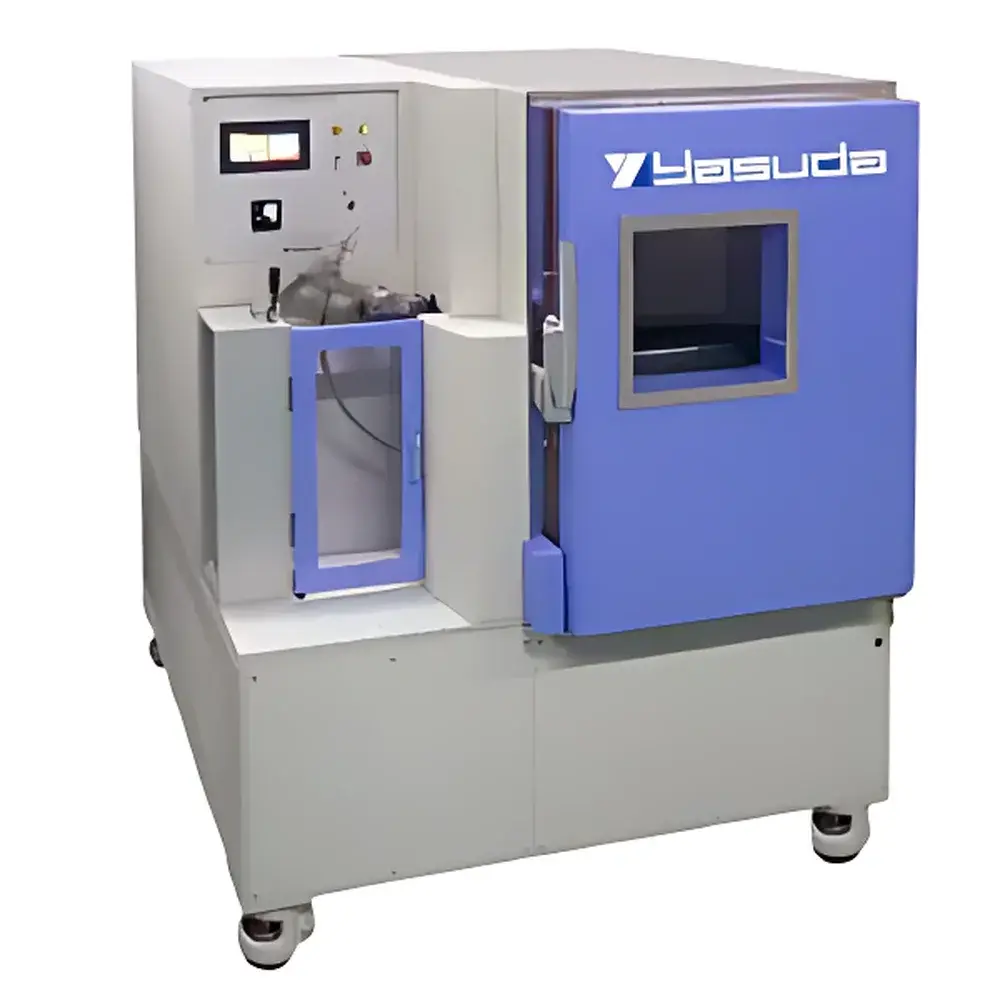
Yasuda No.181-L Film Impact Tester with Integrated Low-Temperature Chamber
| Brand | Yasuda |
|---|---|
| Origin | Japan |
| Model | No.181-L |
| Compliance | ASTM D3420 |
| Test Principle | Pendulum Impact Energy Measurement |
| Temperature Range (Chamber) | −40 °C to +25 °C (typical operational range for low-temp film testing) |
| Impact Energy Scale | 0–5 J (calibrated, analog angular scale) |
| Pendulum Arm Length | 300 mm (standard per ASTM D3420 configuration) |
| Impact Tip | Spherical steel impactor (6.35 mm diameter, hardened) |
| Specimen Clamp | Fixed-die pneumatic or mechanical clamping system (adjustable for 100 × 100 mm specimens) |
| Data Readout | Direct visual angular deflection scale (graduated in joules) |
Overview
The Yasuda No.181-L Film Impact Tester with Integrated Low-Temperature Chamber is a precision-engineered pendulum-type impact testing system designed specifically for evaluating the puncture resistance and energy absorption characteristics of thin flexible materials—including polymer films, laminates, coated papers, and metallized substrates—under controlled sub-ambient thermal conditions. Unlike ambient-only impact testers, the No.181-L incorporates a thermally insulated low-temperature chamber directly integrated into the test frame, enabling real-time conditioning and impact evaluation at stabilized temperatures as low as −40 °C. The instrument operates on the fundamental principle of conservation of mechanical energy: a calibrated pendulum arm, fitted with a standardized spherical impactor at its tip, is released from a fixed height; upon striking a horizontally clamped specimen, the residual swing angle is measured via a high-contrast angular scale. This deflection correlates directly to the energy absorbed during perforation, expressed in joules (J), per ASTM D3420–17 “Standard Test Method for Impact Resistance of Plastic Film by the Pendulum Method.” The system’s rigid cast-iron base, low-friction bearing pivot, and vibration-damped enclosure ensure high reproducibility (< ±2% RSD across replicate tests under identical conditions) and long-term measurement stability.
Key Features
- Integrated low-temperature chamber with independent temperature control (−40 °C to +25 °C), featuring forced-air circulation and PID-regulated refrigeration for uniform thermal distribution across the specimen zone.
- Pendulum assembly with precision-machined stainless-steel arm, hardened steel impact sphere (6.35 mm Ø, Rockwell C58–62), and zero-backlash pivot bearing for minimal hysteresis.
- Optically enhanced angular scale with dual-scale graduation (degree and joule equivalents), calibrated traceably to NIST-traceable torque standards.
- Specimen holder with adjustable pneumatic clamping force (0.2–0.8 MPa) and quick-change die set accommodating standard 100 mm × 100 mm specimens per ASTM D3420.
- Thermal isolation between chamber and pendulum mechanism prevents cold-induced viscosity changes in pivot lubricants and ensures consistent kinetic performance across temperature ranges.
- Compliance-ready mechanical design—no embedded microprocessors or software—ensuring full auditability and suitability for GLP environments where electronic data integrity requirements (e.g., FDA 21 CFR Part 11) do not apply.
Sample Compatibility & Compliance
The No.181-L is validated for use with single-layer and multilayer films ranging from 12 µm to 250 µm thickness, including polyethylene (LDPE, LLDPE), polypropylene (BOPP), PET, nylon, cellulose acetate, and aluminum-laminated structures. It supports both free-fall and constrained-clamp configurations per ASTM D3420 Annex A1. The device conforms fully to ASTM D3420–17, and its mechanical calibration protocol aligns with ISO 179-1 (Plastics—Determination of Charpy impact properties) principles for pendulum-based energy quantification. All structural components meet JIS B 7711 (Japanese Industrial Standard for Impact Testing Machines). As a Class I mechanical testing instrument, it requires no electrical safety certification beyond standard industrial grounding; however, chamber refrigeration circuits comply with IEC 60335-2-89 for refrigerating appliances.
Software & Data Management
The Yasuda No.181-L operates as a fully manual, analog-readout instrument with no embedded firmware, touchscreen interface, or digital data output. All measurements are recorded manually by trained operators using the calibrated angular scale and transcribed into laboratory notebooks or LIMS-compatible spreadsheets. This architecture eliminates software validation burdens and ensures unambiguous chain-of-custody for raw test data—a critical advantage in regulated quality control laboratories operating under ISO/IEC 17025 or pharmaceutical GMP frameworks. Optional accessories include a calibrated reference pendulum kit (for periodic verification per ASTM E23 Appendix X3) and a temperature mapping probe set (for chamber uniformity qualification per ISO 17025 Clause 6.4.3).
Applications
- Quality assurance of frozen-food packaging films subjected to warehouse handling at −25 °C.
- R&D evaluation of low-temperature embrittlement thresholds in biodegradable PLA and PHA films.
- Comparative impact resilience screening of barrier-coated paperboard used in chilled beverage cartons.
- Validation of seal integrity in medical pouch laminates after accelerated aging at −30 °C.
- Supplier qualification testing for automotive interior trim films exposed to winter cabin thermal cycling.
- Academic research on viscoelastic transition behavior in thermoplastic elastomers below Tg.
FAQ
Does the No.181-L support automated data logging or USB output?
No. It is a purely mechanical, operator-read instrument. Data capture requires manual transcription.
Can the chamber accommodate specimens thicker than 250 µm?
The standard clamping gap is optimized for films ≤250 µm. Thicker substrates require custom die inserts, available upon request.
Is calibration certification included with shipment?
Yes—each unit ships with a factory calibration certificate traceable to JCSS (Japan Calibration Service System), covering pendulum moment of inertia and scale linearity.
What maintenance is required for long-term accuracy?
Biannual verification of pendulum pivot friction (using ASTM E23 Method A), annual chamber temperature uniformity mapping, and routine cleaning of optical scale surfaces with isopropyl alcohol.
Is the refrigeration system serviceable in the field?
Yes—the sealed R-404A refrigeration module is accessible via front-panel service ports and compatible with standard HVAC-R technician tools and gauges.



