
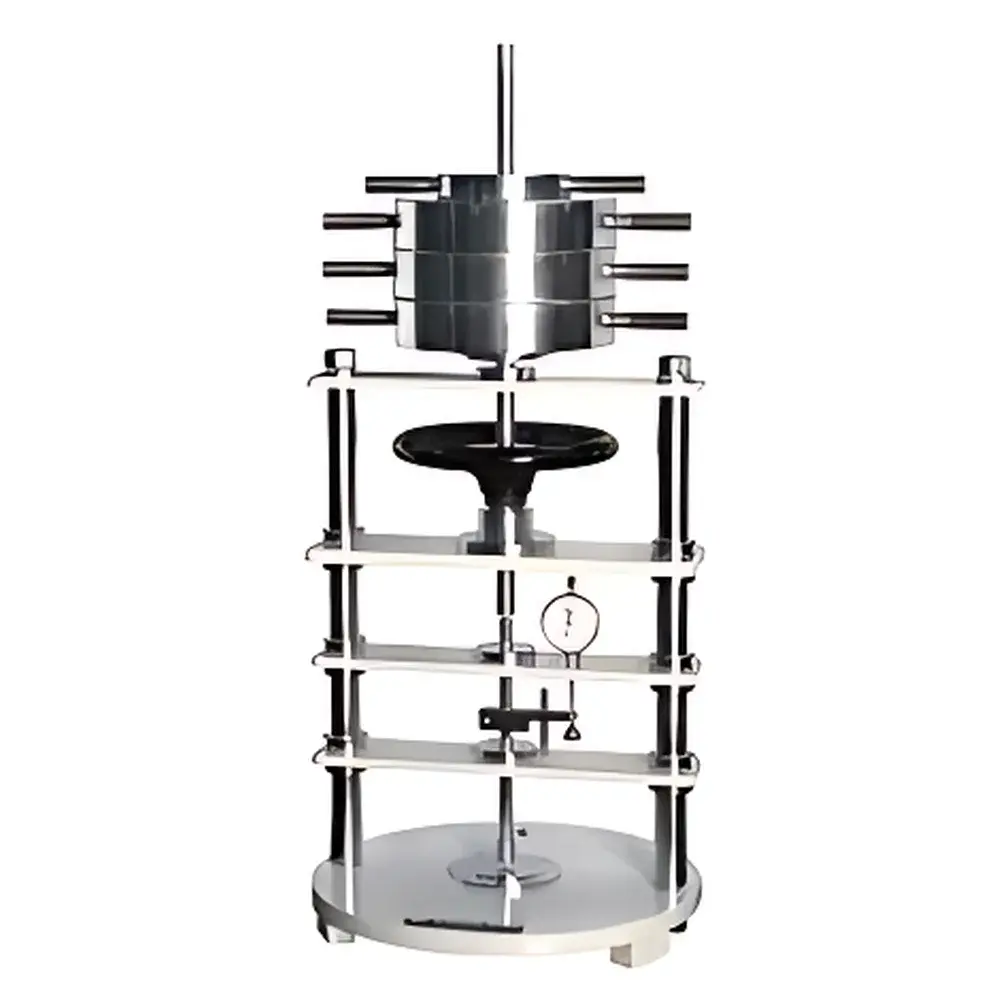
Yasuda No.184-B Residual Indentation Tester
| Brand | Yasuda |
|---|---|
| Origin | Japan |
| Model | No.184-B |
| Applicable Standards | JIS A1454, JIS A5705 |
| Test Load | 356 N (10 min) / 222 N (5 min for foam) |
| Recovery Time | 60 min post-load removal |
| Load Application Duration | 10 min (standard), 5 min (foam) |
| Measurement | Residual indentation depth (mm) |
| Compliance | JIS-certified test configuration |
Overview
The Yasuda No.184-B Residual Indentation Tester is a precision-engineered mechanical testing instrument designed to quantify the permanent deformation behavior of resilient materials—particularly flexible foams, elastomeric sheets, and cushioning composites—under controlled static compressive loading. It operates on the fundamental principle of time-dependent viscoelastic recovery: a standardized load is applied vertically to a conditioned specimen via a rigid indenter, held for a defined duration, then fully removed; the residual indentation depth is measured after a specified recovery period (60 minutes per JIS A1454 and JIS A5705). This measurement directly reflects the material’s ability to recover from sustained compression—a critical performance parameter for applications in automotive seating, mattress manufacturing, packaging inserts, and medical support surfaces. Unlike general-purpose universal testing machines, the No.184-B implements a dedicated, fixed-load, fixed-time protocol aligned with Japanese Industrial Standards, ensuring metrological consistency across laboratories and production QA environments.
Key Features
- Fixed-load actuation system calibrated to deliver precisely 356 N (±1.0%) for standard testing or 222 N (±1.0%) for foam-specific protocols, traceable to JIS-compliant force calibration procedures.
- Thermally stable stainless-steel loading column and base plate minimize thermal drift during extended dwell periods, supporting high reproducibility across ambient temperature variations (15–30 °C).
- Manual micrometer-based depth measurement system with 0.01 mm resolution, integrated into a rigid C-frame structure that eliminates lateral deflection and ensures axial load alignment within ±0.2°.
- JIS A1454– and A5705–compliant fixture geometry: 50 mm diameter flat-ended cylindrical indenter with polished surface finish (Ra ≤ 0.4 µm) and standardized specimen support plate (150 × 150 mm, hardened steel).
- No electronic controllers or software dependencies—designed for operational simplicity, long-term mechanical reliability, and minimal maintenance in regulated QC labs where audit trails prioritize mechanical verifiability over digital complexity.
Sample Compatibility & Compliance
The No.184-B accommodates specimens up to 150 mm × 150 mm × 50 mm (L × W × H), suitable for slabstock foams, molded elastomer parts, laminated composites, and textile-reinforced cushioning layers. Specimen conditioning follows JIS Z 8703 (standard atmosphere: 23 ± 2 °C, 50 ± 5% RH) prior to testing. The instrument’s mechanical architecture and procedural sequence are fully aligned with JIS A1454 (“Testing methods for resilient floor coverings”) and JIS A5705 (“Testing methods for flexible polyurethane foam for furniture”), including load application timing, dwell duration, and post-recovery measurement window. While not inherently ISO or ASTM certified, its test output is technically equivalent to ISO 2439 (Method A, constant-load indentation) and ASTM D3574 (Test B – Indentation Force Deflection), enabling cross-standard correlation when used with documented procedural equivalency statements.
Software & Data Management
The Yasuda No.184-B is a purely mechanical, analog test system with no embedded electronics, firmware, or data logging capabilities. All measurements are recorded manually in laboratory notebooks or LIMS-integrated paper-based forms. This design supports GLP and GMP environments where instrument qualification emphasizes mechanical traceability, operator training records, and physical calibration logs over digital audit trails. For laboratories requiring electronic data capture, third-party digital calipers (e.g., Mitutoyo Absolute Series) with RS-232/USB output may be integrated externally—though such configurations fall outside Yasuda’s factory validation scope and require site-specific IQ/OQ documentation per FDA 21 CFR Part 11 Annex 11 requirements.
Applications
- Quality control of flexible polyurethane (PU) and thermoplastic polyolefin (TPO) foams in Tier-1 automotive interior supply chains.
- Batch release testing of residential and commercial carpet underlay per JIS A1454 compliance requirements.
- R&D evaluation of viscoelastic memory foam formulations, including additive effects on permanent set behavior.
- Supplier qualification audits for furniture manufacturers requiring JIS-conforming resilience documentation.
- Comparative analysis of aged vs. virgin elastomer samples to assess compression set degradation kinetics.
FAQ
Is the No.184-B compatible with ISO or ASTM standards?
Yes—while mechanically configured to JIS protocols, its test methodology aligns with ISO 2439 Method A and ASTM D3574 Test B; formal equivalency requires documented procedural mapping and interlaboratory validation.
Does the instrument include calibration certificates?
Yasuda supplies a factory-issued mechanical calibration report for the load train and depth gauge; annual recalibration by an ISO/IEC 17025-accredited provider is recommended for GLP/GMP use.
Can test duration or load be adjusted beyond JIS-specified values?
No—the No.184-B is a fixed-parameter device; deviation from JIS-defined loads (356 N / 222 N) or dwell times (10 / 5 min) invalidates JIS compliance and voids standard conformance claims.
What maintenance is required?
Biannual lubrication of the load column guide rails and quarterly verification of micrometer zero-point repeatability using certified gauge blocks (Class AA, 0.01 mm tolerance).



