
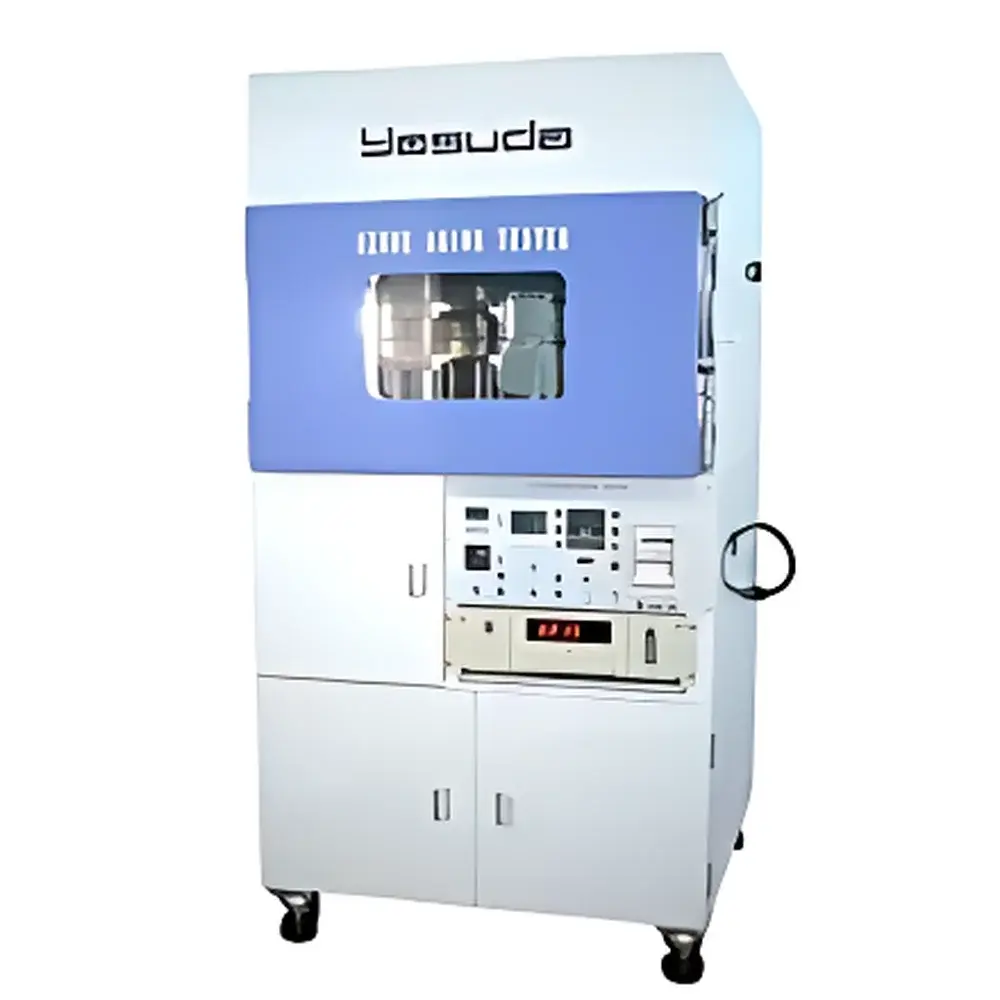
Yasuda No.187 Ozone Aging Test Chamber
| Brand | Yasuda |
|---|---|
| Origin | Japan |
| Model | No.187 |
| Chamber Dimensions | 500 × 500 × 500 mm (0.125 m³) |
| Temperature Range | Up to 70 °C |
| Ozone Generation Method | UV Lamp |
| Ozone Measurement Principle | UV Absorption Spectroscopy |
| Ozone Control | PID Feedback Loop |
| Static Tensile Strain Range | 0–100% |
| Static Specimen Capacity | 16 samples |
| Dynamic Tensile Frequency (Optional) | 0.5 ± 0.025 Hz (30 ± 1.5 cycles/min) |
| Dynamic Specimen Capacity | 12 samples |
| Rotational Speed (Static/Dynamic) | 2 rpm |
| Timer Types | Test Timer (resettable), Lamp Life Timer (running) |
| Power Supply | 220 V, 3-phase, 30 A, 50/60 Hz |
| Compliance Standards | JIS K 6259, ISO 1431-1 |
Overview
The Yasuda No.187 Ozone Aging Test Chamber is a precision-engineered environmental test system designed for evaluating the ozone resistance of vulcanized and thermoplastic elastomers under controlled static or dynamic tensile stress. It operates on the principle of accelerated aging via exposure to precisely regulated ozone concentrations in a temperature-stabilized, light-shielded environment—fully aligned with internationally recognized test methodologies defined in JIS K 6259 and ISO 1431-1. Unlike generic environmental chambers, the No.187 integrates a dedicated UV-based ozone generation and real-time feedback control architecture, ensuring traceable, reproducible ozone dosing across low- and high-concentration ranges (20–250 pphm and 20–200 pphm, respectively). The chamber’s internal volume (0.125 m³) is optimized for uniform gas distribution and thermal homogeneity, while its stainless-steel construction and sealed optical path eliminate external UV interference and minimize ozone decomposition. This system is not intended for general-purpose climate simulation but specifically for standardized rubber degradation assessment where ozone-induced surface cracking serves as the primary failure metric.
Key Features
- UV lamp-based ozone generation with dual-range capability (No.187-A: low-concentration mode; No.187-B: high-concentration mode), enabling compliance with both standard and accelerated test protocols.
- Real-time ozone concentration monitoring and closed-loop regulation via UV absorption spectroscopy—calibrated against NIST-traceable reference standards—and PID-controlled feedback for ±5 pphm stability over extended test durations.
- Dual-mode mechanical loading: static tensile fixture accommodating up to 16 specimens at adjustable strain (0–100%), and optional dynamic tensile module delivering sinusoidal extension at 0.5 ± 0.025 Hz (30 ± 1.5 cycles/min) for 12 specimens.
- Integrated dual-timer system: independent resettable test timer for protocol adherence and non-resettable lamp life timer for preventive maintenance scheduling and audit readiness.
- Thermal management system maintaining temperature uniformity within ±1.5 °C across the working volume, with maximum setpoint of 70 °C and rapid stabilization (<15 min from ambient to 50 °C).
- Rotating sample holder (2 rpm) ensures consistent exposure geometry and mitigates localized stagnation zones, enhancing inter-sample repeatability in multi-specimen evaluations.
Sample Compatibility & Compliance
The No.187 accommodates standard dumbbell-shaped, ring, or strip specimens per ISO 1431-1 Annex A and JIS K 6259 Type 1–3 geometries. Its static clamping mechanism supports ASTM D1149-compliant mounting without introducing unintended torsional stress. All internal surfaces are electropolished stainless steel (SUS316L) to prevent catalytic ozone decomposition. The system meets essential requirements for GLP-compliant laboratories: full parameter logging (ozone concentration, temperature, time, lamp runtime), user-accessible calibration records, and hardware-level interlocks preventing operation outside certified operating envelopes. While not pre-certified to FDA 21 CFR Part 11, its data architecture supports validation for regulated environments when paired with compliant LIMS or ELN platforms.
Software & Data Management
The No.187 operates via front-panel digital interface with tactile push-button controls and LED status indicators—designed for robustness in industrial lab settings where touchscreens may degrade. All operational parameters (setpoints, actuals, alarms) are logged to internal non-volatile memory with timestamp resolution of 1 second. Data export is supported via RS-232 serial interface (ASCII format) for integration into laboratory informatics systems. Optional analog outputs (4–20 mA) are available for ozone concentration and temperature signals, facilitating connection to centralized SCADA or PLC networks. Firmware updates are performed via secure USB port with cryptographic signature verification to ensure integrity.
Applications
- Quality assurance testing of automotive rubber components (hoses, seals, bushings) exposed to urban ozone-rich atmospheres.
- R&D screening of novel elastomer formulations for improved ozone resistance, including halobutyl, EPDM, and hydrogenated nitrile compounds.
- Validation of protective coatings and antioxidant additives under standardized aging conditions.
- Comparative lifecycle analysis of recycled rubber compounds versus virgin materials.
- Supporting ISO/IEC 17025-accredited testing laboratories requiring documented metrological traceability for ozone concentration and thermal profiles.
FAQ
What ozone measurement principle does the No.187 employ, and why is UV absorption preferred over electrochemical sensors?
UV absorption spectroscopy provides long-term stability, minimal drift, and immunity to cross-sensitivity from NOx, humidity, or VOCs—critical for multi-week aging studies where sensor recalibration would compromise data continuity.
Can the No.187 be used for dynamic testing without modification?
Dynamic tensile functionality is an optional factory-installed module; it is not retrofittable in the field due to structural reinforcement and controller firmware dependencies.
Is temperature ramping supported?
No—the No.187 maintains a fixed temperature setpoint during test execution. Ramp profiles require external environmental controllers and are outside the scope of JIS/ISO ozone aging standards.
How is lamp aging compensated in ozone output calculations?
The integrated lamp life timer triggers automatic gain adjustment in the PID loop based on empirically derived UV output decay curves, preserving concentration accuracy throughout the lamp’s service life (typically 5,000 hours).
Does the chamber meet CE or UKCA marking requirements?
As a Class I electrical device intended for laboratory use under supervised conditions, the No.187 complies with IEC 61010-1:2010 safety requirements; CE marking is applied per EU Declaration of Conformity issued by Yasuda Precision Machinery Co., Ltd.
Related Products



