
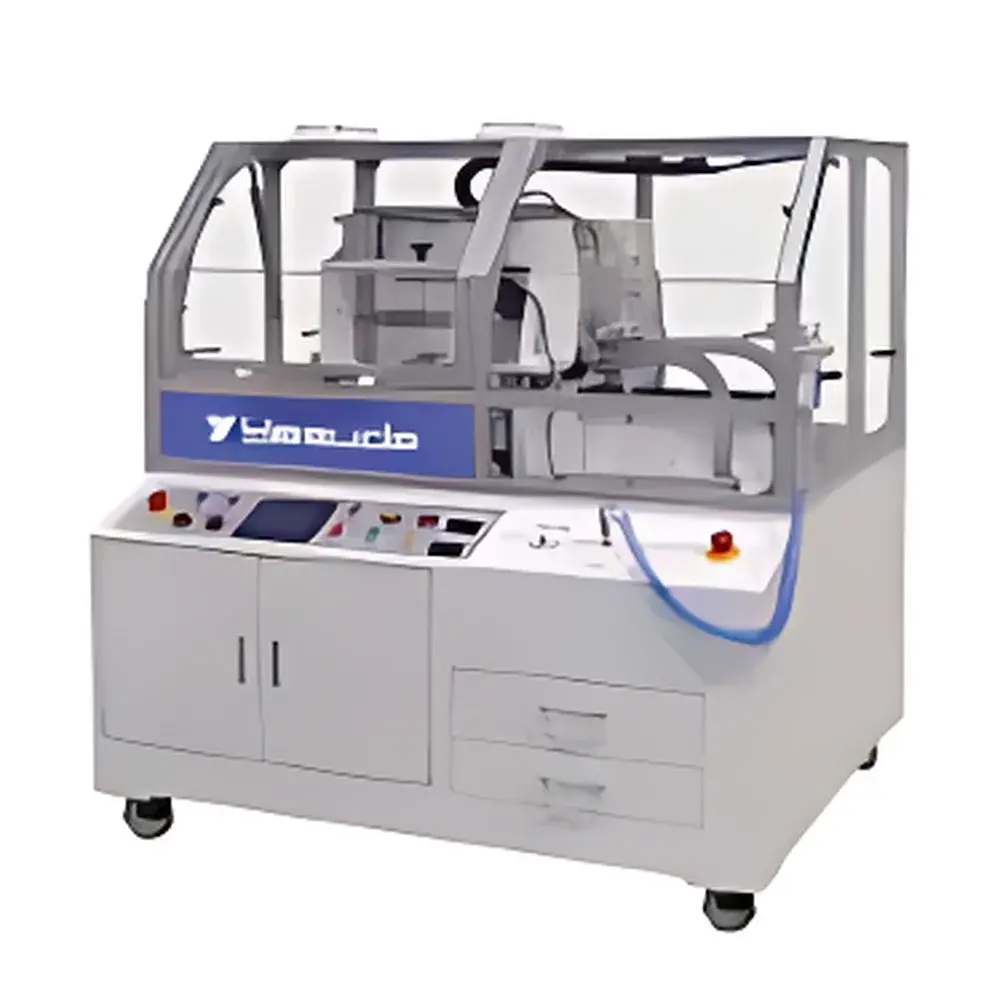
Yasuda No.189-PFA Automatic Profile Cutting Machine for Notched Specimen Preparation
| Brand | Yasuda |
|---|---|
| Origin | Japan |
| Model | No.189-PFA |
| Type | Automatic profile-cutting notched specimen preparation machine |
| Sample geometry support | Dumbbell-shaped and rectangular specimens |
| Fixture compatibility | Standard and custom notched die fixtures |
| Control parameters | Adjustable blade rotational speed, blade downforce, and feed rate |
| Automation level | Semi-automatic (No.189-PFA) |
Overview
The Yasuda No.189-PFA is a precision-engineered automatic profile cutting machine designed specifically for the reproducible preparation of standardized and non-standard notched tensile specimens in polymer, composite, and plastic materials testing laboratories. Based on mechanical profile-following (contour tracing) principle, the system utilizes a servo-controlled rotating carbide-tipped blade guided by a physical master template or CNC-defined path to achieve high-accuracy edge definition and notch geometry replication. Unlike manual milling or die-punching methods, this machine eliminates operator-induced variability in notch depth, radius, and alignment—critical parameters influencing fracture mechanics outcomes such as impact strength (e.g., Izod, Charpy), tensile elongation at break, and fatigue crack propagation analysis. The No.189-PFA complies with dimensional tolerances specified in ISO 179-1, ISO 180, ASTM D638, ASTM D256, and ISO 527-2 for both standard dumbbell and rectangular specimen formats.
Key Features
- Precision contour-following mechanism with ±0.02 mm positional repeatability across full X-Y travel range
- Adjustable blade rotational speed (500–3,000 rpm) optimized for material-specific thermal management and surface finish
- Programmable blade downforce (0.5–15 N) to prevent delamination in layered composites or micro-cracking in brittle thermoplastics
- Variable feed rate control (1–25 mm/min) enabling fine-tuning for high-aspect-ratio notches or thin-section samples
- Modular fixture interface supporting ISO/ASTM-compliant notched dies (e.g., Type A, Type B, Type C per ASTM D5041) as well as user-designed templates for proprietary geometries
- Integrated vacuum chuck and pneumatic clamping system ensuring zero lateral shift during cutting
- Optional PFA-S fully automated version includes auto-positioning stage, optical specimen recognition, and one-touch start sequence compliant with GLP workflow requirements
Sample Compatibility & Compliance
The No.189-PFA accommodates specimens ranging from 1.0 mm to 25 mm in thickness and up to 200 mm × 200 mm in planar dimension. Compatible substrates include thermoplastics (PP, PE, PC, ABS), thermosets (epoxy, phenolic), fiber-reinforced composites (CFRP, GFRP), elastomers, and rigid foams. All cutting parameters are traceable and logged with timestamp, operator ID, and fixture ID—supporting audit readiness under ISO/IEC 17025, FDA 21 CFR Part 11 (when paired with validated software), and internal QA/QC protocols. Notch root radii as small as 0.1 mm can be consistently reproduced within ±5% tolerance, meeting requirements for essential work-of-fracture (J-integral) testing per ASTM E1820.
Software & Data Management
The base model operates via dedicated front-panel HMI with parameter presets for common standards (e.g., “ISO 179-1 Type I”, “ASTM D256 Unnotched”). The optional PC-based Yasuda CutControl™ software (v3.2+) provides extended functionality including G-code import for custom paths, real-time force monitoring graphs, batch processing logs with CSV export, and electronic signature-enabled report generation. Audit trails record all parameter changes, calibration events, and maintenance alerts. Software validation documentation (IQ/OQ/PQ summaries) is available upon request for regulated environments requiring GMP or GLP compliance.
Applications
- Preparation of notched specimens for Charpy and Izod impact testing per ISO 179 and ASTM D256
- Manufacturing of ASTM D638 Type I–V tensile bars with controlled gauge section geometry
- Generation of SENB (Single-Edge Notched Beam) and CT (Compact Tension) pre-crack starter notches for fracture toughness studies
- Routine QC specimen fabrication in automotive polymer suppliers and aerospace composite manufacturers
- Research-grade specimen conditioning for environmental stress cracking (ESC) and creep rupture experiments
FAQ
What types of materials can be processed on the No.189-PFA without tooling modification?
Standard configurations support unreinforced and short-fiber thermoplastics; optional high-torque spindle and diamond-coated blades extend capability to carbon-fiber laminates and filled engineering resins.
Is the PFA-S fully automatic version compatible with LIMS integration?
Yes—via OPC UA or RESTful API interface; specimen ID, process parameters, and pass/fail status can be transmitted to laboratory information management systems meeting ASTM E1578 requirements.
Does Yasuda provide NIST-traceable calibration certificates for the No.189-PFA?
Calibration services include dimensional verification using certified gauge blocks and laser interferometry; certificates conform to ISO/IEC 17025 and are issued by Yasuda’s accredited metrology lab in Yokohama.
Can custom notch profiles (e.g., V-notches with 30° or 60° angles) be programmed?
Yes—using Yasuda CutControl™ software with user-defined angular compensation algorithms and multi-pass depth sequencing to ensure consistent flank angle integrity.
What maintenance intervals are recommended for optimal long-term repeatability?
Blade replacement every 200–500 cuts depending on material abrasiveness; quarterly spindle bearing inspection; annual full-axis backlash and encoder verification per maintenance manual Rev. 4.1.



