
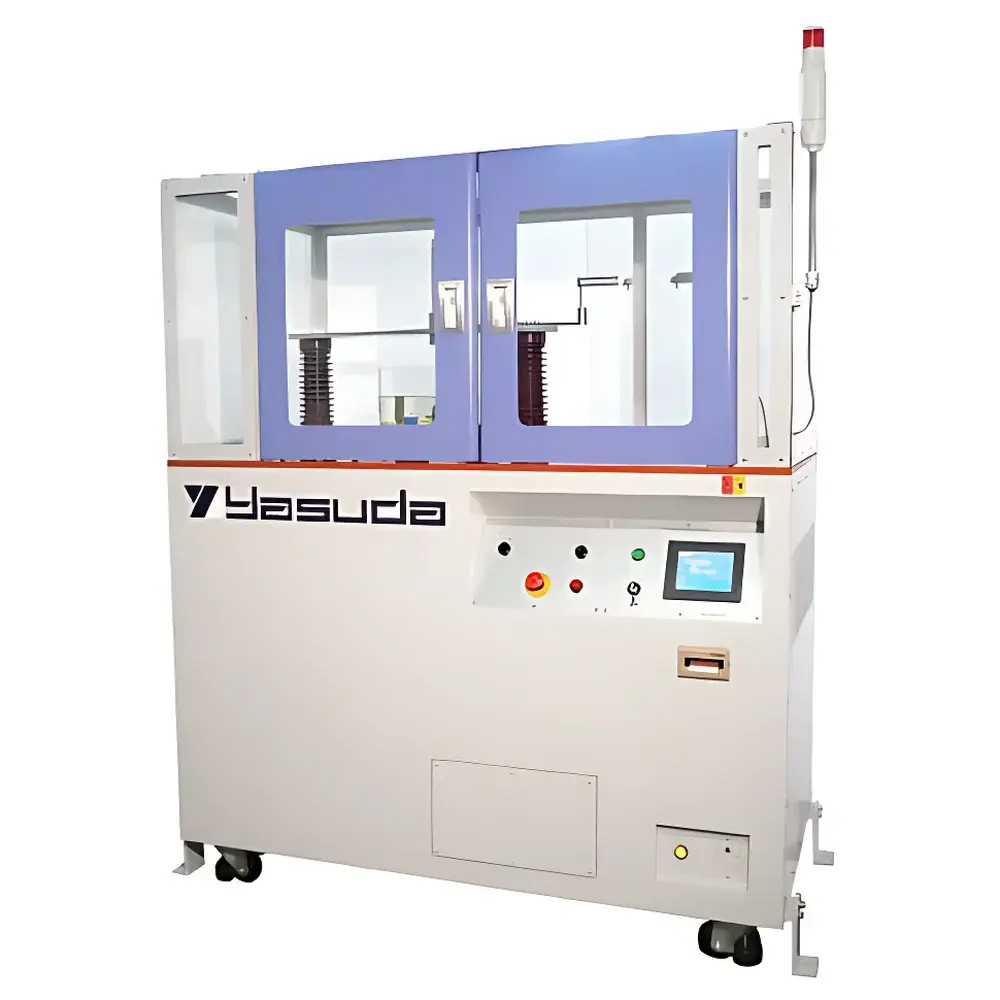
Yasuda No.199 High-Voltage Dielectric Strength Tester
| Brand | Yasuda |
|---|---|
| Origin | Japan |
| Model | No.199 |
| Dielectric Breakdown Voltage | 100 kV |
| Compliance Standards | GB/T 1408.1, IEC 60243-1, IEC 60851-5, JIS C2110 (C3003), JIS C3216-5 |
| Safety Features | Interlocked safety door, dual-start push buttons, emergency stop, acrylic + mesh steel test chamber, visual/audible alarm tower, key-operated preparation switch |
| Output Options | Touchscreen display, mini thermal printer, CSV data export |
| Drive System | Motor-driven variable-ratio transformer for precise and repeatable voltage ramping |
Overview
The Yasuda No.199 High-Voltage Dielectric Strength Tester is a precision-engineered instrument designed for standardized evaluation of electrical insulation integrity under controlled AC or DC voltage stress. Based on the fundamental principle of dielectric breakdown — wherein an insulating material transitions from resistive to conductive behavior upon exceeding its critical electric field strength — this system enables quantitative determination of breakdown voltage (kV) and comparative assessment of dielectric performance across diverse solid and liquid dielectrics. It adheres strictly to internationally recognized test methodologies defined in IEC 60243-1 (Electric strength of insulating materials — Test methods — Part 1: Tests at power frequencies), GB/T 1408.1 (Chinese national adaptation of IEC 60243-1), IEC 60851-5 (for enameled wires), and JIS C2110/C3216-5 (Japanese Industrial Standards for insulating materials and winding wires). The tester supports three primary test modes: continuous voltage ramp (for rapid breakdown detection), stepwise voltage increment (for evaluating withstand margin and progressive degradation), and constant-voltage endurance testing (for time-lag breakdown analysis). Its 100 kV maximum output capacity ensures compatibility with high-performance polymer films, composite laminates, battery separator membranes, and industrial coatings requiring rigorous qualification per automotive, aerospace, and energy storage specifications.
Key Features
- Motor-driven precision voltage regulation via servo-controlled variable-ratio transformer, ensuring ±0.5% repeatability in voltage ramp rate and endpoint accuracy across repeated tests.
- Modular electrode fixture system enabling rapid configuration for flat sheets (e.g., PET film, epoxy-coated PCB substrates), cylindrical specimens (e.g., insulated tubing, magnet wire), irregular geometries (e.g., wood panels, textile laminates), and thin-film samples using foil-electrode or needle-electrode arrangements.
- Integrated 100 kV high-voltage generator with oil-immersed transformer design and reinforced ceramic bushings for stable operation under sustained load and minimized corona discharge.
- Full-spectrum safety architecture: interlocked acrylic/mesh-steel test chamber with real-time visibility; dual redundant start buttons requiring simultaneous actuation; electromagnetic door lock engaged during voltage application; key-operated preparation switch to prevent unauthorized setup; and Class 0 emergency stop circuit compliant with IEC 61800-5-2.
- Visual and audible alarm tower with customizable LED color sequencing and buzzer patterns, synchronized with test phase status (standby, ramping, breakdown, fault).
Sample Compatibility & Compliance
The No.199 accommodates a broad spectrum of dielectric specimens without modification to core hardware. Standard configurations support ASTM D149 / IEC 60243-compliant flat-sheet testing (using brass disk electrodes per IEC 60243-1 Annex A), while optional fixtures enable evaluation of enameled copper wire per IEC 60851-5 (using wrap-around or needle-contact electrodes), tubular insulation per JIS C3216-5, and layered coatings on metallic substrates. It is routinely deployed for quality assurance of lithium-ion battery separator films (e.g., PE/PP microporous membranes), conformal coatings on power electronics modules, and high-dielectric-strength varnishes used in motor windings. All test protocols are traceable to ISO/IEC 17025 requirements for calibration and uncertainty reporting, and the system’s operational log retains timestamped records of voltage profiles, breakdown events, and operator actions — supporting GLP/GMP audit readiness and FDA 21 CFR Part 11 compliance when paired with validated software.
Software & Data Management
Operation is managed through a 10.1-inch industrial-grade capacitive touchscreen HMI running a deterministic real-time control kernel. Test parameters — including initial voltage, ramp rate (kV/s), hold time, step increment, and pass/fail thresholds — are configured via intuitive graphical menus. Real-time voltage-current waveforms are displayed during each test cycle, with automatic capture of breakdown onset time, peak voltage, and post-breakdown leakage current. Results are stored locally in non-volatile memory with UTC timestamps and user ID tagging. Export options include direct thermal printing of test certificates (with QR-coded traceability), USB-stored CSV files containing full waveform metadata, and optional Ethernet-based integration with LIMS or MES platforms via Modbus TCP. Audit trails record all parameter changes, test executions, and safety interlock activations — satisfying documentation requirements for ISO 9001 Clause 8.5.2 and IATF 16949 Section 8.5.1.2.
Applications
- Quality control of polymeric insulating films (e.g., PI, PET, PTFE) used in flexible printed circuits and high-frequency substrates.
- Evaluation of dielectric strength in battery separator membranes under dry and electrolyte-wet conditions per UL 1642 and UN 38.3 thermal abuse protocols.
- Validation of coating uniformity and pinhole-free coverage on stator windings and transformer coils in accordance with IEEE Std 930 and NEMA MG-1.
- R&D screening of novel nanocomposite dielectrics, including SiO₂-epoxy and BN-filled polymers, for aerospace and EV traction inverter applications.
- Third-party certification testing for CE marking (Low Voltage Directive 2014/35/EU) and RoHS-compliant material declarations.
FAQ
What standards does the No.199 fully support out-of-the-box?
It natively implements test sequences and electrode configurations aligned with IEC 60243-1, GB/T 1408.1, IEC 60851-5, JIS C2110, and JIS C3216-5. Calibration certificates are issued against NIST-traceable high-voltage reference dividers.
Can it test liquid dielectrics such as transformer oil?
Yes — optional oil bath fixtures with temperature-controlled immersion tanks (–20 °C to +100 °C) are available, enabling dielectric breakdown testing per IEC 60156 and ASTM D877/D1816.
Is remote monitoring or automated batch testing possible?
Via optional Ethernet interface and SCPI command set, the unit supports unattended sequential testing of up to 99 samples with programmable pass/fail logic and auto-generated summary reports.
How is measurement uncertainty quantified for accreditation purposes?
Uncertainty budgeting follows EA-10/14 guidelines, incorporating contributions from voltage divider ratio stability (±0.25%), ramp rate linearity (±0.3%), and environmental temperature drift (±0.1%/°C), resulting in a typical expanded uncertainty (k=2) of ±1.2% at 100 kV.
Does the system meet electromagnetic compatibility (EMC) requirements for laboratory environments?
Yes — certified to IEC 61326-1:2023 Class A for emission and immunity, with conducted/radiated disturbance limits verified per CISPR 11 and IEC 61000-4 series test plans.



