
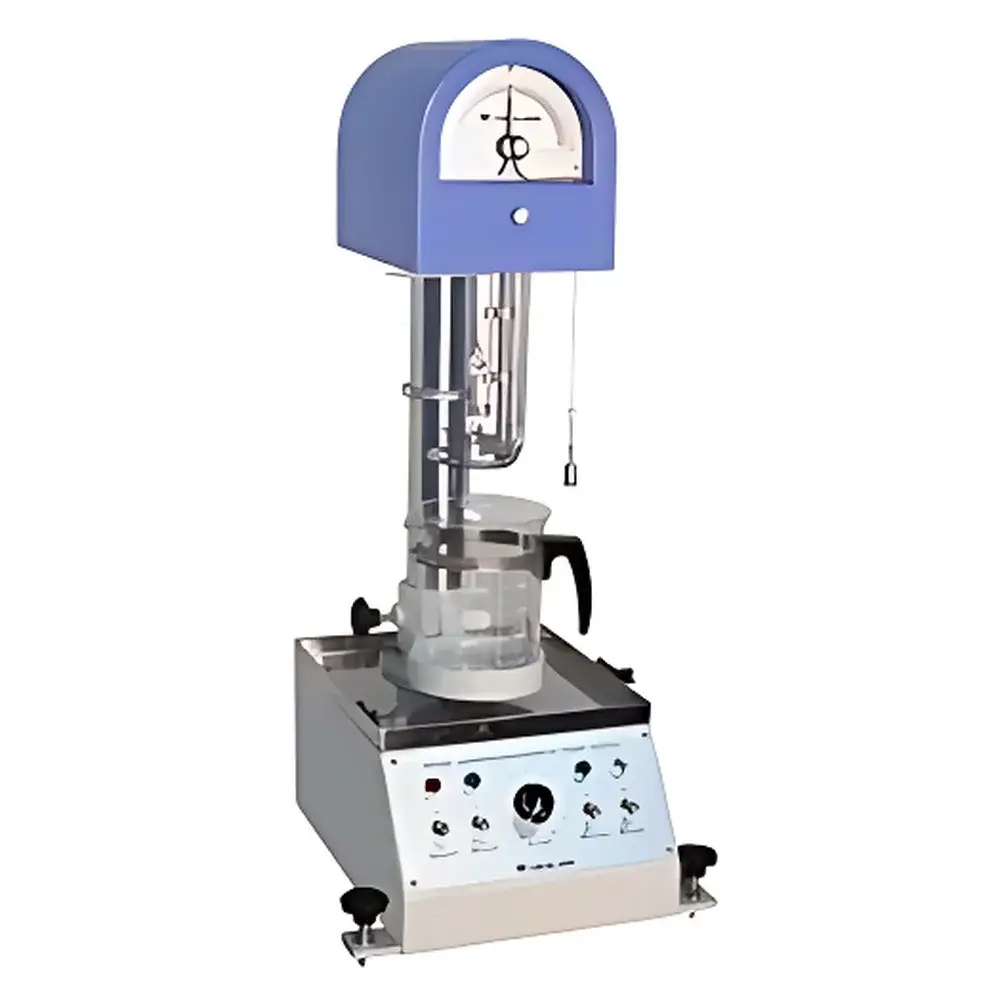
Yasuda No.202 Leather Contraction Temperature Tester
| Brand | Yasuda |
|---|---|
| Origin | Japan |
| Model | No.202 |
| Compliance Standards | JIS K6550, JIS K6552 |
| Test Principle | Controlled-heating immersion with mechanical load and dimensional change detection |
| Temperature Ramp Rate | Programmable (standard 1.0–2.0 °C/min) |
| Load Application | Fixed static tensile force via dual-clamp system |
| Sample Fixation | Upper and lower precision machined clamps with micrometer-adjustable grip pressure |
| Temperature Measurement Accuracy | ±0.2 °C (traceable to NIST-certified RTD sensor) |
| Data Output | Analog temperature vs. time + contraction onset trigger point |
Overview
The Yasuda No.202 Leather Contraction Temperature Tester is a precision-engineered instrument designed for the standardized determination of the shrinkage temperature (Ts) of leather materials under controlled thermal and mechanical conditions. Ts is defined as the lowest temperature at which a leather specimen exhibits measurable dimensional contraction—typically ≥0.5% linear reduction—when subjected to a specified tensile load during gradual aqueous heating. This parameter serves as a critical indicator of collagen crosslinking density, tanning efficacy, and thermal stability in finished leathers. The device operates on the principle of dynamic immersion thermometry: a conditioned leather strip is rigidly fixed between two vertically aligned, load-applying clamps, immersed in a thermostatically regulated water bath, and heated at a strictly defined ramp rate per JIS K6550 and JIS K6552. Real-time dimensional monitoring is achieved through high-resolution optical or mechanical displacement sensing (user-configurable), synchronized with calibrated Pt100 resistance temperature detection. The onset of contraction is identified algorithmically from the first inflection point in the strain–temperature curve, ensuring repeatability across operators and laboratories.
Key Features
- Compliance-ready architecture meeting all mechanical, thermal, and data integrity requirements of JIS K6550 (leather—determination of shrinkage temperature) and JIS K6552 (leather—test methods for physical properties)
- Dual-clamp fixation system with micrometer-controlled grip pressure to eliminate slippage and ensure uniform stress distribution across the specimen cross-section
- Programmable digital temperature controller with ramp rate selection (1.0, 1.5, or 2.0 °C/min) and ±0.2 °C accuracy traceable to NIST-standard RTD sensors
- Integrated load application mechanism delivering consistent static tensile force (typically 0.1–0.5 N depending on sample thickness and standard protocol)
- Corrosion-resistant stainless-steel bath chamber and clamp assemblies compatible with prolonged exposure to deionized water and mild tanning residue solutions
- Modular design supporting optional upgrade paths including automated data logging, USB/RS-232 interface, and GLP-compliant audit trail generation
Sample Compatibility & Compliance
The No.202 accommodates rectangular leather specimens measuring 20 mm × 100 mm (standard per JIS), with thicknesses ranging from 0.8 mm to 3.5 mm. Specimen conditioning follows ISO 2419 and JIS Z 8703 protocols (23 ± 2 °C, 50 ± 5% RH, minimum 48 h equilibration). The system supports both chrome-tanned, vegetable-tanned, and synthetic-retanned leathers, including automotive upholstery, footwear, and glove-grade materials. All test procedures align with internationally recognized quality frameworks: raw data files retain full metadata (operator ID, calibration date, ambient conditions), and instrument logs comply with ALCOA+ principles (Attributable, Legible, Contemporaneous, Original, Accurate, Complete, Consistent, Enduring, Available) for regulatory audits. While not inherently 21 CFR Part 11 certified, the device’s analog-digital hybrid architecture permits integration into validated LIMS environments when paired with compliant data acquisition software.
Software & Data Management
The base configuration includes analog output (0–10 V DC) for temperature and displacement signals, enabling connection to external chart recorders or DAQ systems. Optional firmware upgrades provide native USB connectivity and companion Windows-based software (Yasuda TestSuite v3.x) featuring real-time curve overlay, automatic Ts calculation per JIS-defined derivative threshold, and export to CSV, PDF, and XML formats. All software modules enforce user-level access control (administrator/operator modes), electronic signature capture for report finalization, and immutable audit trails recording every parameter change, measurement start/stop, and calibration event—fully supporting GLP and GMP documentation requirements in contract testing laboratories and tannery QC departments.
Applications
- Quality assurance of tanned hides prior to cutting and finishing operations
- Comparative evaluation of tanning agent performance (e.g., aldehyde vs. chromium vs. glutaraldehyde crosslinkers)
- Stability assessment of eco-friendly retanning systems under accelerated thermal aging
- Root-cause analysis of batch-to-batch shrinkage variability in automotive leather production
- Supporting R&D validation of novel collagen-stabilizing enzymes or bio-based tanning alternatives
- Third-party certification testing for ISO/IEC 17025-accredited material testing laboratories
FAQ
What is the definition of shrinkage temperature (Ts) according to JIS standards?
Ts is the lowest temperature at which a leather specimen, under specified tensile load and immersed in water, exhibits a permanent linear contraction of ≥0.5% relative to its original length.
Does the No.202 support automated Ts detection without manual curve interpretation?
Yes—the optional digital control module implements second-derivative analysis of the strain–temperature profile to identify Ts objectively, eliminating subjective visual judgment.
Can the instrument be used for non-leather collagenous materials such as gelatin films or parchment?
While not validated per JIS for those substrates, the core thermal–mechanical methodology is applicable; users must establish in-house correlation protocols and validate against reference methods.
Is routine calibration required, and what standards are recommended?
Annual calibration against NIST-traceable temperature and force standards is recommended; Yasuda provides certified calibration certificates and maintains an authorized service network in North America and EMEA.
How is sample slippage prevented during thermal expansion prior to contraction onset?
The dual-clamp system incorporates hardened steel jaws with micro-textured gripping surfaces and adjustable pre-load torque, verified by DIN 50125 mechanical grip testing prior to shipment.



