
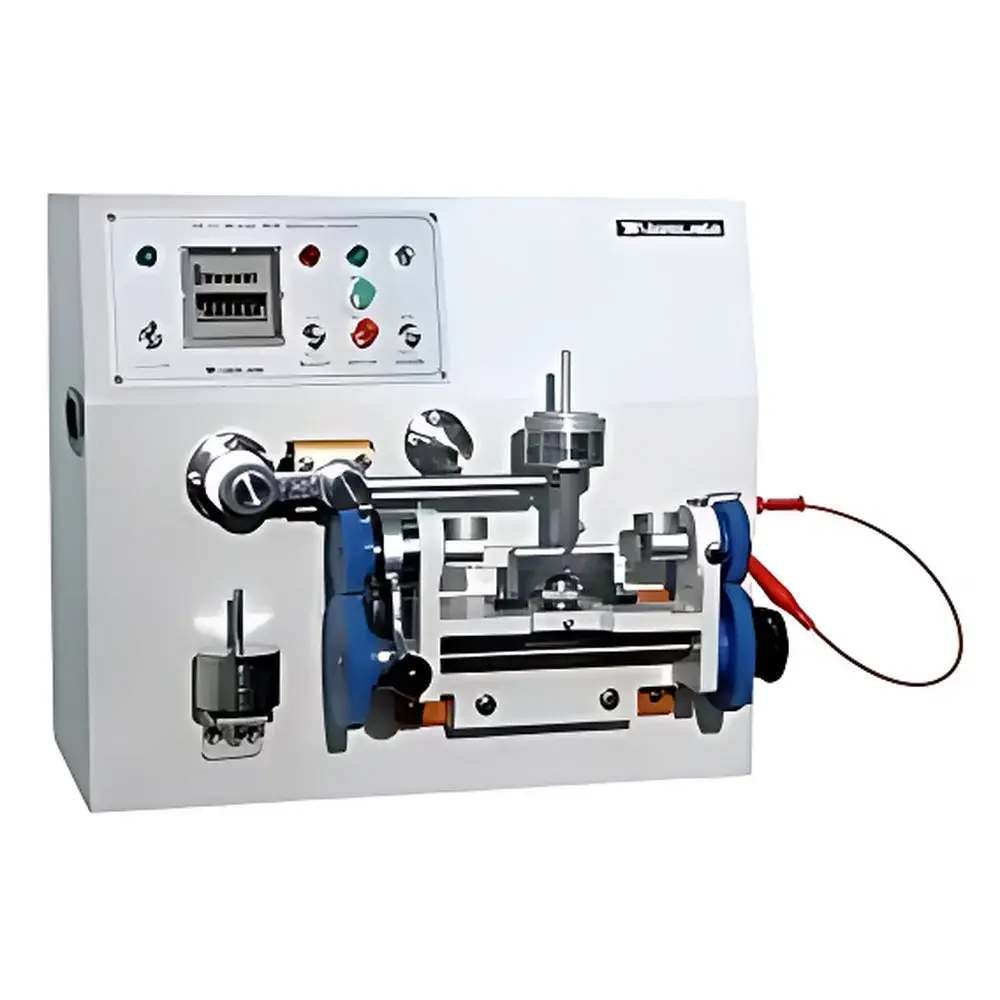
Yasuda No.210 Enamel Wire Abrasion Tester (Reciprocating Type)
| Brand | Yasuda |
|---|---|
| Origin | Japan |
| Model | No.210 |
| Instrument Type | Reciprocating Tribological Tester |
| Standard Compliance | NEMA C9.5, JASO E 402, ISO 6722 |
| Stroke Distance | 10 mm (NEMA) / 15.5 ± 1 mm (ISO/JASO) |
| Reciprocating Frequency | 60 cycles/min (NEMA) / 55 ± 5 cycles/min (ISO/JASO) |
| Load Range | 2–10 N (adjustable |
| Abrading Tip Diameter | φ0.4 mm (NEMA) / φ0.45 ± 0.01 mm (ISO/JASO) |
| Specimen Holder Spacing | 71 mm (center-to-center |
| Rotation Angles | 0°, 120°, 240° (NEMA) / 0°, 90°, 180°, 270° (ISO/JASO) |
| Counter | 6-digit presettable digital counter |
| Safety Enclosure | Integrated polycarbonate shield |
| Power Supply | AC 100 V, single-phase, 3 A, 50/60 Hz |
| Dimensions (W×D×H) | ≈ 480 × 447 × 600 mm |
| Weight | ≈ 33 kg |
Overview
The Yasuda No.210 Enamel Wire Abrasion Tester (Reciprocating Type) is a precision-engineered tribological testing instrument designed specifically for evaluating the mechanical durability of enamel insulation on magnet wires under standardized reciprocating sliding conditions. It operates on the principle of controlled linear oscillation—where a calibrated abrasive tip (tungsten carbide or hardened steel blade) moves with fixed stroke length and frequency across a tensioned wire specimen under precisely regulated normal load. The test endpoint is defined as electrical continuity between conductor and ground, indicating complete insulation breach. This deterministic failure criterion enables high reproducibility in quality assurance workflows for motor, transformer, and inductor manufacturers. The instrument supports dual-standard configurations: NEMA C9.5 (North American specification) and ISO 6722 / JASO E 402 (international and Japanese automotive standards), ensuring global regulatory alignment for Tier-1 suppliers and OEM validation labs.
Key Features
- Reciprocating motion architecture with electromagnetic or cam-driven actuation, delivering stable stroke amplitude (10 mm or 15.5 ± 1 mm) and cycle rate (60 or 55 ± 5 min⁻¹) independent of load variation.
- Adjustable vertical loading mechanism with calibrated spring or dead-weight system, enabling precise application of normal force from 2 N to 10 N; ISO-compliant configuration fixes nominal load at 7.0 ± 0.05 N.
- Dual-mode specimen holder: accommodates either static mounting or indexed rotational positioning (0°/120°/240° for NEMA; 0°/90°/180°/270° for ISO/JASO), allowing up to four independent wear assessments on a single wire sample without re-clamping.
- High-precision φ0.4 mm (NEMA) or φ0.45 ± 0.01 mm (ISO/JASO) abrasive tip mounted on rigid cantilever arm to minimize lateral deflection and ensure consistent contact geometry.
- Integrated 6-digit presettable digital counter with automatic stop-on-failure logic—records exact reciprocation count at insulation breakdown, eliminating operator subjectivity.
- Full-height transparent polycarbonate safety enclosure with interlocked door switch, compliant with IEC 61000-6-2/6-4 EMC requirements and local laboratory safety protocols.
Sample Compatibility & Compliance
The No.210 accepts round enamel-coated copper or aluminum wires ranging from 0.05 mm to 1.6 mm diameter. Specimens are secured using parallel-jaw clamps with non-marring serrated faces, maintaining uniform axial tension while preventing slippage during high-cycle testing. All mechanical and electrical parameters—including stroke displacement tolerance, load accuracy, tip geometry, and counting resolution—are traceably aligned to the measurement uncertainties specified in NEMA Standards Publication C9.5 (2022 edition) and ISO 6722-3:2019 (Road vehicles — Electric cables — Part 3: Test methods). The device is routinely deployed in GLP-compliant environments for qualification of new enamel formulations (e.g., polyamide-imide, polyester-imide) and batch release testing per IATF 16949 clause 8.6.5. Documentation includes factory calibration certificates referencing JCSS (Japan Calibration Service System) traceability.
Software & Data Management
While the base No.210 operates as a standalone electromechanical tester with analog controls and digital counter display, optional RS-232 or USB-to-serial interface modules enable integration with external data acquisition systems. When paired with validated third-party software (e.g., LabVIEW-based custom modules or MATLAB Instrument Control Toolbox), users can log real-time cycle count, trigger timestamps, and pass/fail status to CSV or SQL databases. Audit trail functionality—including user ID, test start/stop time, load setting, and rotation angle selection—is achievable via configurable metadata tagging. For regulated environments, optional 21 CFR Part 11-compliant software packages provide electronic signatures, role-based access control, and immutable record archiving—supporting FDA submissions for medical-grade motor components.
Applications
- Quality control of magnet wire used in EV traction motors, where insulation integrity under vibration-induced fretting is critical to long-term reliability.
- Comparative evaluation of thermal-class-rated enamels (e.g., Class 180 vs. Class 220) under accelerated mechanical stress prior to thermal aging studies.
- Process validation of wire drawing and enamel curing parameters—correlating abrasion resistance with line speed, oven temperature profiles, and solvent content.
- Failure analysis of field-returned stator windings by replicating suspected wear mechanisms in controlled lab conditions.
- Supporting ASTM D3594 and IEC 60851-5 test method development for next-generation biodegradable insulation systems.
FAQ
What standards does the Yasuda No.210 explicitly support?
The instrument is configured to meet the dimensional, kinematic, and loading requirements of NEMA C9.5, JASO E 402, and ISO 6722-3. Full compliance documentation—including deviation logs and uncertainty budgets—is provided with each unit.
Can the tester accommodate flat or rectangular magnet wire?
No. The standard fixture geometry is optimized for round-section conductors. Custom jaw inserts for shaped profiles are available upon engineering review but require recalibration and validation against reference standards.
Is periodic recalibration required, and by whom?
Yes. Annual verification of stroke length, load accuracy, and counter functionality is recommended. Yasuda-authorized service centers perform traceable recalibration using JCSS-certified force transducers and laser displacement sensors.
Does the machine include electrical continuity detection circuitry?
Yes. A low-voltage (< 12 V DC), current-limited (< 1 mA) continuity monitor is integrated into the specimen circuit. Detection threshold is factory-set to < 10 kΩ between conductor and grounded abrader assembly.
What maintenance is required for daily operation?
Daily inspection of abrasive tip wear (via optical comparator), cleaning of guide rails with lint-free cloth, and verification of clamp torque (4.5 ± 0.3 N·m) using calibrated torque screwdriver. Lubrication is not required—the linear motion system uses self-lubricating polymer bushings.



