
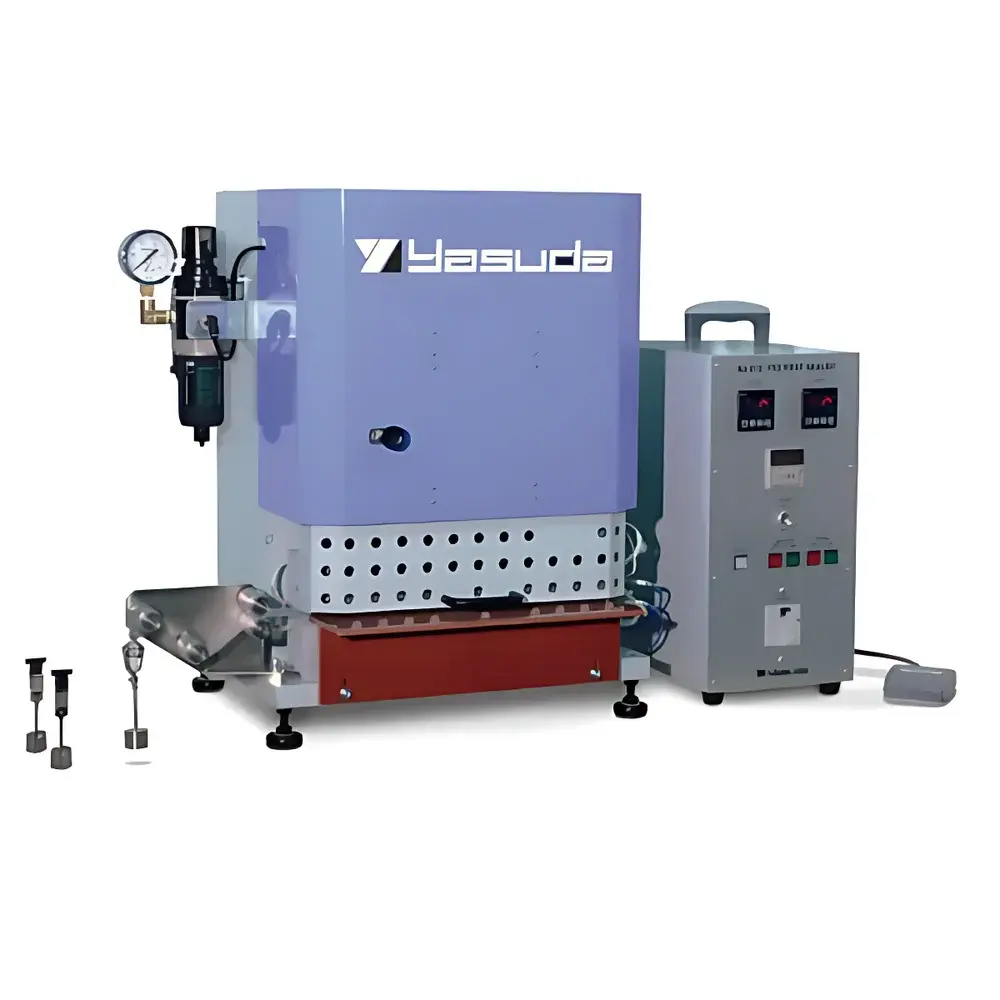
Yasuda No.212 YSS Heat Sealer
| Brand | Yasuda |
|---|---|
| Origin | Japan |
| Model | No.212 |
| Sealing Width | 5–20 mm (adjustable) |
| Sealing Length | 300 mm |
| Max. Temperature | 300 °C |
| Pressure Range | 0–0.5 MPa (graduated in 0.01 MPa increments) |
| Dwell Time | 0.01–99.99 s |
| Pneumatic Actuation | Cylinder-driven |
| Cylinder Stroke | ≤45 mm |
| Power Supply | AC 100 V, 15 A, 50/60 Hz |
| Air Supply Requirement | ≥0.5 MPa |
| Main Unit Dimensions | W450 × D385 × H650 mm, ~105 kg |
| Control Panel Dimensions | W230 × D450 × H515 mm, ~15 kg |
| Standard Accessories | Foot switch |
| Optional Accessories | Safety guard, hot tack fixture, specimen clamping plate, air compressor |
Overview
The Yasuda No.212 YSS Heat Sealer is a precision-engineered, pneumatically actuated laboratory-scale heat sealing instrument designed for quantitative evaluation of seal integrity in flexible packaging materials—including cellophane, polyethylene (PE), polypropylene (PP), polyester (PET), laminated films, and other thermoplastic substrates. It operates on the principle of controlled thermal compression bonding: applying calibrated temperature, pressure, and dwell time to generate reproducible seals under standardized conditions. Unlike manual or spring-loaded sealers, the No.212 employs a regulated air cylinder to deliver consistent, repeatable force—eliminating operator-dependent variability and enabling compliance with method-defined protocols such as ASTM F2029, ISO 11607-2, and JIS Z 1707. Its modular architecture supports both routine quality control testing and R&D-level parameter optimization for seal initiation temperature (SIT), hot tack strength, and seal strength profiling.
Key Features
- Pneumatic pressure control: Integrated pressure gauge (0–0.5 MPa, 0.01 MPa resolution) enables precise, traceable force application across the full 5–20 mm sealing jaw width; eliminates mechanical hysteresis inherent in manual or solenoid-driven systems.
- Independent parameter adjustment: Three critical sealing variables—temperature (up to 300 °C, user-specified setpoint), dwell time (0.01–99.99 s, 0.01 s resolution), and contact pressure—are fully decoupled and digitally monitored, supporting Design of Experiments (DoE) workflows.
- Robust thermal architecture: Heated sealing bar with uniform surface temperature distribution (±2 °C typical across 300 mm length) ensures edge-to-edge seal consistency; rapid thermal stabilization (<60 s from ambient to 150 °C) minimizes throughput delays.
- Modular accessory integration: Factory-calibrated hot tack measurement fixture (optional) allows real-time tensile evaluation of seal strength during cooling phase—critical for evaluating sealant resins with narrow hot tack windows.
- Operator safety & process fidelity: Optional safety guard meets IEC 61496-1 Type 2 requirements; foot-switch activation enforces hands-free operation during sealing cycle, reducing risk of thermal exposure and improving repeatability.
Sample Compatibility & Compliance
The No.212 accommodates flat-sheet specimens up to 300 mm wide and any practical thickness (typical range: 20–250 µm). It is routinely deployed in laboratories adhering to ISO/IEC 17025-accredited quality systems and supports documentation requirements for FDA-regulated packaging validation (e.g., 21 CFR Part 11-compliant data logging when paired with external acquisition hardware). Seal strength test results generated using this instrument are referenced in packaging qualification dossiers compliant with ISO 11607-2:2019 (Packaging for terminally sterilized medical devices) and ASTM F88/F88M (Standard Test Method for Seal Strength of Flexible Barrier Materials). All pneumatic and electrical components conform to CE marking directives (2014/30/EU EMC, 2014/35/EU LVD) and Japanese JIS B 9741 safety standards for industrial machinery.
Software & Data Management
The No.212 operates as a standalone benchtop instrument with analog-digital hybrid controls: temperature is regulated via PID controller with digital display; pressure and time are monitored via calibrated analog gauges and digital timer. While the base unit does not include embedded software or USB/RS-232 interfaces, its operational parameters are fully compatible with external data acquisition systems (e.g., LabVIEW, MATLAB, or custom SCADA platforms) via 4–20 mA or 0–10 V analog outputs (available upon request). For GLP/GMP environments, users commonly integrate the sealer into validated test protocols using electronic lab notebooks (ELNs) that capture operator ID, batch number, environmental conditions (room temperature/humidity), and seal parameter logs—ensuring full audit trail traceability per ALCOA+ principles.
Applications
- Optimization of heat seal parameters for new film structures in pharmaceutical blister packaging and sterile barrier systems.
- Hot tack curve generation for ethylene-vinyl acetate (EVA) and ionomer-based sealants used in high-speed form-fill-seal (FFS) lines.
- Accelerated aging studies correlating seal strength retention with storage conditions (e.g., 40 °C/75% RH per ISO 11607-1 Annex D).
- Root cause analysis of seal failures (leak paths, delamination, scorching) by isolating individual variable effects (e.g., pressure vs. temperature sensitivity).
- Supplier qualification testing per contractual specifications requiring minimum seal strength thresholds at defined dwell times.
FAQ
What materials can be tested on the Yasuda No.212?
It is validated for thermoplastic films including LDPE, HDPE, PP, PET, PS, PVC, cellophane, aluminum foil laminates, and coextruded structures—provided they exhibit thermal softening within the 50–300 °C range.
Is calibration certification included with shipment?
The instrument ships with factory calibration records for temperature (NIST-traceable thermocouple verification) and pressure (deadweight tester validation); annual recalibration is recommended per ISO/IEC 17025 Clause 6.6.
Can the No.212 be integrated into automated production line validation protocols?
Yes—its pneumatic interface and stable thermal response allow synchronization with PLC-controlled test sequences; optional analog output modules enable real-time parameter logging into MES systems.
What safety certifications does the system meet?
Base configuration complies with JIS B 9741 (Japanese Industrial Standard for industrial machinery safety); optional safety guard adds compliance with IEC 61496-1 Type 2 photoelectric protective devices.
Is compressed air supply included?
No—an external oil-free air compressor delivering ≥0.5 MPa at ≥10 L/min is required; inlet filter/regulator/lubricator (FRL) units are strongly recommended to prevent cylinder contamination.




