
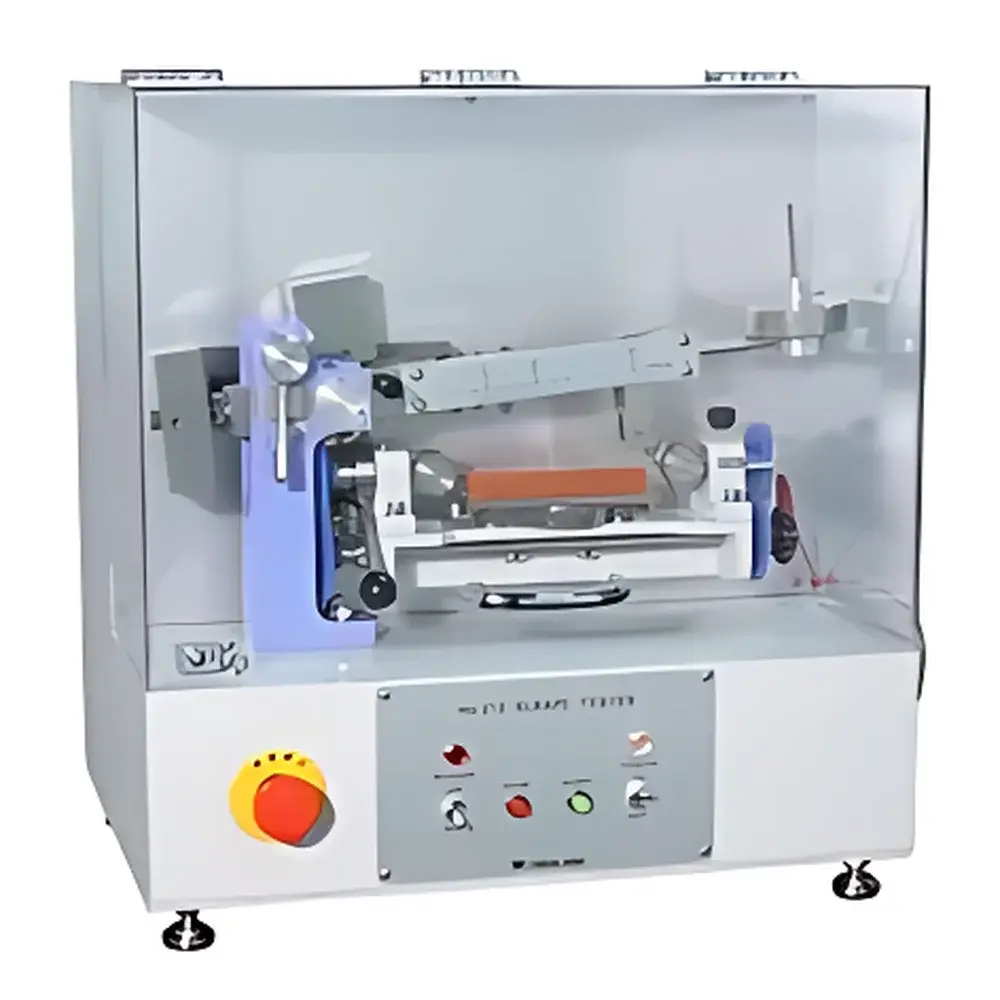
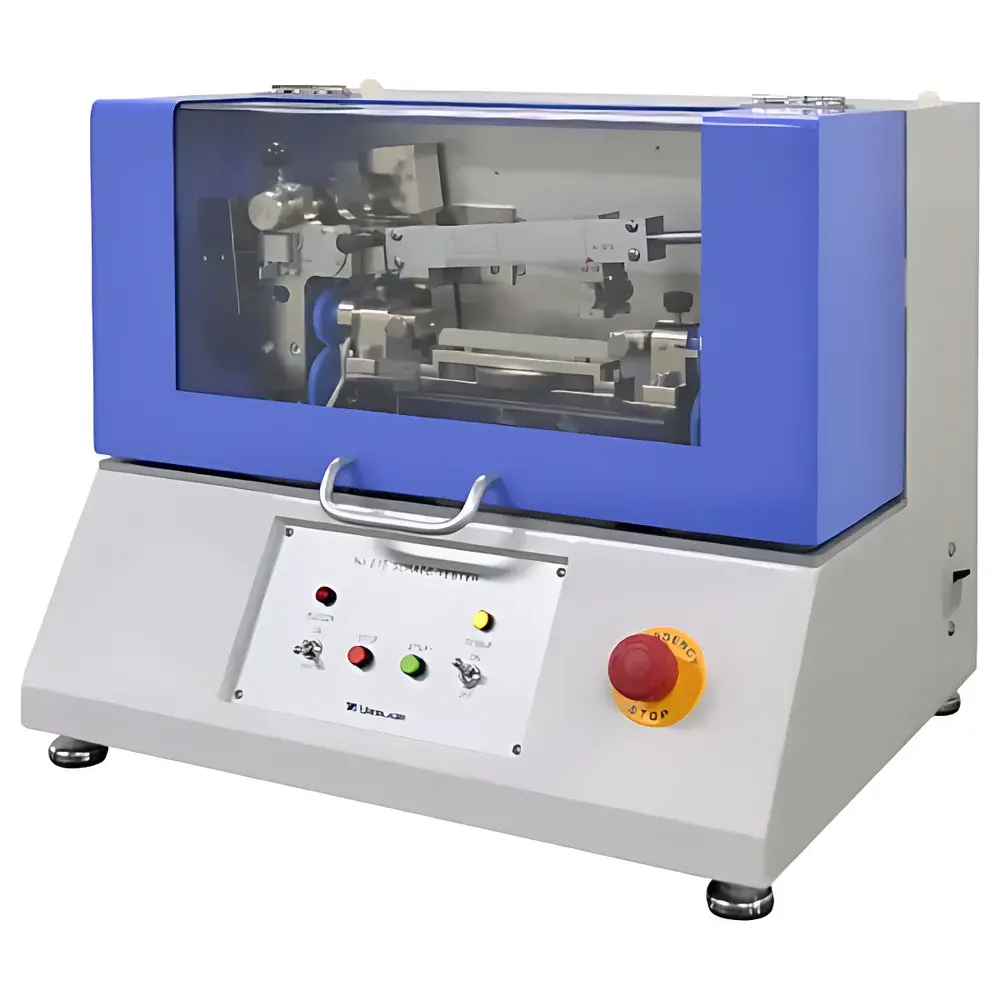
Yasuda No.215 One-Direction Scrape Tester
| Brand | Yasuda |
|---|---|
| Origin | Japan |
| Model | No.215 |
| Standard Compliance | JIS C 3003, IEC 60172, IEC 60851, NEMA C9.5 |
| Scratching Distance | 100 mm |
| Scratching Speed | 400 ± 40 mm/min |
| Load Range | 100 gf to 3.2 kgf (initial) |
| Piano Wire Diameter | φ0.23 ± 0.01 mm |
| Specimen Rotation Angles | 0°, 120°, 240° (optional) |
| Safety Enclosure | Integrated |
| Power Supply | AC 100 V, Single-phase, 5 A, 50/60 Hz |
| Dimensions (W×D×H) | Approx. 560 × 470 × 490 mm |
| Weight | Approx. 45 kg |
Overview
The Yasuda No.215 One-Direction Scrape Tester is a precision-engineered tribological testing instrument designed specifically for evaluating the mechanical abrasion resistance and insulation integrity of enameled winding wires—particularly magnet wire used in electric motors, transformers, and inductors. It operates on a controlled unidirectional scratching principle: a calibrated piano wire traverses a fixed 100 mm linear path across the wire’s enamel coating under incrementally increasing normal load. The critical failure point—the “scrape-through load”—is defined as the minimum applied force at which electrical continuity between the conductor core and the scratching probe is first detected, indicating breakthrough of the insulating layer. This deterministic endpoint measurement provides a highly reproducible quantitative index of enamel toughness, adhesion strength, and process consistency. Unlike oscillatory or multi-cycle wear testers, the No.215 implements a single-pass, monotonic loading protocol aligned with standardized test methods including JIS C 3003, IEC 60172, IEC 60851-5, and NEMA MW 1000-C9.5, ensuring regulatory traceability for quality assurance laboratories operating under ISO/IEC 17025, IATF 16949, or internal GMP-aligned protocols.
Key Features
- Unidirectional linear scratching mechanism with precise stroke control over a fixed 100 mm travel distance
- Electromechanically regulated load application system enabling stepwise or continuous increase from 100 gf to 3.2 kgf with high repeatability
- Integrated conductive detection circuitry for real-time monitoring of insulation breakdown; automatic load capture at first continuity event
- Optional specimen rotation stage supporting three discrete angular positions (0°, 120°, 240°), allowing up to three independent scrape tests on a single wire sample without remounting
- Calibrated piano wire probe (φ0.23 ± 0.01 mm) manufactured to strict dimensional tolerances per ASTM E1812 requirements for wire-based abrasion tools
- Full polycarbonate safety enclosure compliant with IEC 61000-4-2 and EN 60204-1 for operator protection during live electrical detection
- Stable base frame and vibration-damped mounting platform minimizing parasitic motion artifacts during high-sensitivity conductivity detection
Sample Compatibility & Compliance
The No.215 accommodates round enameled copper or aluminum magnet wires ranging from AWG 30 to AWG 12 (0.05–2.05 mm diameter), with insulation thicknesses typical of polyurethane, polyester-imide, polyamide-imide, and self-bonding coatings. Specimens are mounted using standard dual-clamp fixtures with adjustable tension control to prevent slippage or deformation under load. All operational parameters—including speed tolerance (±40 mm/min), wire diameter specification, and load resolution—are validated against the metrological requirements of JIS C 3003 Annex B and IEC 60851-5 Clause 6. The instrument’s electrical detection threshold is set to ≤10 µA at ≤5 V DC, satisfying the sensitivity criteria for insulation failure detection in international standards. Full documentation support—including calibration certificates traceable to JCSS (Japan Calibration Service System) and conformity statements to RoHS Directive 2011/65/EU—is provided with each unit.
Software & Data Management
The No.215 operates as a stand-alone hardware platform with analog front-end signal conditioning and digital load encoding. While it does not incorporate embedded firmware or touchscreen interface, its electrical output signals (load value at breakdown, elapsed time, and pass/fail status) are compatible with external data acquisition systems via 0–10 V analog output and TTL-level digital trigger ports. Users may integrate the tester into LabVIEW, MATLAB, or custom SCADA environments for automated logging, statistical process control (SPC), and audit-ready report generation. When deployed within regulated environments (e.g., automotive Tier-1 suppliers or medical device component manufacturers), the system supports 21 CFR Part 11-compliant workflows when paired with validated third-party software that provides electronic signatures, audit trails, and role-based access control.
Applications
- Quality control of enameled wire batches prior to coil winding in motor manufacturing
- Comparative evaluation of new enamel formulations or curing process adjustments
- Failure analysis of field-returned windings exhibiting premature short circuits
- Validation of wire supplier qualification protocols per customer-specific technical specifications (e.g., GM GMW15635, Ford WHT-501)
- Supporting R&D activities in insulation material development labs requiring standardized mechanical stress metrics
- Training and certification of laboratory technicians in standardized scrape testing methodology
FAQ
What is the definition of “scrape-through load” in this context?
The scrape-through load is the lowest applied normal force at which electrical continuity is established between the conductive core of the enameled wire and the grounded piano wire probe—indicating complete removal or fracture of the insulating enamel layer along the scratch path.
Can the No.215 be used for non-magnet wire substrates such as coated flat copper or polymer films?
No. The fixture geometry, probe alignment, and detection logic are optimized exclusively for cylindrical enameled wire specimens meeting IEC 60851 dimensional tolerances. Alternative geometries require dedicated test platforms.
Is calibration service available outside Japan?
Yes. Yasuda-authorized service partners in North America, Europe, and Southeast Asia provide on-site verification, adjustment, and JCSS-traceable calibration using NIST- or UKAS-certified reference masses and displacement sensors.
Does the instrument meet electromagnetic compatibility (EMC) requirements for laboratory use?
Yes. The No.215 complies with EN 61326-1:2013 for laboratory equipment, including radiated emissions (Class B), electrostatic discharge immunity (±8 kV contact), and fast transient burst immunity (±2 kV).
Related Products



