
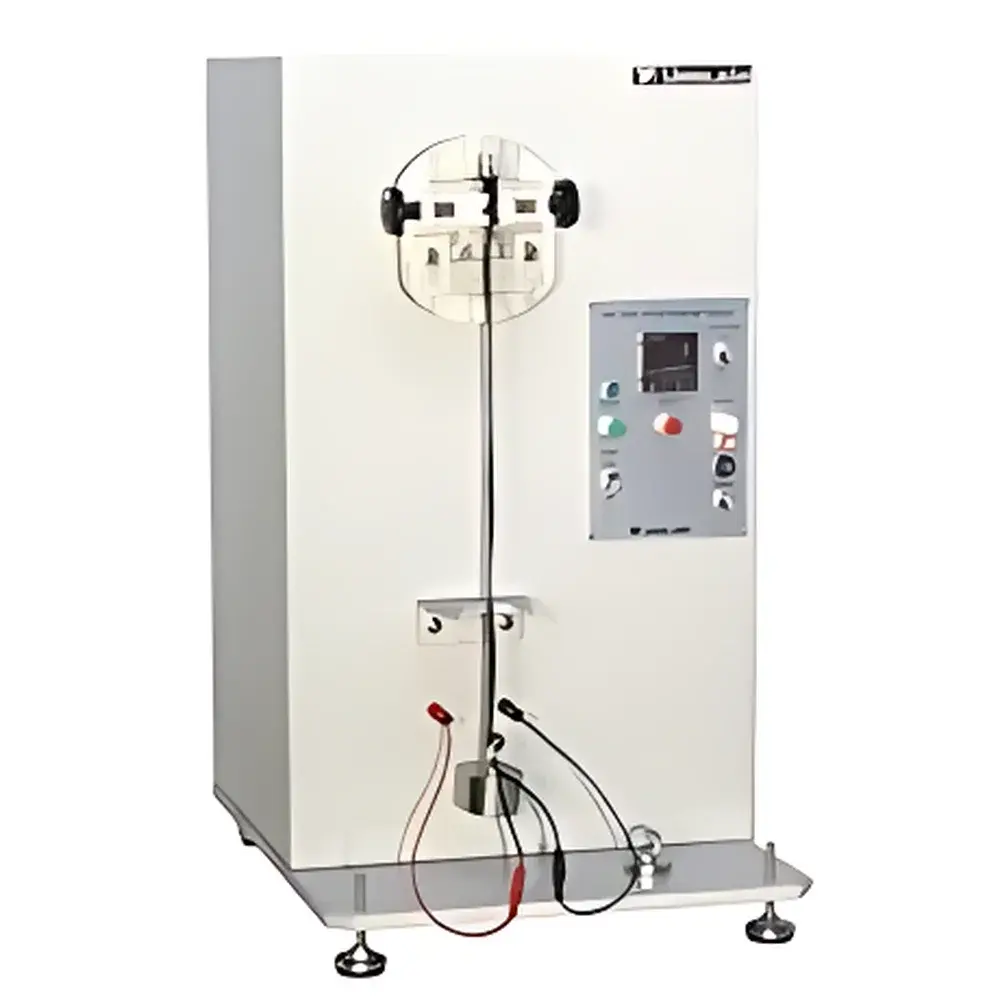
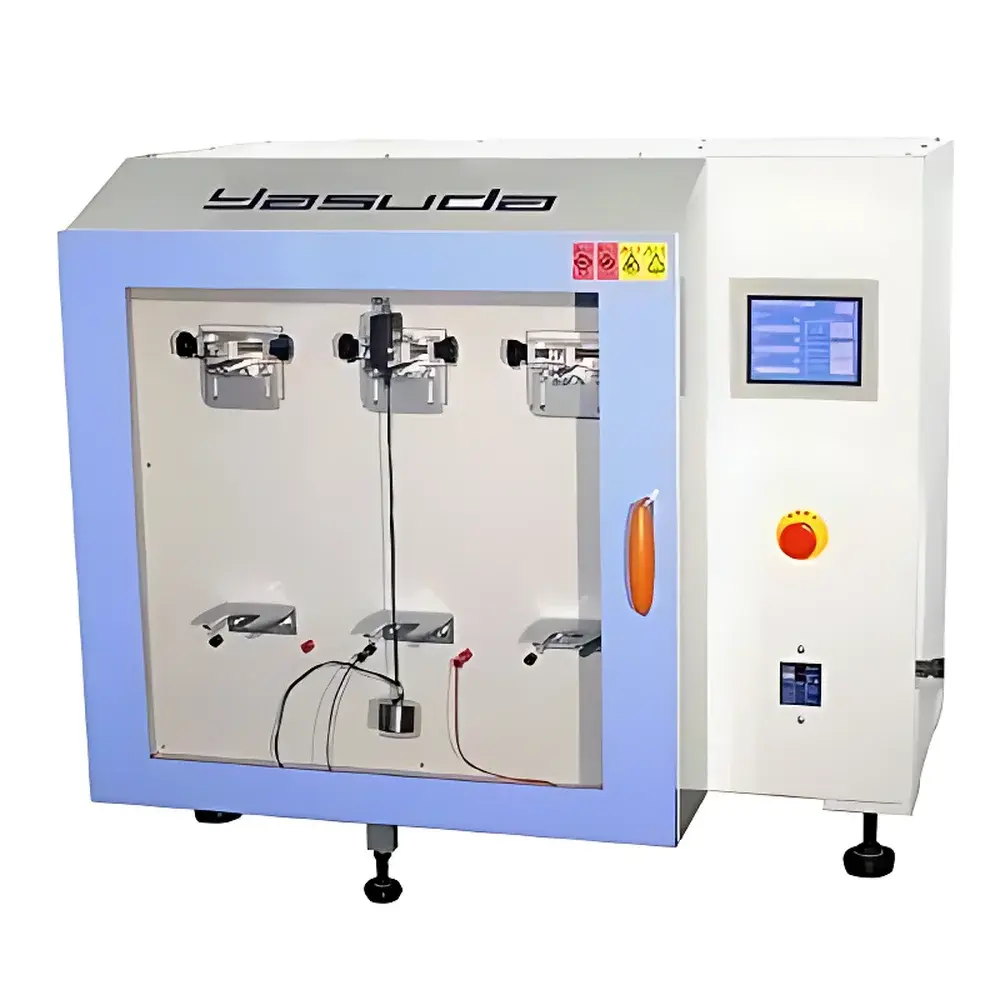
Yasuda No.254 Plug Flexing Tester
| Brand | Yasuda |
|---|---|
| Origin | Japan |
| Model | No.254 |
| Compliance Standard | JIS C 8306 |
| Test Motion | Reciprocating swing ±60° |
| Load Application | Suspended dead-weight loading |
| Output Metric | Conductor breakage rate (failures per cycle count) |
| Configuration | Benchtop, manually loaded, mechanical cam-driven actuation |
| Duty Cycle | Programmable cycle count up to 100,000 cycles (user-defined termination threshold) |
Overview
The Yasuda No.254 Plug Flexing Tester is a precision-engineered mechanical test instrument designed to evaluate the mechanical durability and fatigue resistance of plug terminations and associated flexible leads under repeated bending stress. It operates on the principle of controlled, low-frequency cyclic flexure—mimicking real-world usage conditions where electrical plugs undergo repeated insertion, removal, and incidental lateral strain. The device subjects the lead-to-plug junction to a standardized reciprocating angular displacement of ±60°, while a calibrated dead weight applies tensile and torsional load at the free end. This configuration replicates the combined bending and pulling forces experienced during routine handling in consumer electronics, industrial equipment, and household appliances. As a dedicated compliance verification tool, it supports objective pass/fail assessment based on conductor integrity after a defined number of flexing cycles—directly aligned with the structural reliability requirements of JIS C 8306.
Key Features
- Mechanically synchronized cam-driven oscillation mechanism ensures consistent angular amplitude (±60°) and repeatable stroke timing across all test cycles.
- Adjustable counter with visual LED display enables precise tracking and user-defined termination at preset cycle counts (e.g., 5,000; 10,000; 50,000; or up to 100,000 cycles).
- Modular weight suspension system accommodates standardized test loads per JIS C 8306 specifications—typically 200 g, 300 g, or 500 g, selected based on plug class and lead gauge.
- Benchtop stainless-steel frame provides vibration-dampened stability and long-term dimensional fidelity during extended testing sessions.
- No electronic controllers or software dependencies—designed for operational simplicity, minimal maintenance, and direct GLP-compliant manual recordkeeping.
- Dedicated sample holder with adjustable clamping force prevents slippage while avoiding localized deformation of insulation or strain relief features.
Sample Compatibility & Compliance
The No.254 accommodates a wide range of plug configurations including but not limited to: NEMA 1-15P, IEC 60320 C13/C14, Japanese JIS C 8303-compliant domestic plugs, and custom molded terminations with lead diameters from 0.5 mm to 6.0 mm. Specimens are secured via dual-point fixation—rigid anchoring of the plug body and controlled tension application at the distal lead end—to isolate flexure at the critical strain-relief zone. All test procedures strictly adhere to JIS C 8306:2019 (“Plugs and socket-outlets for household and similar purposes”), which defines acceptance criteria based on absence of open-circuit failure, insulation rupture, or visible conductor exposure after completion of the specified flexing regimen. While not inherently certified to ISO/IEC 17025, the instrument’s mechanical traceability, documented calibration protocol (weight verification, angle verification via protractor gauge), and deterministic motion profile support audit-ready validation in QA/QC laboratories operating under ISO 9001 or IATF 16949 frameworks.
Software & Data Management
The Yasuda No.254 is a standalone electromechanical tester with no embedded firmware or digital interface. Data acquisition is manual: operators record start time, applied load mass, total cycle count, and observed failure mode (e.g., “open circuit at cycle 12,480”, “insulation crack at cycle 48,100”) in laboratory notebooks or LIMS-integrated spreadsheets. For regulated environments requiring electronic records, integration is achieved externally via time-stamped video documentation (using synchronized external cameras), cycle-counter loggers with RS-232 output (third-party add-ons), or paper-based forms compliant with FDA 21 CFR Part 11 when paired with wet-ink signatures and version-controlled templates. The absence of onboard software eliminates cybersecurity concerns and simplifies 21 CFR Part 11 validation pathways for GMP-regulated medical device component testing.
Applications
- Pre-production qualification of molded plug assemblies for consumer electronics OEMs.
- In-process quality assurance in cable harness manufacturing facilities supplying automotive Tier-1 suppliers.
- Third-party certification testing labs performing JIS-mark conformance assessments.
- R&D validation of new thermoplastic elastomer (TPE) or PVC compound formulations for improved flex-life performance.
- Root cause analysis of field return failures linked to premature lead fracture or solder joint fatigue.
- Comparative benchmarking of competing plug designs under identical mechanical stress profiles.
FAQ
Does the No.254 support automated data export or USB connectivity?
No. It is a purely mechanical tester with analog cycle counting. Data logging requires manual entry or external instrumentation.
Can the swing angle be adjusted beyond ±60°?
No. Angular displacement is fixed at ±60° per JIS C 8306 and cannot be modified without compromising standard compliance.
Is calibration documentation provided with shipment?
Yes—each unit ships with a factory calibration certificate verifying dead-weight accuracy (±0.5 g) and angular displacement (±1°) using NIST-traceable reference standards.
What maintenance intervals are recommended?
Lubrication of cam shaft bearings every 50,000 cycles; inspection of clamp jaw surfaces and suspension hooks prior to each test series.
Is the tester compatible with international standards other than JIS C 8306?
While optimized for JIS, its motion profile and loading methodology align closely with portions of IEC 60884-1 Annex D and UL 62 Section 10.2; however, full compliance with those standards requires supplementary fixtures or procedural adaptations not supplied by default.



