
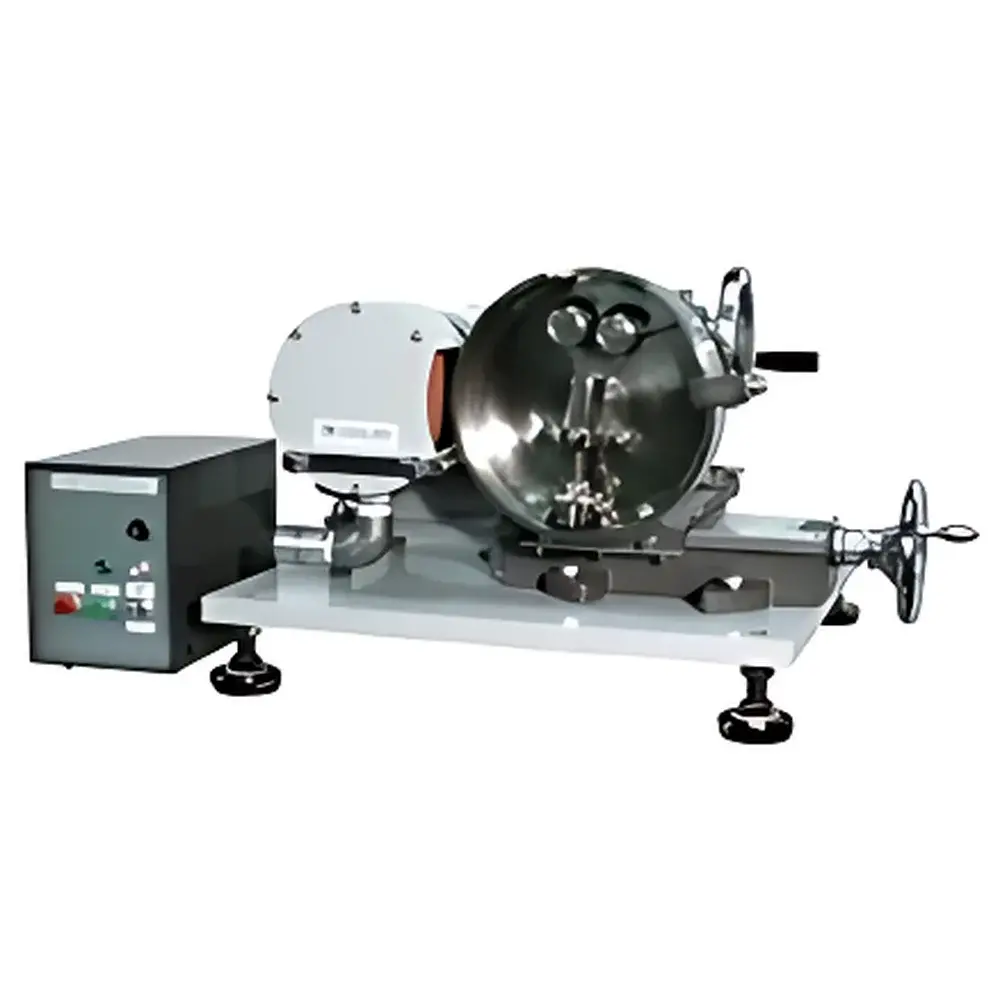
Yasuda No.255 Compound Grinder for Insulated Wires and Cables
| Brand | Yasuda |
|---|---|
| Origin | Japan |
| Model | No.255 |
| Compliance | UL-1581 |
| Application | Specimen Preparation for Tensile Testing of Wire Insulation and Jacketing Materials |
| Type | Precision Rotary Abrasive Grinding System |
Overview
The Yasuda No.255 Compound Grinder is a precision-engineered mechanical specimen preparation instrument designed specifically for the controlled, reproducible grinding of insulated wire and cable sheathing materials to produce standardized test specimens for tensile property evaluation. Operating on the principle of rotary abrasive contact grinding, the system employs a motor-driven abrasive wheel rotating at a regulated surface velocity, while the specimen—mounted on a cylindrical mandrel—is advanced axially or radially against the wheel under consistent pressure. This geometry ensures uniform material removal across the curved surface of insulation layers (e.g., PVC, PE, XLPE, ETFE, FEP), enabling precise thickness control down to ±0.02 mm per pass—critical for achieving ASTM D638 / ISO 527-compliant dumbbell-shaped tensile bars from irregularly shaped wire cross-sections. Unlike manual scraping or cryogenic sectioning, the No.255 delivers high repeatability in specimen geometry, minimizing inter-laboratory variability in mechanical testing outcomes.
Key Features
- Stainless-steel construction with corrosion-resistant anodized aluminum housing for long-term stability in laboratory and QC environments.
- Adjustable mandrel speed (0–60 rpm) and feed rate control to accommodate varying polymer hardness and thermal sensitivity—preventing localized melting or deformation during grinding.
- Interchangeable abrasive wheels (standard grit: #120–#400 Al₂O₃ or SiC) with quick-release mounting for rapid adaptation to different insulation chemistries and target thicknesses.
- Mechanical depth stop with vernier scale (resolution: 0.01 mm) for repeatable final specimen thickness targeting—essential for UL-1581 Section 1060 (Tensile Test Specimen Requirements) compliance.
- Integrated dust extraction port compatible with standard 50–100 mm vacuum ducting, meeting OSHA 1910.94 and ISO 8502-3 particulate exposure guidelines.
- No electrical heating elements or laser sources—fully mechanical operation ensures intrinsic safety when processing halogenated or flame-retardant compounds.
Sample Compatibility & Compliance
The No.255 accommodates insulated wires and cables with outer diameters ranging from 0.5 mm to 12.0 mm and insulation/jacket thicknesses from 0.2 mm to 3.5 mm. It is routinely validated for use with thermoplastic (PVC, PE, TPU), thermoset (XLPE, EPR), fluoropolymer (FEP, PTFE), and elastomeric (CSPE, CPE) insulations. The device fulfills mandatory specimen preparation requirements defined in UL 1581 (Edition 5, 2022), particularly Sections 1060 (Tensile Test), 1061 (Elongation Test), and Annex A (Specimen Conditioning). It also supports specimen generation aligned with IEC 60811-100 series (polymeric insulations for cables), ASTM D3179 (Standard Practice for Preparing Wire and Cable Test Specimens), and JIS C 3005 (Japanese Industrial Standard for Electrical Wires). All grinding parameters are documented in lab notebooks or electronic logs to satisfy GLP audit traceability requirements.
Software & Data Management
As a fully mechanical benchtop instrument, the No.255 operates without embedded firmware or digital interfaces. However, its operational parameters—including mandrel rotation speed, wheel RPM (fixed at 1,750 ± 30 rpm), number of passes, measured final thickness (via calibrated micrometer), and operator ID—are structured for integration into LIMS or ELN platforms via manual entry or barcode-scanned worksheet templates. Optional accessories include a certified NIST-traceable digital micrometer (0–25 mm, ±0.001 mm) and a UL-1581-compliant specimen logbook pre-formatted for FDA 21 CFR Part 11–aligned signature fields. Audit trails for specimen preparation records are maintained per ISO/IEC 17025:2017 Clause 7.5.2 (Control of Records).
Applications
- Preparation of Type A and Type B tensile test specimens from building wire (THHN, THWN, XHHW), automotive wiring (SAE J1128), and aerospace cables (MIL-DTL-27500).
- Thickness reduction of jacketed coaxial or multi-conductor cables prior to peel strength or dielectric testing.
- Generation of uniform-thickness films from extruded insulation scrap for comparative rheological or DSC analysis.
- Controlled surface profiling of aged or weathered cable samples for failure analysis labs investigating UV degradation or thermal embrittlement.
- Supporting internal R&D validation of new insulation formulations by enabling direct comparison of tensile modulus and elongation-at-break across prototype batches.
FAQ
Does the No.255 require calibration certification prior to first use?
Yes—users must verify mandrel concentricity (≤0.02 mm TIR), wheel runout (<0.05 mm), and depth-stop linearity using Class 0 gauge blocks before initial operation. Calibration records should be retained for ISO/IEC 17025 audits.
Can the grinder process halogen-free low-smoke (LSOH) cables without compromising material integrity?
Yes—the absence of frictional heating spikes and adjustable feed rate prevent charring or dehydrochlorination in LSOH compounds such as EVA or PO-based formulations.
Is operator training required for UL-1581 compliance?
Per UL’s Field Evaluation Body (FEB) guidance, personnel must complete documented competency assessment covering specimen mounting sequence, grit selection logic, and thickness verification protocol—typically delivered via Yasuda’s authorized distributor workshops.



