
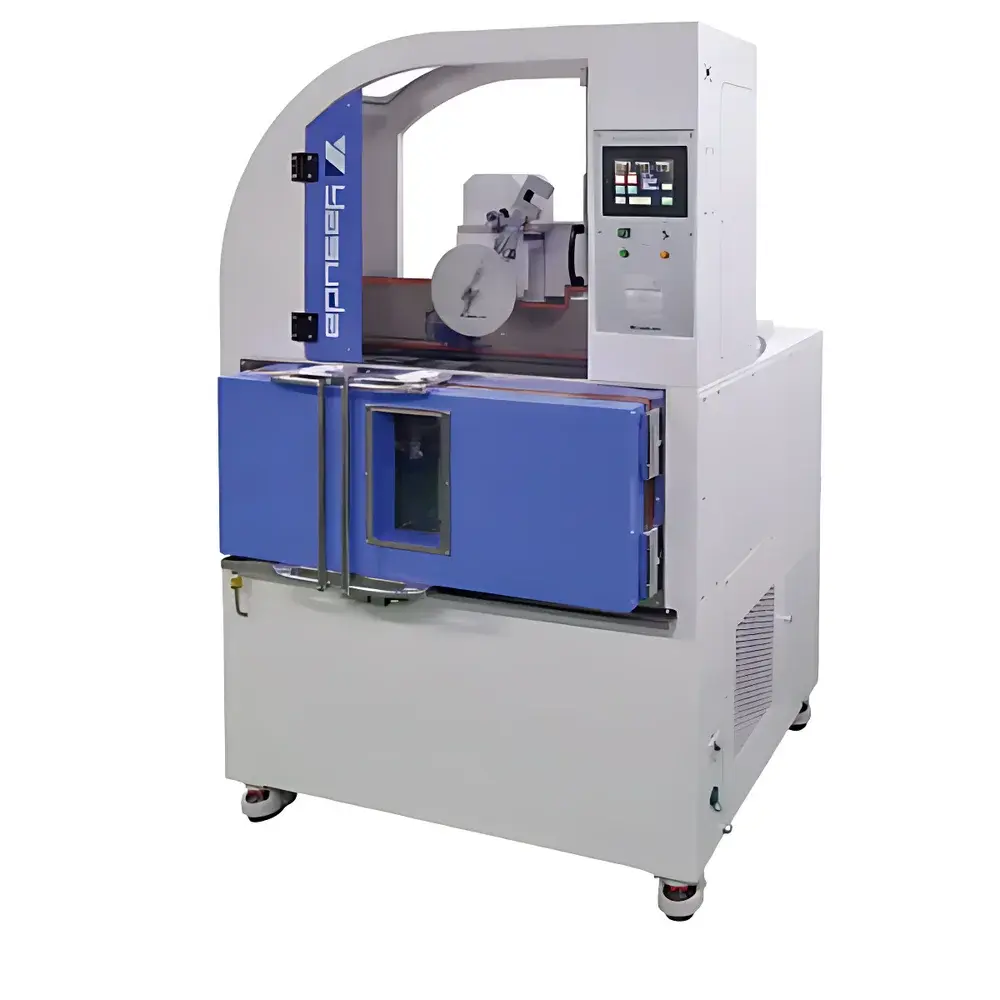
Yasuda No.258-L Low-Temperature Pendulum Impact Testing Machine
| Brand | Yasuda |
|---|---|
| Origin | Japan |
| Instrument Type | Pendulum Impact Tester |
| Impact Energy Range | 0.5–50 J |
| Impact Velocities | 2.9 m/s, 3.8 m/s, 3.46 m/s |
| Pendulum Torque (Impact Constant) | 30 N·m/rad |
| Load Cell Range | 0–50 N |
| Maximum Pendulum Lift Height | 150 mm |
| Compliance Standards | JIS K7110, JIS K7111, ASTM D256, ISO 179, ISO 180, GB/T 1043, GB/T 1843 |
| Temperature Control Integration | Integrated Dual-Door Low-Temperature Chamber |
Overview
The Yasuda No.258-L Low-Temperature Pendulum Impact Testing Machine is a precision-engineered instrument designed for standardized Charpy and Izod impact testing under controlled sub-ambient conditions. Based on the fundamental principles of pendulum-based energy absorption measurement—where kinetic energy loss of a falling pendulum is quantified upon fracture of a notched specimen—the system delivers high reproducibility in determining impact resistance of rigid plastics, thermosets, composites, and engineering polymers. Its integrated low-temperature chamber enables consistent thermal conditioning of specimens per ASTM D256 Annex A3, ISO 179-2, and JIS K7111 Clause 6, supporting reliable evaluation of ductile-to-brittle transitions across temperature gradients from –70 °C to +60 °C (dependent on chiller specification). The machine conforms to the mechanical design requirements of ISO 148-1 and ISO 180-1 for pendulum impact testers, ensuring traceable calibration and geometric fidelity of the striking edge, anvil radius, and specimen support span.
Key Features
- Dual-door cryogenic chamber architecture: Inner door remains sealed during specimen loading via external clamping ports, minimizing thermal drift (< ±0.5 °C over 5 min) and preserving test condition stability.
- Calibrated pendulum system with three selectable impact velocities (2.9, 3.46, and 3.8 m/s), each corresponding to defined energy ranges (0.5–5 J, 1–25 J, and 2.5–50 J) and verified per ISO 148-2 Annex B.
- High-stiffness cast-iron base and hardened steel anvil assembly ensure minimal frame deflection (< 0.02 mm under full 50 J impact), critical for accurate energy restitution calculation.
- Integrated load cell (0–50 N range) with digital signal conditioning provides real-time force-time waveform capture—enabling supplementary analysis of peak load, fracture initiation energy, and post-yield dissipation.
- Pendulum torque constant fixed at 30 N·m/rad, enabling direct conversion between angular displacement and absorbed energy without iterative calibration.
- Maximum pendulum lift height of 150 mm supports full energy range coverage while maintaining compliance with ISO 148-1 clearance and safety interlock requirements.
Sample Compatibility & Compliance
The No.258-L accommodates standard Charpy (10 × 10 × 55 mm) and Izod (63.5 × 12.7 × 3.2 mm or 12.7 mm thick) specimens per ISO 179-1, ISO 180-1, ASTM D256, and JIS K7110. Notch geometries include ASTM U-notch (1.0 mm depth, 0.25 mm root radius) and ISO V-notch (2 mm depth, 0.25 mm radius), machined using certified tooling. Specimen conditioning follows ISO 291 and ASTM D618 protocols; the dual-door chamber allows pre-cooling to target temperature (±1 °C tolerance) with hold times ≥15 min prior to impact. All test reports comply with ISO/IEC 17025 documentation requirements, including uncertainty budgets for energy measurement (k = 2, ≤ ±1.2% for 10–50 J range).
Software & Data Management
The system interfaces with Yasuda’s IMPACT-Link v4.2 software suite (Windows 10/11 compatible) for automated test sequencing, real-time energy calculation, and waveform export in CSV and ASCII formats. Software features include GLP-compliant audit trails, user role-based access control (admin/operator), electronic signature support per FDA 21 CFR Part 11, and automatic generation of test certificates aligned with ISO 17025 clause 7.8. Data files embed metadata such as ambient temperature, chamber setpoint, specimen ID, notch type, and calibration certificate expiry dates. Exported datasets are compatible with LIMS platforms via ODBC drivers and support statistical process control (SPC) charting per ISO 7870-2.
Applications
- Quality control of injection-molded automotive interior components (PP/EPDM blends, PC/ABS) at –30 °C to assess cold-weather brittleness.
- R&D validation of bio-based polyesters (e.g., PLA, PHA) under thermal cycling per ISO 179-2 Method A (unnotched) and Method B (notched).
- Regulatory submission testing for medical device housings (ISO 10993-12 compliant polymers) requiring impact performance data at sterilization-relevant temperatures.
- Failure analysis of fiber-reinforced composites in aerospace applications, where low-temperature Izod data inform delamination thresholds.
- Material qualification for electrical insulation materials per IEC 60695-1-30, correlating impact strength with arc resistance behavior.
FAQ
What standards does the No.258-L fully support for low-temperature impact testing?
JIS K7110 (Charpy), JIS K7111 (Izod), ASTM D256 (with Annex A3 for low-temp), ISO 179-2 (Charpy, multi-temperature), ISO 180-2 (Izod, multi-temperature), GB/T 1043, and GB/T 1843.
Is the dual-door chamber supplied with a refrigeration unit?
Yes—the chamber includes a self-contained cascade refrigeration system capable of reaching –70 °C; optional liquid nitrogen assist is available for ultra-low thermal ramping.
Can the system be calibrated to national metrology institute (NMI) traceable standards?
Yes—Yasuda provides factory calibration certificates traceable to NMIJ (Japan) or PTB (Germany), with optional on-site verification by accredited third-party labs.
Does the load cell output meet ISO 148-2 requirements for force measurement uncertainty?
Yes—the 0–50 N sensor achieves ≤ ±0.8% full-scale uncertainty (k = 2), satisfying Clause 6.3.2 of ISO 148-2 for auxiliary instrumentation.
Is specimen alignment verification included in routine maintenance?
Yes—each service interval includes anvil parallelism check (≤ 0.05 mm deviation), striker edge radius verification (0.8 ± 0.05 mm), and support span measurement (40.0 ± 0.2 mm for Charpy, 62.0 ± 0.2 mm for Izod).



