
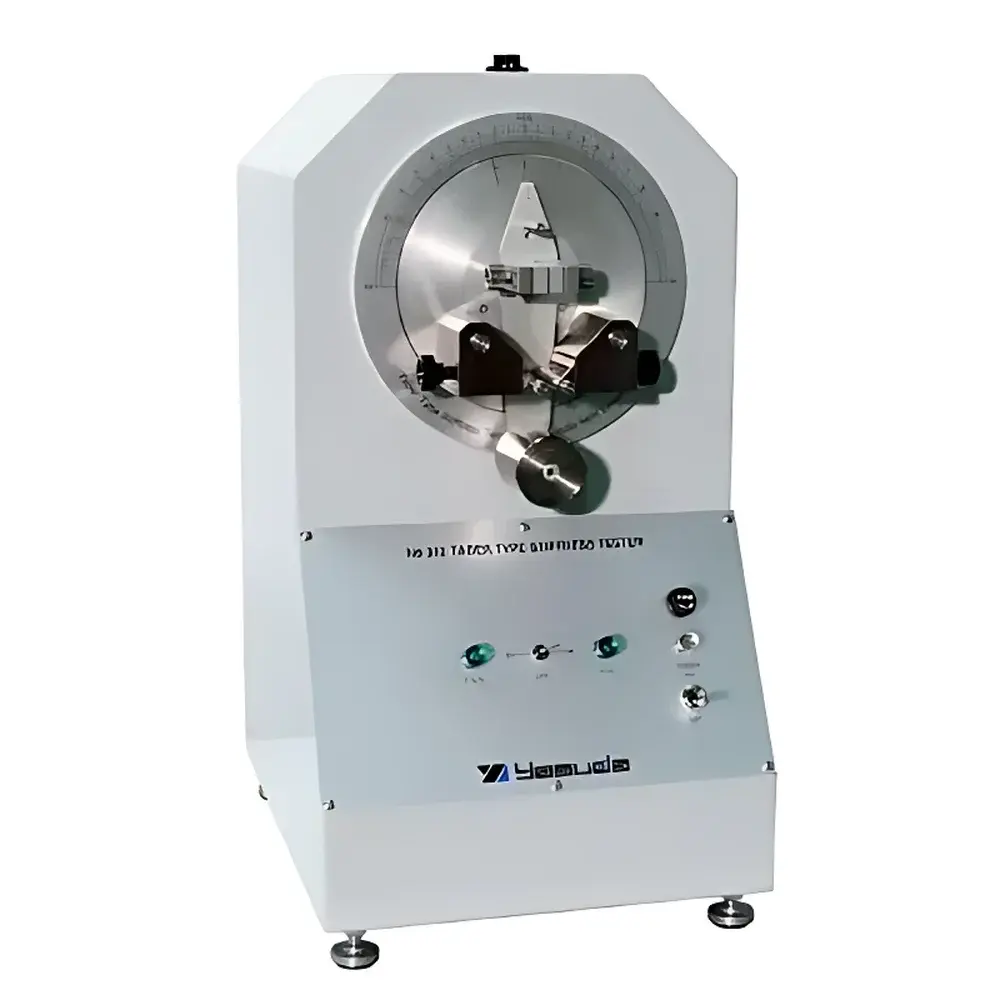
Yasuda No.312 Taber-Type Stiffness Tester
| Brand | Yasuda |
|---|---|
| Origin | Japan |
| Model | No.312 |
| Applicable Standards | JIS P8125, TAPPI T489, ISO 2493 |
| Test Principle | Cantilever bending at 15° deflection with 50 mm moment arm |
| Measurement Output | Stiffness (mN·m) |
Overview
The Yasuda No.312 Taber-Type Stiffness Tester is a precision mechanical instrument engineered for the quantitative evaluation of bending stiffness in paper, paperboard, and thin flexible sheet materials. It operates on the classical cantilever beam principle defined in internationally harmonized standards—including JIS P8125, TAPPI T489, and ISO 2493—where a rectangular specimen is clamped at one end to form a fixed-free configuration. The free end is deflected at a controlled angular rate until a 15° bend is achieved, with the applied torque measured at a standardized moment arm length of 50 mm. This method delivers a direct, reproducible metric of material resistance to bending deformation under low-strain, quasi-static conditions—critical for predicting performance in packaging integrity, folding endurance, and structural rigidity during conversion and end-use.
Key Features
- Robust cast-iron base and precision-machined aluminum frame ensure long-term dimensional stability and minimal vibration-induced measurement drift.
- Calibrated torsion spring mechanism with dual-scale analog dial indicator (0–100 mN·m range, 1 mN·m resolution) provides immediate visual readout without dependency on external electronics.
- Adjustable specimen clamp with parallel-faced jaws and micrometer-controlled pressure ensures consistent grip force and eliminates slippage across thicknesses from 0.1 to 2.0 mm.
- Fixed 50 mm lever arm geometry complies strictly with ISO 2493 Annex A, eliminating operator-induced variability in moment arm definition.
- Mechanically driven 15° deflection actuation via calibrated cam-and-follower system guarantees repeatable angular displacement rate (0.5°/s nominal), independent of operator technique or environmental temperature fluctuations.
- Compliance-ready design supports documented calibration traceability to national metrology institutes (e.g., NMIJ/AIST in Japan) and facilitates integration into GLP-compliant laboratory quality systems.
Sample Compatibility & Compliance
The No.312 accommodates standard test specimens measuring 38 mm wide × 70 mm long (per TAPPI T489) or 15 mm × 70 mm (per JIS P8125), with thicknesses ranging from 0.1 mm (lightweight tissue) to 2.0 mm (corrugated board liners). Specimen conditioning per ISO 187 (23 ± 1°C, 50 ± 2% RH, ≥24 h equilibration) is required prior to testing to ensure moisture-content consistency. All operational procedures align with the normative test methods referenced in JIS P8125:2021, TAPPI T489 om-22, and ISO 2493:2010. The instrument’s mechanical architecture inherently satisfies the “non-electronic, direct-reading” requirement specified in Clause 5.2 of ISO 2493 for primary stiffness determination.
Software & Data Management
As a fully mechanical, analog-readout instrument, the No.312 requires no embedded firmware, software drivers, or digital connectivity. This architecture eliminates cybersecurity vulnerabilities, software validation overhead, and obsolescence risks associated with proprietary operating systems. Test results are manually recorded in laboratory notebooks or LIMS-compatible spreadsheets. For laboratories operating under FDA 21 CFR Part 11 or ISO/IEC 17025 requirements, the device supports audit-trail integrity through: (1) stamped calibration certificates with uncertainty budgets; (2) operator-signed test records referencing specific calibration lot numbers; and (3) periodic verification using NIST-traceable reference stiffness standards (e.g., certified polymer reference strips). Optional digital documentation kits—including calibrated USB microscopes for specimen edge inspection and timestamped digital calipers for width/thickness verification—are available to augment data traceability without compromising core mechanical integrity.
Applications
- Quality control of folding boxboard and solid bleached sulfate (SBS) grades for pharmaceutical and luxury packaging.
- Corrugated medium selection and linerboard specification validation in industrial packaging R&D.
- Comparative stiffness profiling of coated vs. uncoated papers in printing substrate qualification.
- Process optimization of calendering and supercalendering parameters in paper machine off-line trials.
- Regulatory submission support for packaging dossiers requiring ISO 2493-compliant stiffness data (e.g., EU Directive 94/62/EC compliance reports).
- Teaching laboratories demonstrating fundamental beam mechanics and material property–structure relationships in pulp & paper engineering curricula.
FAQ
Does the No.312 require electrical power or compressed air?
No. It is a purely mechanical instrument relying on gravity-assisted deflection and calibrated spring return. No utilities are needed.
Can it be used for non-paper materials such as thin plastics or foils?
Yes—provided the material exhibits linear elastic behavior within the 15° deflection range and maintains dimensional stability during clamping. Validation per ISO 2493 Annex B is recommended for non-standard substrates.
What calibration frequency is recommended for GLP environments?
Annual calibration by an ISO/IEC 17025-accredited provider is standard; interim verification using reference standards before each test batch is required under strict GLP protocols.
Is the 50 mm moment arm adjustable?
No. It is a fixed, machined component integral to the instrument’s metrological design and must not be modified to maintain compliance with ISO 2493 Clause 6.2.
How does humidity affect test outcomes?
Paper stiffness is highly hygroscopic. Specimens must be conditioned per ISO 187; uncontrolled RH variations >±2% will introduce >5% measurement uncertainty in stiffness values.



