
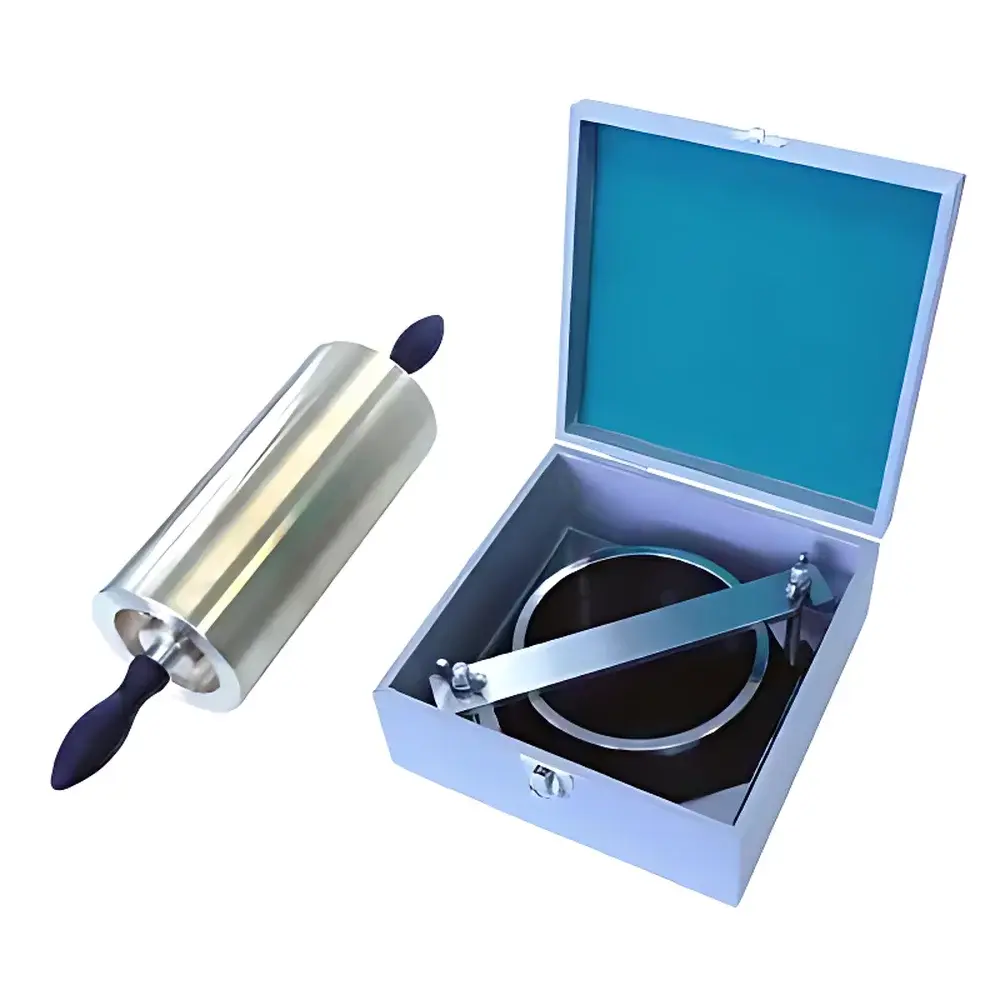
Yasuda No.352 Gurley-Type Water Absorptiveness Tester (Cobb Method)
| Brand | Yasuda |
|---|---|
| Origin | Japan |
| Model | No.352 |
| Compliance Standards | JIS P8140, TAPPI T441, ISO 535 |
| Test Principle | Gravimetric Cobb Method (120-s immersion) |
| Sample Format | Flat sheet specimens (typically 125 mm × 125 mm) |
| Measurement Unit | g/m² |
| Applicable Materials | Non-absorbent to low-absorbent papers and paperboards |
Overview
The Yasuda No.352 Gurley-Type Water Absorptiveness Tester is a precision-engineered gravimetric instrument designed for quantitative evaluation of surface water absorption behavior in papers and paperboards using the standardized Cobb method. It operates on the fundamental principle of controlled immersion: a conditioned specimen is clamped horizontally with one surface exposed to distilled water for a defined duration—typically 120 seconds per ISO 535 and JIS P8140—after which the unabsorbed water is carefully removed via blotting under standardized pressure and time, and the specimen is reweighed. The mass gain per unit area (g/m²) constitutes the Cobb value, a critical parameter for assessing surface sizing efficiency, coating integrity, and barrier performance in packaging, printing, and industrial paper grades. Unlike capillary or penetration-based methods, the Cobb test isolates short-term surface wetting response under static hydrostatic contact, making it particularly relevant for applications where initial liquid contact resistance governs functional performance—such as food wrap substrates, label facestocks, and pharmaceutical carton boards.
Key Features
- Robust Gurley-style mechanical design with precision-machined brass test chamber and calibrated clamping mechanism ensuring consistent specimen sealing and immersion geometry.
- Dual-scale digital balance integration (optional or external, per lab configuration) compliant with ISO 535 Annex A requirements for mass resolution ≤ 0.01 g and repeatability ≤ 0.02 g.
- Standardized 125 mm × 125 mm test area aperture, aligned with TAPPI T441 and JIS P8140 specimen dimension specifications.
- Temperature-controlled water reservoir support (ambient or 23 ± 1 °C operation) to maintain thermal stability during immersion—critical for minimizing evaporative loss and interfacial tension variability.
- Interchangeable specimen holders accommodate both single- and double-sided testing configurations, enabling comparative analysis of coated vs. uncoated surfaces.
- Corrosion-resistant stainless-steel and anodized aluminum construction ensures long-term dimensional stability and compliance with GLP laboratory environment requirements.
Sample Compatibility & Compliance
The No.352 tester is validated for use with flat, rigid-to-semirigid paper and paperboard specimens ranging from 60 g/m² to 600 g/m² basis weight. It accommodates grammage-dependent thicknesses up to 1.2 mm without compromising seal integrity. Specimen conditioning follows ISO 187 (23 ± 1 °C, 50 ± 2 % RH, ≥24 h equilibration) prior to testing. The instrument satisfies all mechanical and procedural requirements stipulated in ISO 535:2019, JIS P8140:2018, and TAPPI T441 om-18. Data generated are admissible in regulatory submissions requiring ASTM D570–17 (moisture absorption) correlative validation and support GMP-aligned quality control protocols for packaging materials subject to FDA 21 CFR Part 11-compliant documentation systems.
Software & Data Management
While the No.352 is a manually operated benchtop instrument, its measurement workflow is fully compatible with LIMS and ELN platforms via standardized CSV export from connected analytical balances. Optional RS-232 or USB interface modules enable automated timestamped data capture, including ambient temperature/humidity logs, operator ID, and test duration metadata. All raw mass values adhere to ISO/IEC 17025 traceability chains when paired with accredited calibration certificates for integrated weighing systems. Audit trails—including manual entry corrections, retests, and outlier flagging—are preserved in accordance with GLP Annex 11 and FDA 21 CFR Part 11 electronic record retention guidelines.
Applications
- Quality assurance of surface-sized kraft papers used in moisture-resistant shipping sacks.
- Evaluation of aqueous barrier coatings (e.g., starch-PVA blends, acrylic dispersions) on folding boxboard for foodservice packaging.
- Process validation of size press parameters in paper machine off-line trials.
- Comparative benchmarking of recycled fiber content impact on surface hydrophobicity in corrugating medium.
- Supporting ISO 12625-6 permeability correlation studies for tissue and towel products.
- Raw material release testing for pharmaceutical secondary packaging boards per USP .
FAQ
What is the recommended water temperature for Cobb testing per ISO 535?
ISO 535 specifies 20 ± 1 °C; however, laboratories operating under JIS P8140 may use 23 ± 1 °C—both are supported by the No.352’s thermal stability design.
Can the No.352 be used for testing corrugated board?
Yes, provided the specimen is cut flat and the flutes are compressed uniformly during clamping to ensure full surface contact—per TAPPI T441 Section 6.3.
Is calibration certification included with the instrument?
The No.352 is supplied with a factory mechanical verification report; NIST-traceable balance calibration and annual chamber seal integrity checks are user-responsibility per ISO/IEC 17025 Clause 6.4.
How does the Cobb value relate to Cobb60 and Cobb120?
Cobb120 (standard) reflects 120-second immersion; Cobb60 is an accelerated variant. The No.352 supports both durations via timer synchronization—values are not linearly interchangeable and must be reported with explicit time annotation.
Does this instrument meet FDA requirements for pharmaceutical packaging testing?
Yes—the mechanical design, measurement traceability pathway, and compatibility with Part 11-compliant data systems fulfill predicate requirements for USP and ICH Q5C stability protocol execution.



