
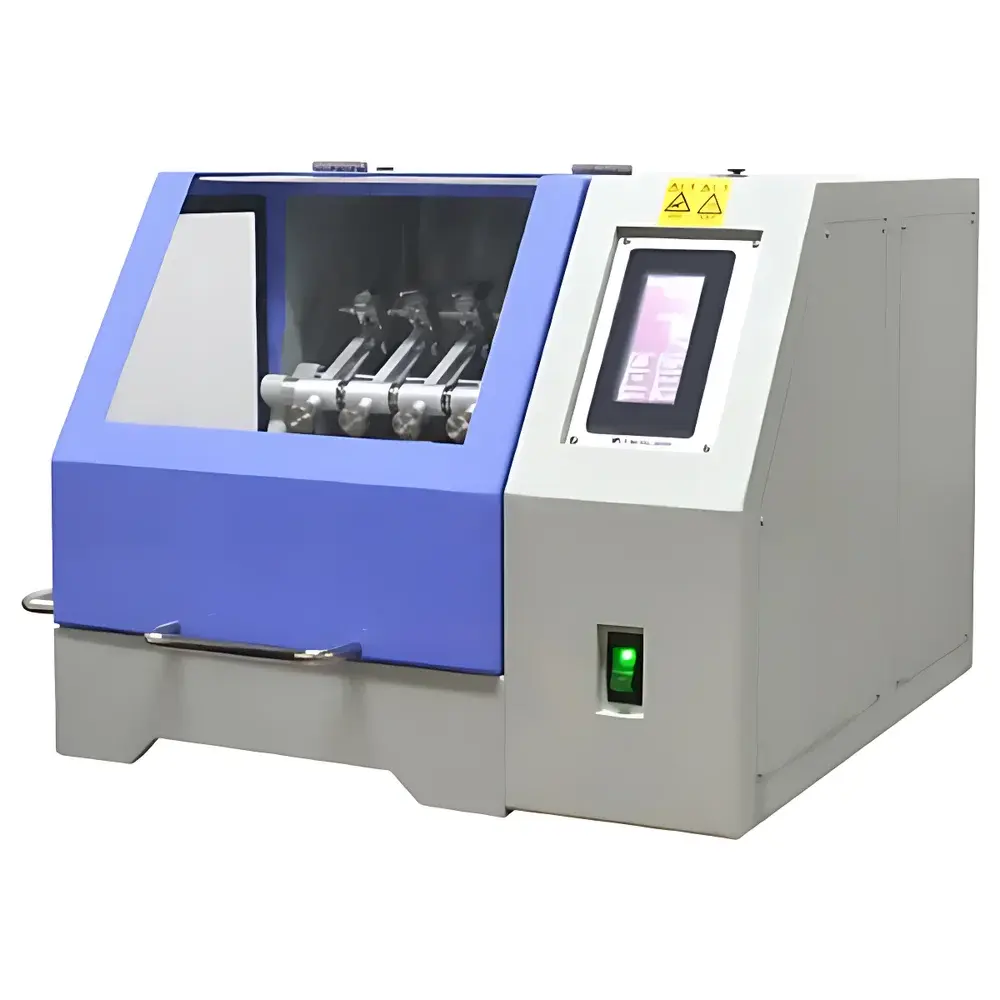
Yasuda No.428 Color Fastness Rubbing Tester
| Brand | Yasuda |
|---|---|
| Origin | Japan |
| Model | No.428 |
| Standards Compliance | JIS K5701-1, K6404-16, K6547, K6772, L0849, L0862, L1084, P8136, ISO 105-X12 (JASO) |
| Specimen Dimensions | 220 × 30 mm |
| White Cotton Cloth | 50 × 50 mm |
| Initial Load | 1.96 N (6 optional weights provided) |
| Friction Element Radius | R45 mm, 20 × 20 mm contact area |
| Test Table Radius | R200 mm, semi-cylindrical (flat table optional) |
| Stroke Length | 120 mm (100 mm for flat table option) |
| Stroke Rate | 30 double strokes/min |
| Counter | 9-digit presettable digital counter |
| Optional Weights | 4.9 N and 9.8 N (6 total) |
| Power Supply | AC 100 V, 1-phase, 10 A, 50/60 Hz |
| Dimensions (W×D×H) | approx. 600 × 700 × 450 mm |
| Weight | approx. 70 kg |
Overview
The Yasuda No.428 Color Fastness Rubbing Tester is a precision-engineered instrument designed to evaluate the dry and wet color transfer resistance of textiles, leather, rubber, synthetic fabrics, coated papers, inks, and other surface-treated materials under standardized mechanical abrasion. It operates on the principle of reciprocating linear friction between a conditioned test specimen and a standardized white cotton cloth—per ASTM D4848, ISO 105-X12, and multiple JIS standards including K5701-1, K6404-16, and K6547. The device replicates real-world wear conditions by applying controlled normal force via calibrated weights, maintaining consistent stroke amplitude and frequency while ensuring repeatable contact geometry between the specimen and friction element. Its semi-cylindrical test table (R200 mm radius) accommodates curved surfaces typical of footwear uppers, automotive interiors, or upholstery, with an optional flat-table configuration for planar substrates such as printed cardboard or laminated films.
Key Features
- Robust cast-iron frame with vibration-damped base ensures mechanical stability during high-cycle testing and minimizes measurement drift.
- Semi-cylindrical specimen holder (R200 mm) enables evaluation of three-dimensional samples without distortion; flat-table variant available for ISO-compliant flat-specimen protocols.
- Precisely machined friction head with R45 mm convex surface and defined 20 × 20 mm contact zone guarantees uniform pressure distribution across the white cotton cloth (50 × 50 mm).
- Digital 9-digit presettable counter allows accurate termination at user-defined stroke counts (e.g., 10, 50, or 100 double strokes), supporting both pass/fail and graded evaluation workflows.
- Modular weight system: includes one 1.96 N (200 g) base load plus six additional calibrated masses enabling application of 4.9 N (500 g) and 9.8 N (1 kg) loads per JIS L1084 and ISO 105-X12 requirements.
- Stable 30 double-stroke/min drive mechanism with synchronous cam-and-follower actuation ensures constant velocity profile and eliminates acceleration artifacts during color transfer assessment.
Sample Compatibility & Compliance
The No.428 accommodates specimens measuring 220 × 30 mm, suitable for woven/knitted fabrics, nonwovens, coated leathers, PVC and PU laminates, inkjet-printed media, and corrugated board surfaces. It supports both dry-rub and wet-rub testing when used with standardized moisture-conditioned cotton cloths. All operational parameters—including stroke length (120 mm standard / 100 mm flat-table), load application method, and cloth specification—align with JIS K6772 (for automotive interior materials), JIS L0862 (for textile dye fastness), and ISO 105-X12 (rubbing fastness to dry/wet crocking). The instrument is routinely validated in GLP-regulated textile QA labs and meets traceability requirements under ISO/IEC 17025 for accredited color fastness testing.
Software & Data Management
While the No.428 operates as a standalone electromechanical tester without embedded firmware or PC connectivity, its design fully supports integration into laboratory quality management systems. Test parameters—including load selection, stroke count, and operator ID—are manually logged in accordance with ISO 17025 documentation requirements. Digital counter output can be recorded directly into LIMS or Excel-based tracking templates. For regulated environments (e.g., automotive Tier-1 suppliers compliant with IATF 16949), audit trails may be maintained using external timestamped logbooks or validated electronic notebooks satisfying FDA 21 CFR Part 11 principles where electronic records are employed.
Applications
- Evaluation of crocking resistance in dyed and printed apparel fabrics per ISO 105-X12 and AATCC 8.
- Assessment of pigment rub-off from coated leather used in handbags and automotive seating.
- Verification of ink adhesion durability on flexible packaging films and label stocks (JIS P8136).
- Quality control of colored rubber compounds in gasket and seal manufacturing (JIS K6547).
- Pre-shipment validation of color stability for technical textiles exposed to repeated handling (e.g., safety vests, workwear).
- Research-grade comparative studies of binder systems in aqueous pigment dispersions for textile printing.
FAQ
What standards does the Yasuda No.428 comply with?
It conforms to JIS K5701-1, K6404-16, K6547, K6772, L0849, L0862, L1084, P8136, and ISO 105-X12 (JASO), covering textile, leather, paper, and automotive material testing.
Can the tester accommodate curved or irregularly shaped specimens?
Yes—the standard semi-cylindrical test table (R200 mm) is specifically engineered to hold contoured samples such as shoe uppers or molded interior trim without slippage or edge lift.
Is wet-rub testing supported?
Yes, when paired with moisture-conditioned white cotton cloth per ISO 105-X12 Section 7.2 and JIS L0862 Annex B, using standardized water immersion and blotting procedures.
How is load calibration verified?
Each supplied weight is traceably calibrated to JCSS (Japanese Calibration Service System) standards; laboratories are advised to perform periodic verification using Class M1 reference masses per ISO 9001 clause 7.1.5.
Does the device support automated data export?
No—the No.428 is a dedicated mechanical tester without USB, RS-232, or Ethernet interfaces; however, its digital counter output is compatible with manual entry into validated LIMS or QMS platforms.





