
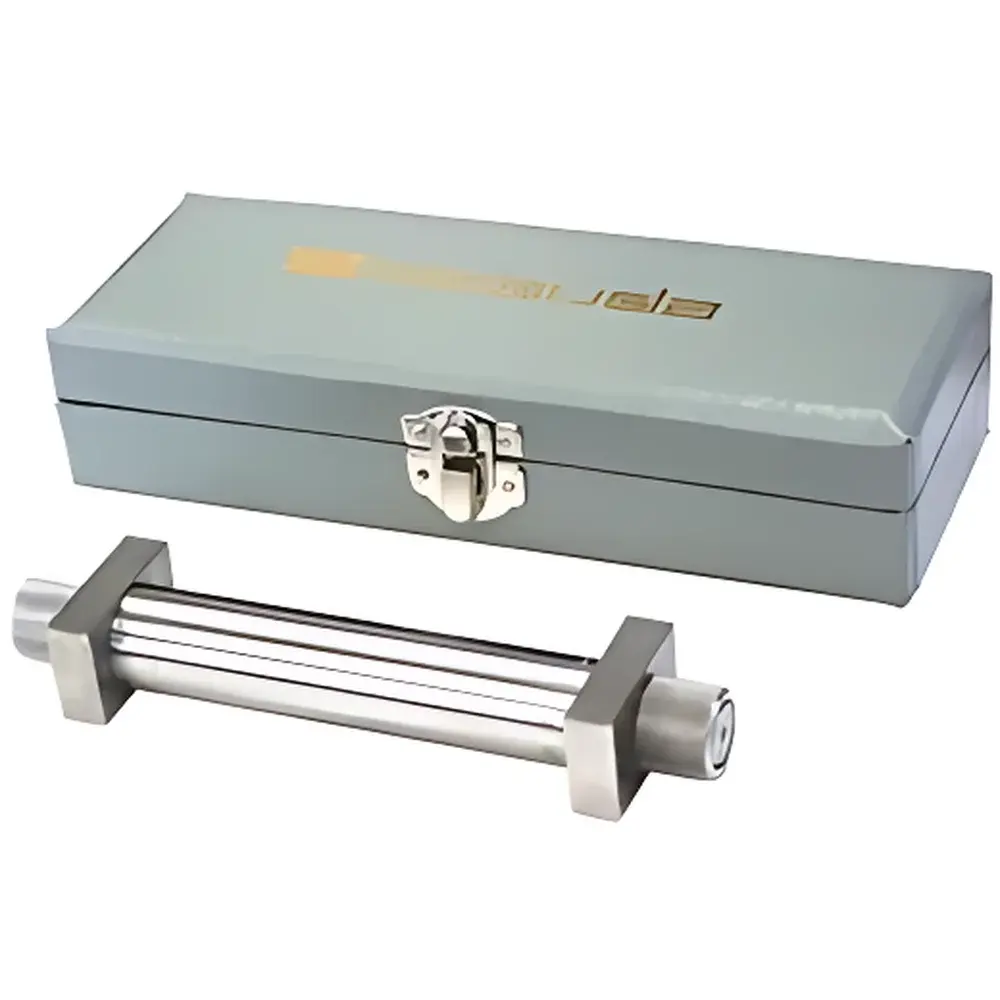
Yasuda No.510 BAKER-Type Film Applicator
| Brand | Yasuda |
|---|---|
| Origin | Japan |
| Model | No.510 |
| Compliance | JIS K 5101, JIS K 5400 |
| Application Principle | Eccentric gap control mechanism |
Overview
The Yasuda No.510 BAKER-Type Film Applicator is a precision manual film applicator engineered for reproducible, uniform wet-film deposition of liquid coatings—including paints, varnishes, inks, and pigment dispersions—onto flat, rigid substrates. It operates on the well-established BAKER principle: a fixed-angle, eccentrically mounted stainless-steel bar rolls across the substrate surface, maintaining a consistent gap between the bar’s lower edge and the substrate. This gap—determined by mechanical alignment of dual engraved depth scales—is directly proportional to the resulting wet-film thickness. Unlike wire-wound or drawdown bars with fixed notches, the No.510 enables continuous, stepless adjustment from approximately 10 µm to 250 µm (wet), making it suitable for method development, QC screening, and comparative coating performance evaluation under standardized laboratory conditions.
Key Features
- True BAKER geometry with hardened stainless-steel applicator bar, precision-ground to ±1 µm surface tolerance and corrosion-resistant for long-term dimensional stability.
- Dual independent vernier-style depth scales on both ends—calibrated in micrometers—allow simultaneous visual verification and precise alignment to achieve target wet-film thickness without external gauges.
- Eccentric mounting system ensures constant pressure distribution and minimal lateral shear during drawdown, reducing streaking, orange peel, or edge buildup.
- Compact, ergonomic aluminum alloy frame with non-slip rubber feet; designed for benchtop use with standard glass, metal, or plastic test panels (up to 200 mm × 300 mm).
- No consumables or calibration certificates required—mechanical accuracy is maintained through factory-set tolerances traceable to JIS-compliant metrology procedures.
Sample Compatibility & Compliance
The No.510 is validated for use with Newtonian and mildly shear-thinning liquids (viscosity range: ~10–500 mPa·s at application shear rates). It supports standard test substrates per JIS K 5101 (general testing methods for paints) and JIS K 5400 (testing methods for rust-preventive oils and related protective coatings). While not an automated instrument, its design aligns with GLP-aligned lab practices: thickness settings are manually recorded, and film uniformity can be verified post-drying using ISO 2808-compliant micrometer or optical profilometry. The device itself carries no electrical components, eliminating EMI concerns and enabling safe use in solvent-rich fume hoods or inert-atmosphere gloveboxes.
Software & Data Management
As a purely mechanical, hand-operated tool, the Yasuda No.510 requires no firmware, drivers, or software integration. Thickness selection and application are operator-controlled via physical scale alignment—ensuring full auditability and elimination of digital drift or version dependency. For laboratories operating under FDA 21 CFR Part 11 or ISO/IEC 17025 requirements, documented use includes recording the aligned scale value (e.g., “125 µm”), substrate ID, ambient temperature/humidity, and operator initials in a controlled logbook or LIMS-linked worksheet. No electronic data capture or electronic signature functionality is embedded—or necessary—for compliance.
Applications
- Routine QC of batch-to-batch film thickness consistency in paint formulation labs.
- Correlation studies between wet-film thickness and final dry-film properties (e.g., gloss, adhesion, hardness) per ASTM D1210 or ISO 2808.
- Accelerated weathering and corrosion resistance testing where controlled initial film mass is critical (e.g., salt spray per ASTM B117).
- Development of low-VOC waterborne systems, where precise wet-film control minimizes sagging and improves drying uniformity.
- Academic research on coating rheology–film formation relationships, particularly for latex-based and high-solid formulations.
FAQ
What is the minimum and maximum achievable wet-film thickness with the No.510?
The practical adjustable range is 10–250 µm (wet), depending on fluid rheology and substrate wettability. Viscosity >500 mPa·s may cause incomplete coverage; viscosity <10 mPa·s may lead to excessive leveling or runoff.
Is calibration required before each use?
No. The device is factory-calibrated and mechanically stable. Users should verify scale alignment visually before each session and clean the bar with appropriate solvent after use to prevent residue-induced thickness deviation.
Can it be used with curved or flexible substrates?
No. The No.510 is strictly intended for rigid, planar surfaces. Curved or deformable substrates compromise gap consistency and invalidate thickness claims.
Does Yasuda provide NIST-traceable certification?
Not as standard. However, third-party metrology labs can perform dimensional verification of the bar profile and scale graduation upon request—typically for GMP-regulated environments requiring documented traceability.
How does the No.510 differ from a wire-wound applicator (e.g., Mayer rod)?
Unlike fixed-diameter wire rods, the BAKER-type design provides continuous thickness adjustability without changing hardware, eliminates wire groove contamination risks, and delivers superior edge definition for high-resolution coating evaluation.






