
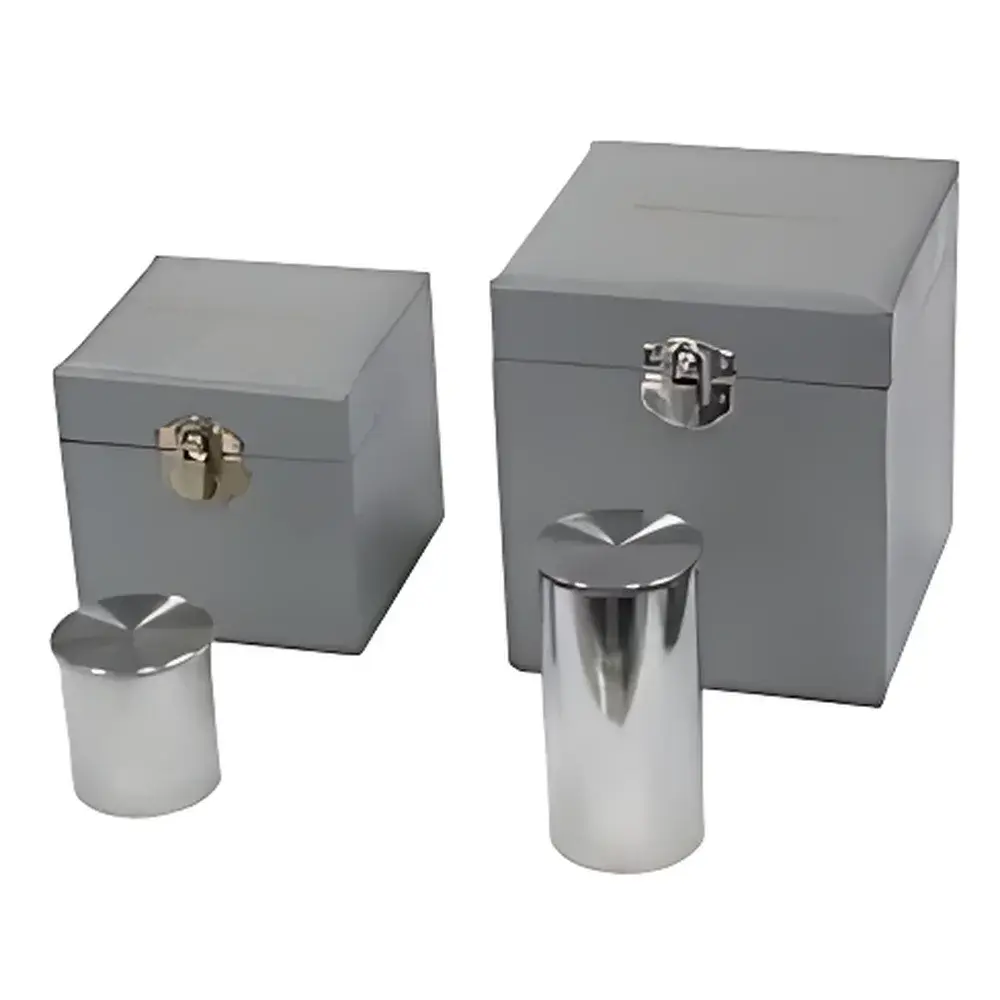
Yasuda No.536 Density Cup
| Brand | Yasuda |
|---|---|
| Origin | Japan |
| Model | No.536 |
| Standards Compliance | JIS K5400, JIS K5600-2-4, JIS K6833, ISO 2811 |
| Unit | g/mL |
| Material | Precision-machined stainless steel |
Overview
The Yasuda No.536 Density Cup is a precision-manufactured, gravity-based pycnometer designed for the accurate determination of density (specific gravity) of low-viscosity liquid materials—primarily coatings, inks, adhesives, resins, and thin polymer solutions—under controlled laboratory conditions. Operating on the fundamental principle of mass-to-volume ratio measurement, the device employs a fixed-volume stainless steel cup whose internal cavity is precisely calibrated to hold exactly 100 mL (±0.05 mL) of sample at standard reference temperature (typically 23 °C ± 0.5 °C). Density is calculated as the quotient of the net sample mass (measured via analytical balance with ≥0.001 g resolution) divided by the certified cup volume, yielding results in g/mL—a unit directly equivalent to kg/L and numerically identical to specific gravity relative to water at 4 °C. This method conforms strictly to gravimetric pycnometry principles defined in international standards including ISO 2811 and multiple JIS specifications (K5400, K5600-2-4, K6833), ensuring metrological consistency across global R&D, QC, and regulatory testing environments.
Key Features
- Precision-machined AISI 304 stainless steel construction for long-term dimensional stability, corrosion resistance, and thermal inertia minimization
- Fixed-volume cavity calibrated and certified per ISO/IEC 17025-accredited procedures; certificate includes uncertainty budget and traceability to NMIJ reference standards
- Integrated ground-glass stopper with silicone O-ring seal to prevent evaporation and ensure volumetric repeatability during weighing
- Beveled rim and ergonomic handle design facilitate clean filling, bubble-free meniscus alignment, and safe handling under solvent-exposed conditions
- Compatible with Class I analytical balances (0.1–1 mg readability) and temperature-stabilized weighing chambers (23 °C ± 0.5 °C)
- No moving parts, electronics, or consumables—ensuring zero drift, minimal maintenance, and operational longevity exceeding 15 years with proper cleaning protocols
Sample Compatibility & Compliance
The No.536 Density Cup is validated for use with Newtonian and near-Newtonian liquids having kinematic viscosity below 500 mm²/s (cSt) at 23 °C. It is routinely employed in paint formulation labs, ink manufacturing QA, adhesive development, and surface treatment process validation. Samples must be free of suspended solids, entrained air, or volatile components prone to rapid evaporation during the 60–90 second weighing window. The instrument meets all physical and procedural requirements stipulated in JIS K5400 (general test methods for paints), JIS K5600-2-4 (density of paints and varnishes), JIS K6833 (adhesives density testing), and ISO 2811-1 (paints and varnishes — determination of density — Part 1: Immersed body (pycnometer) method). Its mechanical design supports GLP-compliant documentation workflows when paired with balance-integrated LIMS or electronic lab notebooks.
Software & Data Management
As a purely mechanical, non-electronic instrument, the No.536 Density Cup requires no firmware, drivers, or proprietary software. Density calculation is performed externally using validated spreadsheet templates or LIMS modules configured with embedded uncertainty propagation formulas per GUM (Guide to the Expression of Uncertainty in Measurement). When integrated into automated QC systems, the cup’s consistent geometry and mass allow for seamless calibration curve generation and statistical process control (SPC) charting of density trends over time. All calibration certificates include digital signatures and are issued with audit-ready metadata (date, technician ID, environmental conditions, balance model and calibration status), satisfying FDA 21 CFR Part 11 requirements for electronic records when stored within compliant document management platforms.
Applications
- Batch release testing of architectural and industrial coatings per ASTM D1475 and ISO 2811
- Density verification of UV-curable inks prior to press qualification
- Raw material acceptance testing for resin suppliers under IATF 16949 quality system requirements
- Formulation consistency monitoring during scale-up from lab to pilot plant
- Supporting density inputs for rheological modeling (e.g., shear-thinning index correction) and VOC content calculations per EPA Method 24
- Reference measurements in inter-laboratory proficiency testing schemes accredited to ISO/IEC 17043
FAQ
What is the certified volume tolerance of the No.536 cup?
The nominal volume is 100.00 mL, with a maximum permissible error of ±0.05 mL as verified during initial certification and re-verification every 24 months.
Can it be used for high-viscosity pastes or thixotropic gels?
No—this cup is unsuitable for non-Newtonian fluids exhibiting yield stress or significant time-dependent flow behavior; alternative methods such as gas pycnometry (ASTM D5550) or oscillating U-tube densitometry (ASTM D4052) are recommended.
Is temperature compensation required during measurement?
Yes—density is temperature-sensitive; all measurements must be conducted at 23 °C ± 0.5 °C, and reported values should reference this condition unless corrected using published thermal expansion coefficients for the specific material.
How often does the cup require recalibration?
Recertification is recommended biannually or after any impact event, cleaning with abrasive agents, or exposure to strong acids/bases that may affect surface integrity.
Does Yasuda provide NIST-traceable calibration documentation?
Calibration is traceable to NMIJ (Japan’s national metrology institute); NIST-traceable equivalents are available through third-party ISO/IEC 17025 laboratories upon request.



