
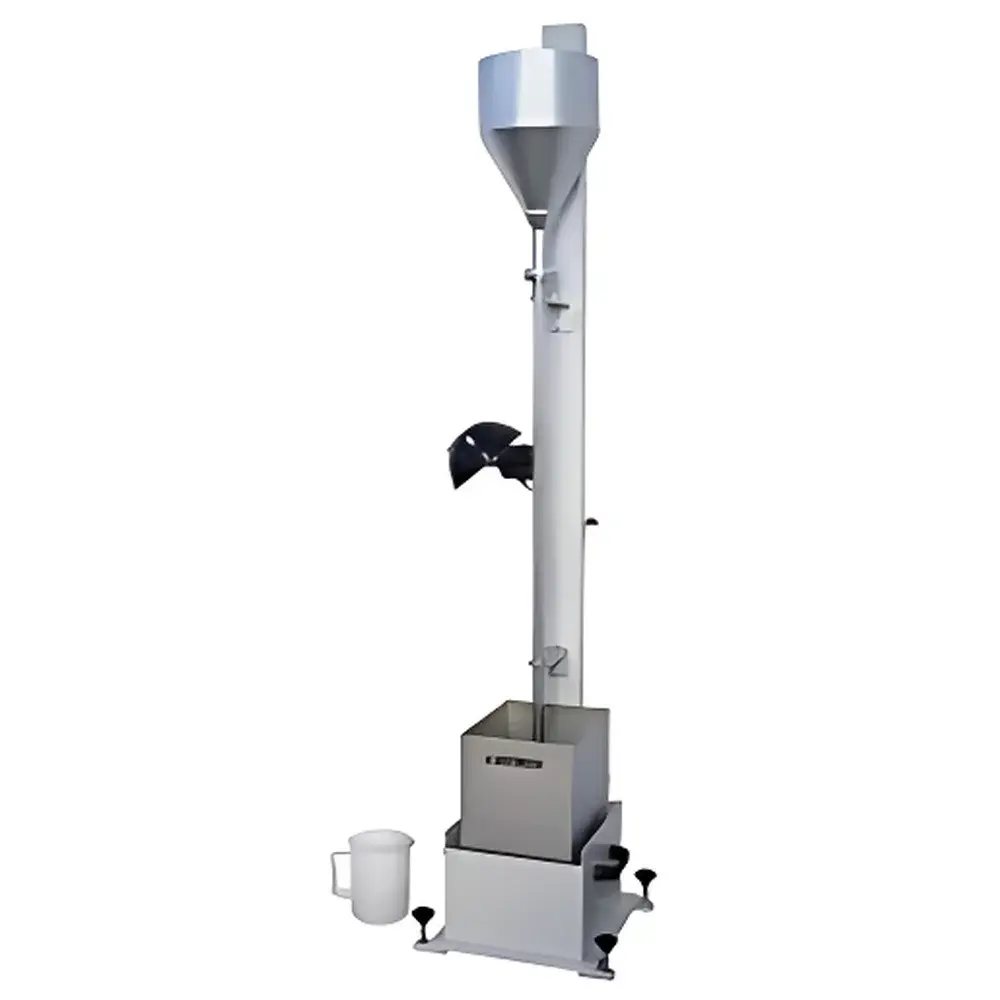
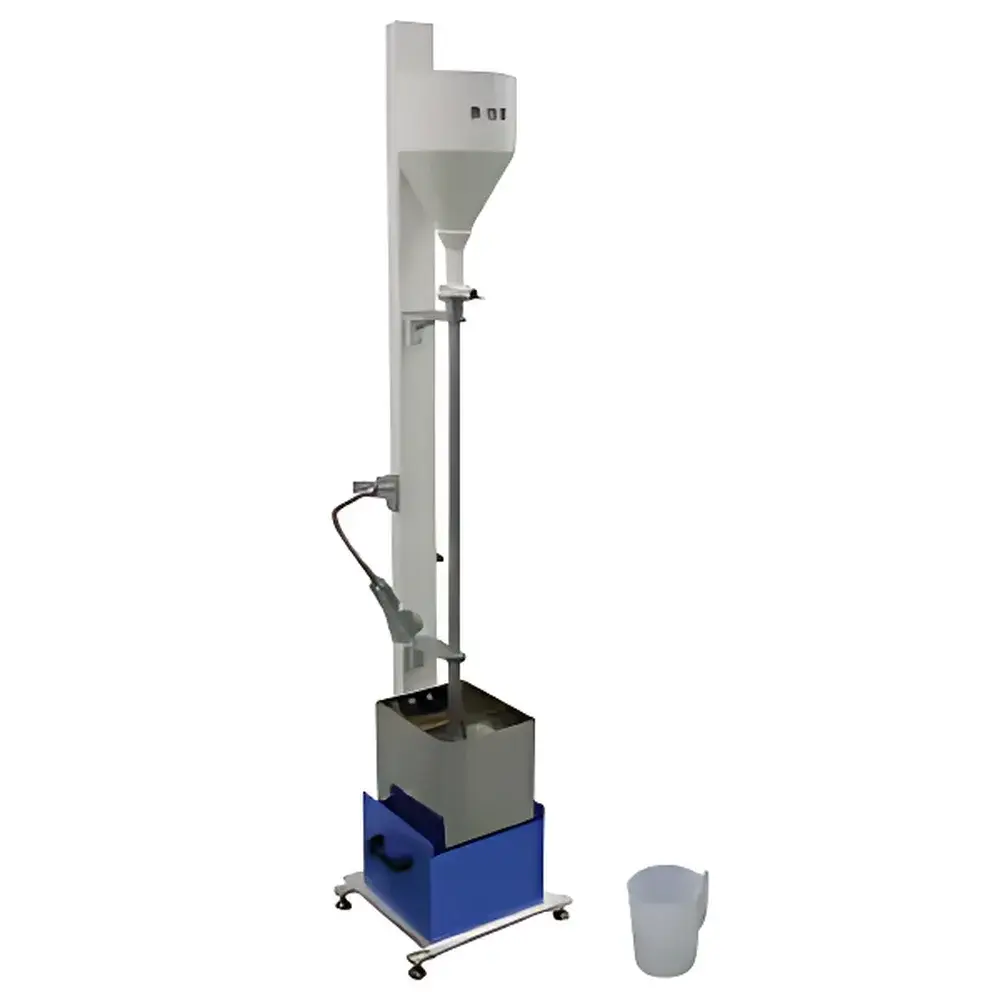
Yasuda No.541 Gardner-Type Falling Sand Abrasion Tester
| Brand | Yasuda |
|---|---|
| Origin | Japan |
| Model | No.541 |
| Applicable Standards | JIS A 1452, JIS A 5423, JIS K 5400 (H8503), JIS K 6791 (H8682-3), ASTM D968 |
| Test Principle | Gravitational sand-flow abrasion under fixed angle and height |
| Sample Mounting Angle | 45° |
| Sand Delivery | Free-fall from calibrated hopper |
| Endpoint Detection | Visual exposure of substrate through coating |
| Measurement Output | Time to failure (s) and cumulative sand mass (g) |
Overview
The Yasuda No.541 Gardner-Type Falling Sand Abrasion Tester is a precision-engineered instrument designed for quantitative evaluation of coating durability against abrasive wear under controlled gravitational sand-flow conditions. Based on the classical Gardner falling-sand methodology, it operates by directing a standardized abrasive medium—typically Ottawa F-11 silica sand—onto an inclined test specimen at a fixed 45° angle relative to the horizontal plane. The sand is released from a calibrated hopper positioned at a defined vertical drop height (standardized per ASTM D968 and JIS K 5400), ensuring reproducible kinetic energy delivery per unit mass. As sand impacts the coated surface, progressive erosion occurs; the endpoint is objectively determined when the underlying substrate becomes visually exposed through the coating film. The primary performance metrics recorded are the time required to reach this failure threshold and the total mass of sand consumed, both of which correlate directly with coating hardness, adhesion integrity, and crosslink density. This method is widely accepted for quality control in industrial coating formulation, automotive OEM finishing lines, architectural paint validation, and electroplated component certification.
Key Features
- Robust cast-aluminum frame with vibration-dampening base for stable sand trajectory and minimal environmental interference
- Precision-machined sample holder accommodating flat panels up to 150 mm × 150 mm, adjustable to exact 45° ± 0.5° inclination
- Stainless-steel sand reservoir with gravity-fed discharge nozzle and integrated flow regulator for consistent sand mass flow rate
- Calibrated digital timer (0.01 s resolution) synchronized with sand release initiation for high repeatability
- Dual-scale sand collection system: primary funnel directs sand into a tared weighing pan (0.01 g readability), while secondary containment prevents scatter loss
- Compliance-ready design supporting traceable calibration logs and operator ID tagging in routine use
Sample Compatibility & Compliance
The No.541 accommodates rigid, flat substrates including cold-rolled steel, aluminum alloy, glass, and plastic panels with coatings applied via spray, dip, electrodeposition, or physical vapor deposition. Specimen thickness must be ≥0.5 mm to ensure mechanical stability during testing. Surface curvature is not supported; only planar geometries conform to JIS and ASTM protocols. The instrument satisfies metrological requirements for ISO/IEC 17025-accredited laboratories when operated with certified reference sands (e.g., ASTM C778 Grade F-11) and traceably calibrated mass/timing instrumentation. It supports documentation workflows aligned with GLP and GMP environments, including manual entry of lot numbers, environmental conditions (temperature/humidity), and observer signatures per test run.
Software & Data Management
While the No.541 is a manually operated mechanical tester with analog/digital hybrid controls (no embedded microprocessor), it integrates seamlessly into modern QA/QC data ecosystems. Test parameters—including sample ID, coating type, cure conditions, ambient temperature, relative humidity, sand batch number, and operator name—are recorded in standardized Excel-based templates compliant with ASTM E1488 guidelines for raw data documentation. Optional third-party digital scales with RS-232 or USB output can auto-log sand mass values into LIMS platforms. All timing and mass data meet FDA 21 CFR Part 11 audit-trail readiness when captured using validated electronic notebooks with user authentication and version-controlled templates.
Applications
- Comparative ranking of automotive clearcoats for UV-stabilized acrylic-polyurethane systems
- Validation of zinc-nickel electroplated layers on fasteners per ASTM B633 Class SC3
- Quality gate testing for coil-coated aluminum used in façade cladding (JIS H 4080)
- R&D screening of nano-reinforced epoxy primers for marine immersion service
- Supplier qualification audits requiring JIS K 5600-5-3 (equivalent to ISO 4628-3) abrasion resistance verification
- Failure analysis of powder-coated bus chassis components subjected to road-debris impact simulation
FAQ
What sand specifications are required for ASTM D968 compliance?
Ottawa F-11 silica sand meeting ASTM C778 grading requirements (particle size distribution: 95–100% retained on 100 µm sieve, ≤5% passing 150 µm sieve) must be used. Sand shall be dried at 105 °C ± 2 °C for 2 hours prior to testing.
Is the 45° sample angle adjustable?
No—the angle is fixed at 45° ± 0.5° per JIS K 5400 and ASTM D968. Deviation invalidates conformance to these standards.
Can the tester evaluate curved parts?
No. Only flat, rigid specimens are supported. Curved or flexible substrates violate standard geometry assumptions and invalidate comparative results.
How often must the sand flow rate be verified?
Per ASTM D968 Section 7.2, flow calibration shall be performed before each test series and after any hopper cleaning or mechanical adjustment, using a minimum of three 30-second trials with mean deviation ≤3%.
Does Yasuda provide calibration certificates?
Yasuda supplies factory-verified mechanical alignment reports for the sample stage and hopper geometry. Traceable calibration of ancillary equipment (timer, scale) remains the responsibility of the end-user laboratory per ISO/IEC 17025 Clause 6.5.



