
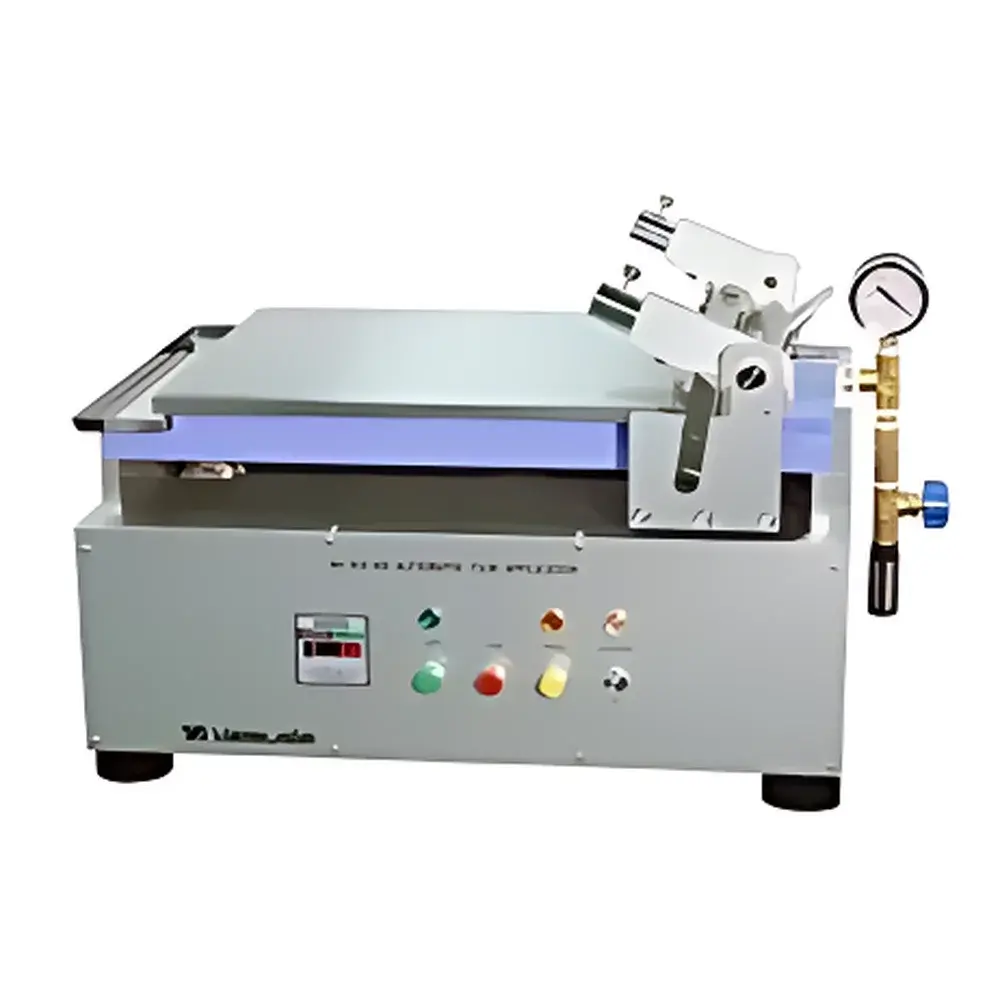
Yasuda No.542-AB Automatic Film Applicator
| Brand | Yasuda |
|---|---|
| Origin | Japan |
| Model | No.542-AB |
| Compliance Standards | JIS K 5101, JIS K 5400, ASTM D823 |
| Operation Principle | Vacuum-assisted, motor-driven drawdown with precision gap control |
| Substrate Fixation | Vacuum suction through perforated platen |
| Coating Method | Fixed-gap bar coating (compatible with wire-wound rods and adjustable applicator bars) |
| Drive System | Stepper motor with constant linear speed control |
Overview
The Yasuda No.542-AB Automatic Film Applicator is an engineered laboratory instrument designed for the reproducible preparation of uniform thin films from liquid coatings—including paints, inks, pigments, and polymer dispersions—on rigid or flexible substrates. It operates on the principle of controlled drawdown: a precisely machined applicator bar (e.g., wire-wound rod or fixed-gap blade) is drawn across a substrate at a constant linear velocity while the sample is metered onto the surface. Simultaneous vacuum fixation via a perforated stainless-steel platen ensures substrate flatness and prevents slippage or wrinkling during coating—critical for achieving high inter-run repeatability and minimizing edge effects. Unlike manual applicators, the No.542-AB eliminates operator-induced variability in speed, pressure, and dwell time, thereby satisfying the stringent requirements of standardized film preparation protocols.
Key Features
- Vacuum-assisted substrate immobilization: Perforated platen with regulated negative pressure (adjustable up to −60 kPa) secures papers (e.g., coated art paper), plastic films (PET, PP), aluminum foil, and glass slides without clamps or adhesives.
- Motor-driven linear translation: Stepper-motor actuation ensures consistent drawdown speed (range: 5–100 mm/s, factory-calibrated and repeatable within ±0.5% of setpoint) across the full 200 mm travel path.
- Modular applicator interface: Accepts industry-standard wire-wound rods (e.g., Mayer rods, ISO 2801 series) and precision-ground fixed-gap bars (gap range: 12–250 µm); quick-release mechanism enables tool-free swapping.
- Robust mechanical architecture: Anodized aluminum frame with hardened steel guide rails and anti-backlash timing belt drive—designed for long-term dimensional stability and minimal maintenance.
- Compliance-ready operation: Fully compatible with test methods requiring defined film thickness and drying geometry per JIS K 5101 (paints), JIS K 5400 (printing inks), and ASTM D823 (standard practice for producing films of uniform thickness).
Sample Compatibility & Compliance
The No.542-AB supports a broad spectrum of coating formulations—from low-viscosity aqueous inks (5,000 mPa·s)—provided viscosity permits clean bar roll-off and meniscus continuity. Substrates must be dimensionally stable under vacuum and possess sufficient surface energy for wetting; typical validated materials include ISO standard test papers (e.g., TAPPI T 494), polyester films (≥25 µm thickness), and silanized glass. All operational parameters—including speed, bar type, and vacuum level—are documented in the instrument log for GLP-compliant traceability. The system does not require software validation but supports manual entry into LIMS or QC documentation systems aligned with ISO/IEC 17025 or FDA 21 CFR Part 11 workflows when paired with auditable lab notebooks.
Software & Data Management
The No.542-AB is a standalone electromechanical device with no embedded microprocessor or digital interface. Speed selection is performed via front-panel rotary encoder with LED confirmation; vacuum level is adjusted manually using a calibrated needle valve. No firmware, cloud connectivity, or proprietary drivers are involved. This analog-digital hybrid design prioritizes reliability, electromagnetic compatibility (EMC Class B), and service longevity over automation complexity. Users maintain full control over experimental variables without dependency on vendor-specific software—enabling seamless integration into regulated environments where software validation burdens must be minimized. Calibration certificates for speed and vacuum gauges are provided upon request and conform to JIS Z 8401 guidelines.
Applications
- Preparation of ASTM D2370-compliant test panels for tensile adhesion and flexibility evaluation.
- Generation of uniform films for gloss measurement (ASTM D523), pencil hardness (ASTM D3363), and cross-hatch adhesion (ASTM D3359).
- Controlled deposition of functional coatings in R&D labs developing anti-fog, anti-static, or barrier layers for flexible electronics.
- Reproducible ink film formation for printability assessment in packaging and graphic arts laboratories.
- Baseline film fabrication prior to accelerated weathering (ISO 4892) or corrosion testing (ASTM B117) to isolate substrate-coating interaction variables.
FAQ
What types of applicator bars are compatible with the No.542-AB?
Standard wire-wound rods (e.g., RD series, ISO 2801), precision-ground notched bars, and custom-machined fixed-gap blades with M4 mounting threads and ≤200 mm width.
Can the instrument accommodate non-planar or curved substrates?
No—the vacuum platen requires flat, air-tight contact; only planar, rigid, or semi-rigid sheet materials are supported.
Is speed calibration traceable to national standards?
Yes—factory calibration uses laser tachometry referenced to JCSS-accredited metrology; NIST-traceable recalibration services are available through authorized Yasuda service centers.
Does the system meet CE or UKCA marking requirements?
Yes—the unit complies with EU Machinery Directive 2006/42/EC and EMC Directive 2014/30/EU; Declaration of Conformity is supplied with each shipment.
What maintenance is required for long-term performance?
Monthly cleaning of vacuum ports and platen surface with lint-free cloth and isopropyl alcohol; annual inspection of timing belt tension and rod guide alignment by qualified technician.
Related Products





