
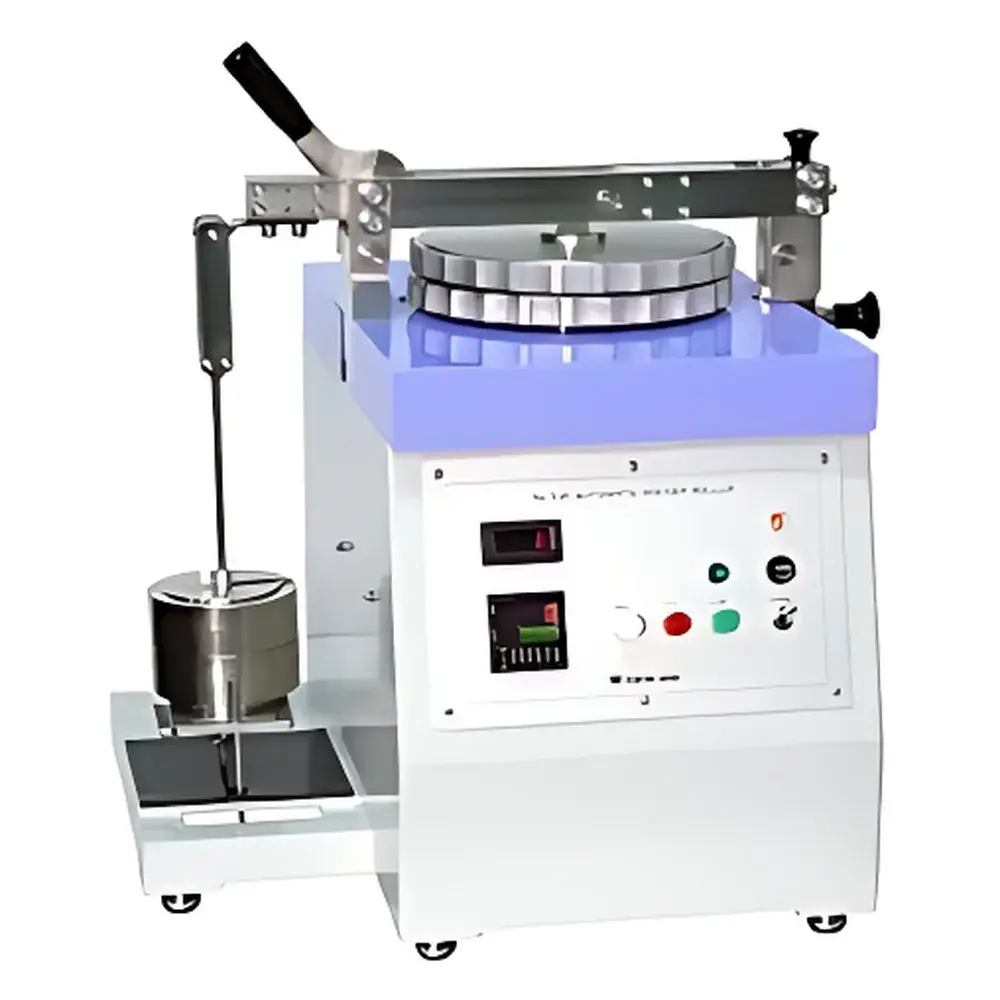
Yasuda No.546 Automatic Hoover Muller for Pigment Dispersion Characterization
| Brand | Yasuda |
|---|---|
| Origin | Japan |
| Model | No.546 |
| Compliance | JIS K 5101 |
| Operating Principle | Vacuum-assisted dual-glass-disc mulling under controlled load and rotation |
| Sample Handling | Manual loading, fully automated grinding cycle |
| Drive System | Precision stepper motor with programmable speed and dwell time |
| Vacuum System | Integrated vacuum pump (≤10 kPa absolute) for air removal during dispersion |
| Disc Material | Optical-grade ground glass (φ150 mm, parallelism ±2 µm) |
| Load Application | Pneumatically actuated vertical force (adjustable 0–200 N) |
| Cycle Control | Fully programmable sequence (grinding time, rest intervals, lift/lower timing) |
Overview
The Yasuda No.546 Automatic Hoover Muller is an engineered instrument designed specifically for standardized evaluation of pigment dispersion characteristics in paint, ink, and coating formulations. It implements the classical Hoover mulling principle—based on controlled shear deformation between two parallel, optically ground glass discs—under vacuum conditions to eliminate entrapped air and ensure reproducible interfacial contact between pigment particles and vehicle (dispersant or binder). This method directly aligns with JIS K 5101 (“Methods of Test for Pigments for Paints”), Section 7, which specifies the use of a Hoover-type muller for assessing grind fineness and dispersion stability. Unlike manual mullers, the No.546 integrates precise pneumatic load control, programmable rotational sequencing, and real-time vacuum maintenance to minimize operator variability and support GLP-compliant documentation workflows.
Key Features
- Vacuum-integrated operation (≤10 kPa absolute) prevents bubble formation and ensures consistent pigment–vehicle interaction during mulling
- Optical-grade ground glass discs (φ150 mm, surface flatness ≤2 µm) provide uniform shear geometry and minimize edge effects
- Pneumatically regulated vertical load (0–200 N range, ±1.5% repeatability) enables method transfer across formulation viscosities and pigment loadings
- Stepper motor-driven disc rotation with programmable speed (0.1–5 rpm) and dwell timing supports multi-stage dispersion protocols per JIS K 5101 Annex B
- Automated lift-lower mechanism ensures repeatable disc separation post-grinding without mechanical shock or sample loss
- Modular base design accommodates integration with downstream particle size analyzers (e.g., laser diffraction or microscopy-based systems) via standardized sample transfer trays
Sample Compatibility & Compliance
The No.546 is validated for use with organic and inorganic pigments, including titanium dioxide, carbon black, phthalocyanine blues/greens, and iron oxides, suspended in solvent-based, water-based, and high-solids resin systems. Its geometry and operational envelope comply strictly with JIS K 5101 requirements for disc diameter, surface finish, applied load range, and vacuum threshold. While not certified to ISO/IEC 17025 as a standalone testing laboratory, the instrument’s mechanical reproducibility (RSD <2.1% across 10 replicate mulls of TiO₂ paste) meets internal QC thresholds for method validation under ASTM D1210 and ISO 1524. Routine calibration verification is performed using traceable gauge blocks and certified vacuum transducers.
Software & Data Management
The No.546 operates via an embedded microcontroller interface with local LCD display and tactile keypad navigation. All process parameters—including vacuum level, applied load, rotation speed, total mull time, and disc separation timestamp—are logged internally with UTC timestamps and stored in non-volatile memory (retention >10 years). Export is supported via USB-C to CSV format for integration into LIMS or electronic lab notebooks. Audit trail functionality records user ID (via optional RFID badge reader), parameter changes, and error events—fully compliant with FDA 21 CFR Part 11 requirements when deployed within validated IT environments. No cloud connectivity or remote access is implemented, preserving data sovereignty per institutional cybersecurity policies.
Applications
- Quantitative comparison of dispersant efficacy across surfactant families in architectural and industrial coatings
- Batch release testing of colorant pastes prior to let-down in automotive OEM paint lines
- R&D screening of novel pigment surface treatments (e.g., silane or polymer grafting) for improved rheological stability
- Root-cause analysis of haze or gloss loss linked to incomplete pigment deagglomeration
- Correlation studies between Hoover muller output and high-shear disperser performance (e.g., rotor-stator homogenizers)
- Supporting regulatory submissions requiring JIS K 5101–aligned dispersion data for pigment registration dossiers
FAQ
Does the No.546 require external vacuum supply?
No—it includes an integrated oil-free diaphragm vacuum pump rated for continuous operation at ≤10 kPa absolute pressure.
Can the glass discs be replaced with alternative materials (e.g., stainless steel or ceramic)?
No. JIS K 5101 mandates ground glass discs to ensure consistent optical scattering behavior and avoid catalytic or abrasive interference with pigment surfaces.
Is software validation support available for 21 CFR Part 11 compliance?
Yes. Yasuda provides IQ/OQ documentation templates, electronic signature configuration guidance, and audit trail verification protocols upon request.
What maintenance is required for long-term accuracy?
Biannual verification of disc parallelism (using optical flats), vacuum sensor calibration, and load cell zero-drift check—full procedures included in the technical manual.
How does the No.546 differ from rotary shear mills or bead mills?
It applies low-shear, high-contact-area deformation under static confinement—emulating film drawdown rather than turbulent attrition—making it uniquely suited for detecting subtle differences in wetting and flocculation behavior.





