
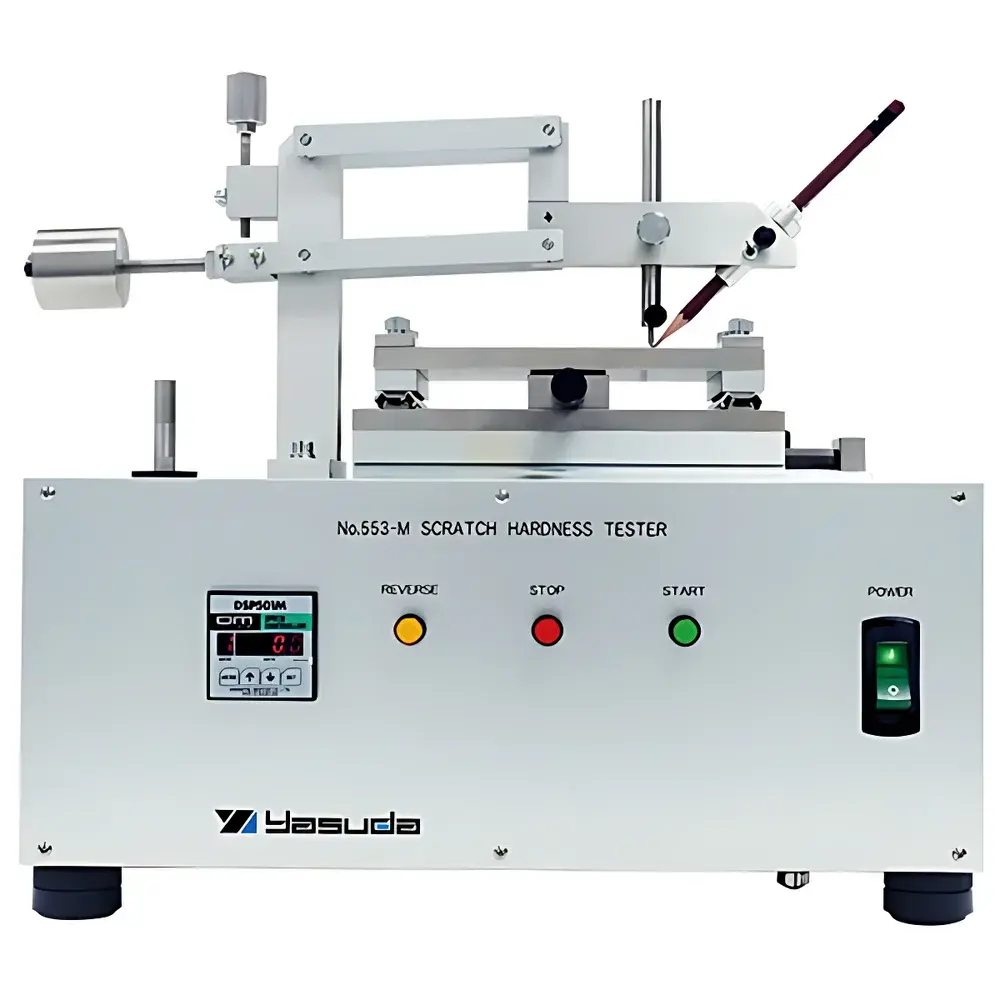
Yasuda No.553-M Electric Pencil Scratch Hardness Tester
| Brand | Yasuda |
|---|---|
| Origin | Japan |
| Model | No.553-M |
| Test Angle | 45° (60° for enameled wire) |
| Stroke Range | Horizontal ≤100 mm, Vertical ≤50 mm |
| Scratching Speed | 0.5–1 mm/s (motor-driven, continuously adjustable) |
| Load Capacity | Up to 1 kgf (beam balance type) |
| Test Table Dimensions | M-1: 100 × 180 mm |
| M-2 | 150 × 180 mm |
| Accessories Included | Mitsubishi Uni pencils (6B–9H, 17 pcs), steel stylus (1 pc), dedicated pencil sharpener, #400 abrasive paper, spirit level |
| Optional Accessories | Heated stage, electrical continuity module, φ3 mm × 23 mm conical stylus (60° tip angle) |
| Power Supply | AC 100 V, single-phase, 3 A, 50/60 Hz |
| Dimensions & Weight | M-1: ~440 × 200 × 440 mm, ~20 kg |
| M-2 | ~440 × 260 × 440 mm, ~27 kg |
| Compliance Standards | JIS C3003, JIS K5400, JIS K5600-5-4, JIS K5651, JIS K6894, JIS K6902, ASTM D2197, ASTM D3363, ISO 15184, GB/T 6739 |
Overview
The Yasuda No.553-M Electric Pencil Scratch Hardness Tester is a precision-engineered instrument designed for quantitative evaluation of coating surface resistance to mechanical abrasion under standardized loading and kinematic conditions. It operates on the principle of controlled linear scratching using standardized graphite pencils—graded from soft (6B) to hard (9H)—applied at a fixed angle (45° for general coatings; 60° for enameled wires) and regulated speed (0.5–1 mm/s). The hardness rating is determined as the hardest pencil grade that does not produce visible substrate exposure, cohesive cracking, or adhesive delamination under defined normal load (up to 1 kgf, applied via calibrated beam balance mechanism). This method conforms to internationally recognized test protocols for organic coatings, decorative laminates, and insulated conductors, providing reproducible, operator-independent results essential for QC/QA laboratories, R&D departments, and third-party certification bodies.
Key Features
- Motor-driven, continuously variable scratching speed (0.5–1 mm/s) ensures consistent velocity across all test cycles, minimizing inter-trial variability.
- Beam-balance loading system delivers precise, gravity-based normal force up to 1 kgf—eliminating electronic load cell drift and enabling traceable calibration per ISO/IEC 17025 requirements.
- Dual-stage test table options (M-1: 100 × 180 mm; M-2: 150 × 180 mm) accommodate diverse sample geometries including flat panels, bent substrates, and coil-wound specimens.
- Fixed-angle mechanical guide maintains strict 45° or 60° stylus incidence—critical for compliance with JIS K5600-5-4 and ASTM D3363 angular tolerance specifications.
- Integrated spirit level and rigid cast-aluminum base ensure horizontal alignment prior to testing—reducing parasitic torsional stress and enhancing measurement fidelity.
- Full accessory set includes 17 graded Mitsubishi Uni pencils (6B–9H), certified sharpening tool, #400 silicon carbide grinding paper, and a hardened steel stylus for alternative scratch geometry validation.
Sample Compatibility & Compliance
The No.553-M supports evaluation of a broad spectrum of coated and laminated materials: architectural and automotive topcoats, powder-coated metal substrates, PVC and melamine-faced decorative boards (including Clemens-type patterned surfaces), and magnet wire enamel systems. Its mechanical architecture accommodates both rigid planar samples and flexible or curved specimens within defined dimensional limits. The instrument fully satisfies mandatory test parameters specified in JIS C3003 (electrical insulating coatings), JIS K5651 (paint film hardness), ISO 15184 (pencil hardness of paints and varnishes), ASTM D3363 (standard test method for film hardness by pencil test), and GB/T 6739 (Chinese national standard equivalent). All operational parameters—including stroke length, angle repeatability, and load application method—are validated against original standard annexes to support audit-ready GLP documentation.
Software & Data Management
As a benchtop mechanical tester, the No.553-M operates without embedded firmware or digital control interface—intentionally designed to minimize software validation burden in regulated environments. All operational parameters are manually set and mechanically locked, ensuring full transparency and direct traceability. Test records—including pencil grade, observed failure mode (e.g., “substrate exposure,” “cohesive crack,” “no damage”), load setting, and environmental conditions—are documented externally per laboratory SOPs. For facilities requiring electronic data capture, optional analog-to-digital interfaces (e.g., USB-based load/stroke encoders) may be integrated externally—subject to site-specific 21 CFR Part 11 validation protocols. Calibration certificates for beam balance and angle guides are provided with each unit, aligned to JIS Z 8401 and ISO/IEC 17025 traceable standards.
Applications
- Quality control of industrial paint systems during batch release and supplier qualification.
- Development-stage screening of novel resin formulations and crosslinker systems for enhanced scratch resistance.
- Comparative assessment of cured film hardness across varying bake schedules, UV dosage, or ambient humidity exposure.
- Evaluation of decorative laminate durability per JIS K6902 (synthetic resin laminated boards).
- Verification of enamel integrity on magnet wire per JIS C3003 and IEC 60851-5, particularly for high-temperature or solvent-resistant grades.
- Failure analysis of coating adhesion loss in field-failed components using reverse-engineering scratch mapping.
FAQ
Is the No.553-M compliant with FDA or pharmaceutical coating testing requirements?
While not specifically designed for USP or FDA guidance on oral solid dosage coatings, its mechanical design and JIS/ISO alignment make it suitable for non-GMP preliminary screening of polymer film hardness—provided method suitability is demonstrated per ICH Q5C and documented internally.
Can the instrument be used for curved or cylindrical samples?
Yes—within the vertical stroke limit (≤50 mm) and with proper fixture adaptation. Sample curvature must not exceed ±2° deviation over the 10 mm scratch length to maintain angular fidelity per ASTM D3363 Annex A1.
What maintenance is required for long-term accuracy?
Annual recalibration of the beam balance assembly and angular guide is recommended. Pencil sharpening geometry should be verified weekly using the supplied template; stylus tips require replacement after 500 cycles or visible wear.
Does Yasuda provide calibration services outside Japan?
Yes—through authorized regional service partners in North America, EU, and APAC regions, all operating under ISO/IEC 17025-accredited procedures with NIST-traceable reference masses and optical angle verification tools.





