
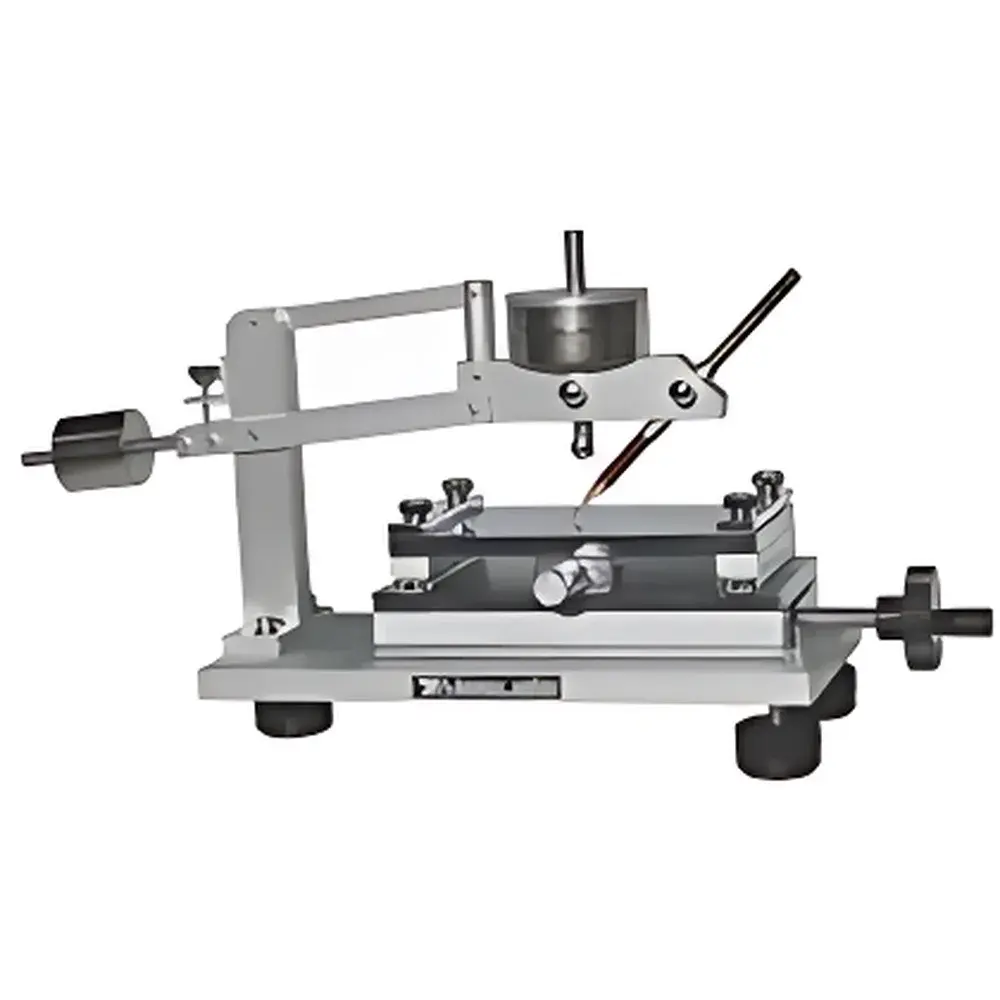
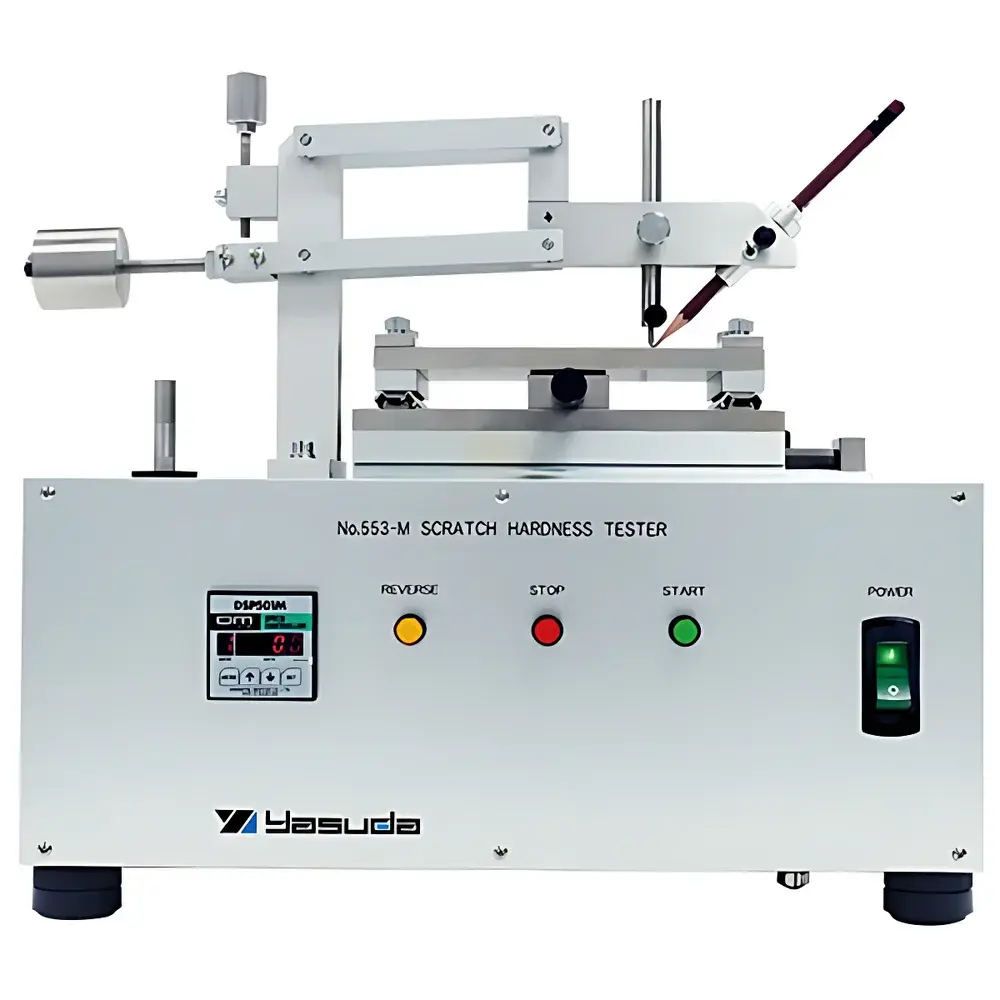
Yasuda No.553 Pencil Scratch Hardness Tester
| Brand | Yasuda |
|---|---|
| Origin | Japan |
| Model | No.553 |
| Standards Compliance | JIS C3003, JIS K5400, JIS K5600-5-4, JIS K5651, JIS K6894, JIS K6902, ASTM D2197, ASTM D3363, ISO 15184, GB/T 6739 |
| Test Angle | 45° |
| Application Scope | Coating hardness, Clemens-type decorative board evaluation, enamel wire solvent resistance testing |
Overview
The Yasuda No.553 Pencil Scratch Hardness Tester is a precision mechanical instrument engineered for standardized assessment of surface scratch resistance in organic coatings, laminates, and insulated wires. It operates on the principle of controlled lateral force application using standardized graphite pencils—graded according to international hardness scales—as indenters. During testing, a pencil is held at a fixed 45° angle relative to the test surface and drawn across it under consistent applied load (typically 750 g ±10 g, per ASTM D3363 and ISO 15184). The hardness rating is determined as the highest pencil grade (e.g., 6H, 4B) that produces no visible substrate exposure, coating fracture, or irreversible deformation under visual inspection at 2× magnification. This method provides a rapid, non-destructive, and operator-repeatable metric for comparative quality control in R&D laboratories, production QA/QC environments, and third-party certification facilities.
Key Features
- Fixed-angle mechanical carriage ensuring precise 45° pencil orientation—critical for inter-laboratory reproducibility per ISO 15184 Clause 6.2 and JIS K5600-5-4.
- Adjustable vertical loading mechanism calibrated to deliver nominal 750 g force with ≤±1% deviation, traceable to national mass standards.
- Interchangeable pencil holder compatible with standard DIN/ISO/JIS graphite pencils (diameter 2.0 mm ±0.1 mm), supporting full hardness range from 6B to 9H.
- Stainless steel base plate with machined V-groove guide for repeatable linear stroke (minimum 6 mm length) and minimized lateral deviation.
- Integrated alignment gauge and zero-point reference mark to verify pencil tip geometry and contact point consistency prior to each test sequence.
- Compact benchtop design (W × D × H: 280 × 180 × 160 mm) suitable for integration into ISO 17025-accredited testing workflows without requiring environmental enclosures.
Sample Compatibility & Compliance
The No.553 accommodates flat, rigid substrates up to 150 mm × 150 mm × 25 mm (L × W × T), including painted metal panels, anodized aluminum, PVC sheets, melamine-faced particleboard (Clemens-type decorative boards per JIS K6902), and magnet wire enamel coatings. Surface curvature is limited to radii ≥50 mm to maintain valid contact geometry. All test procedures align with mandatory clauses of ISO 15184:2022 (Paints and varnishes — Determination of film hardness by pencil test), ASTM D3363–22, and JIS K5600-5-4:2016. The instrument supports GLP-compliant documentation when paired with certified test logs and operator sign-off records; it does not incorporate electronic data capture but is fully compatible with 21 CFR Part 11–compliant LIMS via manual entry protocols.
Software & Data Management
The Yasuda No.553 is a purely mechanical tester with no embedded firmware, display, or digital interface. Test execution and result interpretation follow strictly manual protocols defined in referenced standards. Users record outcomes—including pencil grade, observed failure mode (e.g., “coating lift”, “substrate exposure”, “no damage”), ambient temperature (23 ±2°C) and relative humidity (50 ±5% RH)—in standardized paper-based or LIMS-integrated test reports. Calibration verification is performed annually using NIST-traceable mass sets and optical alignment tools; certificate documentation satisfies ISO/IEC 17025 Clause 6.4.2 requirements for equipment metrological traceability.
Applications
- Quality assurance of architectural and automotive topcoats during batch release (per ASTM D2197 for industrial maintenance coatings).
- Evaluation of UV-curable acrylic and polyester powder coatings for furniture and appliance manufacturers.
- Comparative screening of enamel insulation systems on copper magnet wire (JIS C3003, IEC 60851-5).
- Validation of scratch resistance in decorative high-pressure laminates (HPL) used in interior surfacing (JIS K6902).
- Technical support for failure analysis investigations involving coating delamination or abrasion-induced conductivity loss in PCB conformal coatings.
FAQ
What pencil grades are supported by the No.553 tester?
The instrument accepts all standard graphite pencils conforming to ISO 843:2022 and JIS S6006, spanning 6B (softest) to 9H (hardest), with intermediate grades including HB, F, H, 2H, and 4H.
Is operator training required to achieve reproducible results?
Yes—ISO 15184 Section 8 mandates documented operator competence. Yasuda recommends initial qualification via inter-operator repeatability studies (n≥3 operators, n≥5 replicates per sample) before routine use.
Can the No.553 be used for curved surfaces?
Only for convex surfaces with radius ≥50 mm; concave geometries or radii <50 mm invalidate the 45° contact condition and are excluded from standard compliance.
Does the tester meet FDA or EU regulatory requirements for medical device coating validation?
While not FDA-cleared as a standalone device, test data generated per ISO 15184 and ASTM D3363 is admissible in biocompatibility dossiers (ISO 10993-6) when integrated into a validated coating process control plan.
How often must the pencil tip be sharpened or replaced?
Per ASTM D3363 Section 7.2, the pencil must be re-sharpened before each test series using a precision sharpener meeting JIS B7521 specifications; tip geometry is verified visually against a 10× loupe before every stroke.



