
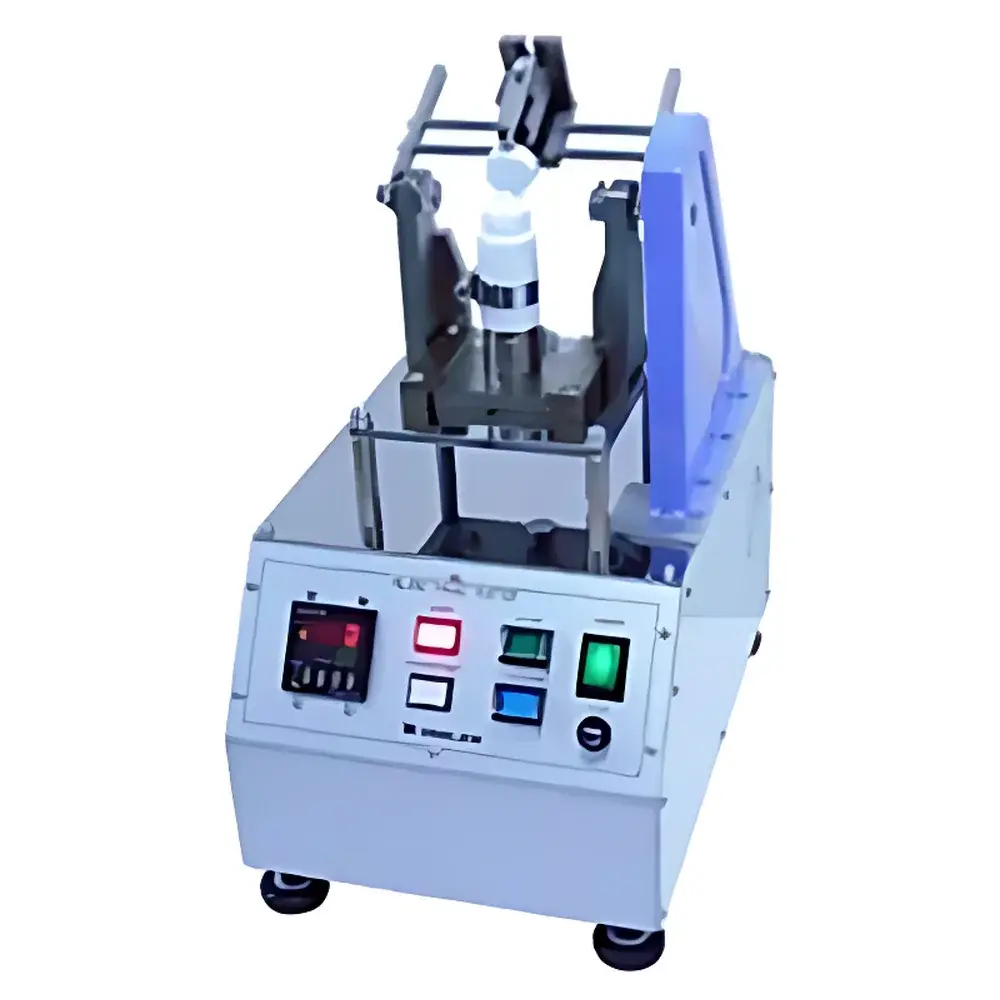
Yasuda No.662 Hinge Cap Durability Tester
| Brand | Yasuda |
|---|---|
| Origin | Japan |
| Model | No.662 |
| Type | Hinge-Actuated Lid Fatigue Testing Machine |
| Application Domain | Packaging Integrity Validation for Food, Cosmetics & Pharmaceutical Containers |
| Compliance Context | Designed for ISO 8504-2 / ASTM D3474 / JIS Z 1707-aligned hinge lifecycle assessment |
Overview
The Yasuda No.662 Hinge Cap Durability Tester is an electromechanically controlled fatigue testing system engineered to evaluate the mechanical endurance of integrated hinge-type closures used on rigid packaging containers. It operates on a repeatable angular displacement principle—applying controlled, cyclical opening and closing motions to simulate real-world user interaction over extended service life. Unlike general-purpose tensile or compression testers, the No.662 is purpose-built for rotational hinge kinematics, incorporating precision cam-driven actuation, programmable dwell timing, and load-monitored cycle termination logic. Its architecture supports standardized durability verification in accordance with packaging performance protocols mandated by food safety regulators (e.g., FDA 21 CFR Part 116), cosmetic packaging guidelines (ISO 22715 Annex C), and pharmaceutical secondary packaging requirements (ICH Q5C, USP ). The tester delivers high reproducibility in hinge torque decay profiling, latch engagement consistency tracking, and structural integrity validation after prescribed cycle counts (typically 1,000–50,000 cycles).
Key Features
- Cam-based actuation mechanism ensuring consistent angular amplitude (±0.5° repeatability) and defined hinge pivot axis alignment
- Programmable cycle count, open/close speed (0.5–5 s per stroke), and dwell time (0–5 s at fully open/closed positions)
- Digital counter with non-volatile memory for audit-ready cycle logging and pass/fail status flagging
- Modular fixture interface accommodating standard container diameters (Φ30–Φ120 mm) and hinge geometries (butt, living, and multi-segment types)
- Integrated mechanical stop limiters preventing over-rotation and preserving hinge geometry during accelerated testing
- Compliance-ready documentation package including calibration certificate traceable to JCSS standards and test method SOP templates
Sample Compatibility & Compliance
The No.662 accommodates polypropylene (PP), polyethylene (PE), and acrylonitrile-butadiene-styrene (ABS) hinge caps mounted on PET, HDPE, or aluminum containers. Fixture adaptability extends to flip-top dispensers, child-resistant closures, and dual-hinge clamshell lids. All test configurations conform to material-specific conditioning requirements per ISO 2233 (standard atmosphere: 23 °C ± 2 °C, 50 % RH ± 5 %) prior to cycling. Test reports generated support GLP-compliant submissions under EU Regulation (EC) No 1935/2004 for food contact materials and align with ASTM D3474’s “Standard Practice for Calibration and Evaluation of Mechanical Testing Machines Used for Packaging” for instrumentation validation.
Software & Data Management
The No.662 operates as a standalone hardware platform without embedded software; however, it interfaces via RS-232 or optional USB-to-serial adapter with third-party data acquisition systems (e.g., LabVIEW, MATLAB, or custom Python-based logging tools). Cycle completion signals, emergency stop triggers, and motor current feedback are exposed through discrete I/O ports for integration into automated QA workflows. Audit trails—including operator ID, start/stop timestamps, ambient temperature/humidity logs (when paired with external sensors), and cycle deviation alerts—are exportable in CSV format. For regulated environments, the system supports 21 CFR Part 11 compliance when deployed with validated electronic record systems featuring role-based access control and electronic signatures.
Applications
- Validation of hinge fatigue resistance for single-use medical device packaging (e.g., sterile peel-open trays)
- Comparative lifecycle analysis of bio-based polymer hinge formulations versus conventional PP
- Pre-shipment qualification testing of cosmetic jar closures subjected to thermal cycling (−20 °C to 40 °C)
- Root cause investigation of cap failure modes: hinge neck cracking, torsional deformation, or latch misalignment
- Supporting Design Failure Mode and Effects Analysis (DFMEA) for new container platforms
- Conformance testing against retailer-specific packaging durability benchmarks (e.g., Walmart’s Sustainable Packaging Playbook Section 4.2)
FAQ
What standards does the No.662 directly support?
It facilitates testing aligned with ISO 8504-2 (packaging—hinge durability), ASTM D3474 (calibration of packaging test equipment), and JIS Z 1707 (Japanese industrial standard for plastic container performance).
Can the tester accommodate irregularly shaped containers?
Yes—custom fixture plates and adjustable clamping arms allow secure mounting of non-cylindrical containers (e.g., rectangular cosmetic compacts or oval food tubs), provided hinge axis orientation remains accessible to the actuator arm.
Is calibration required before each test series?
No—routine calibration is recommended annually or after 10,000 cycles, per Yasuda’s maintenance protocol. A quick functional check using the built-in mechanical reference stop is advised before daily operation.
Does the system provide torque measurement capability?
Not natively—the No.662 is a displacement-controlled endurance tester. Torque profiling requires integration with an external rotary torque sensor (e.g., HBM T10F) mounted in-line with the hinge axis.
How is failure defined during testing?
Failure is operator-defined but typically includes: audible cracking, visible hinge fracture, inability to achieve full closure, or >15% increase in actuation force (measured externally) relative to baseline.



