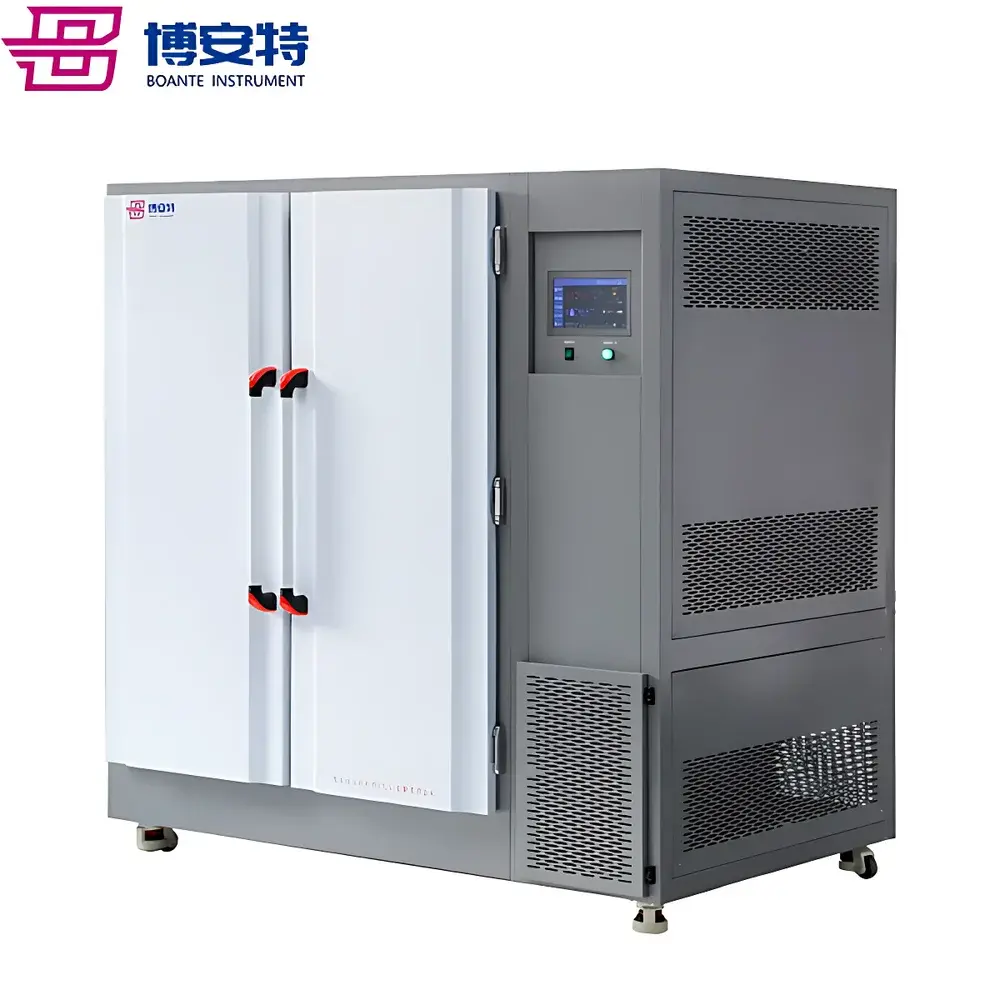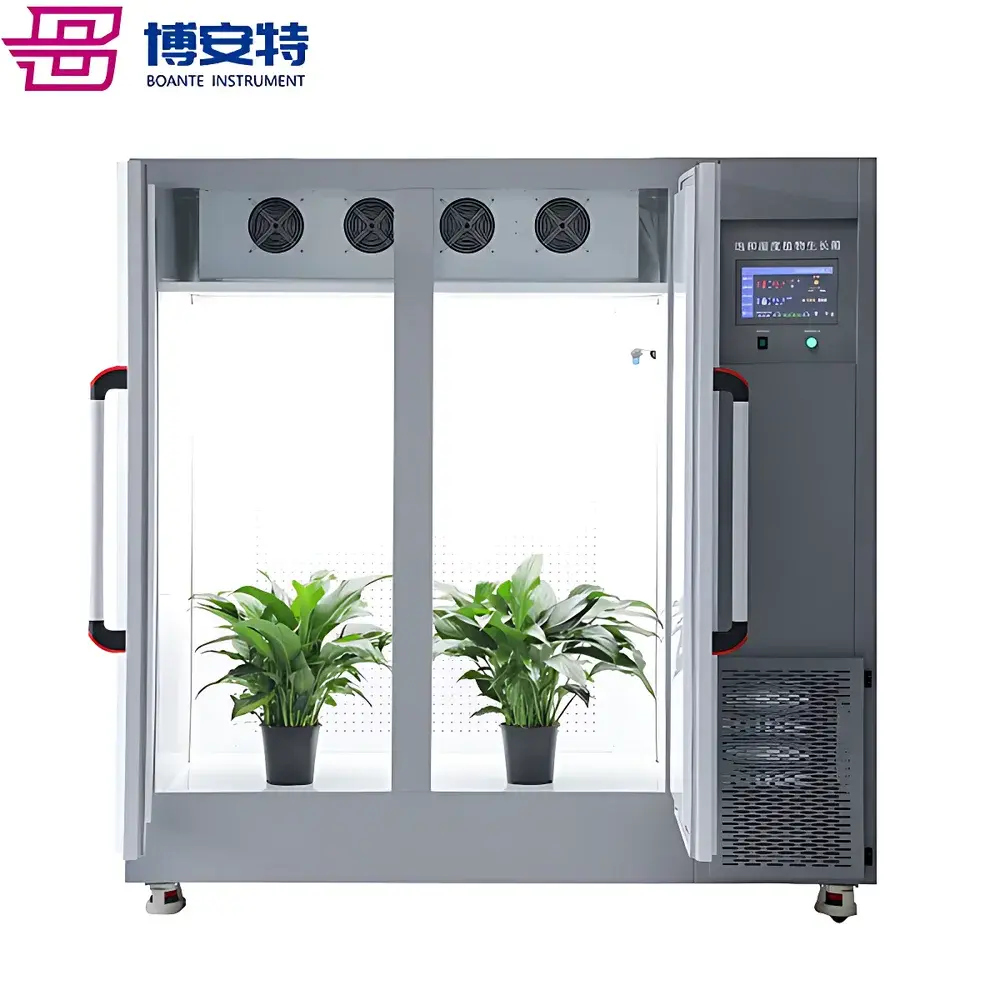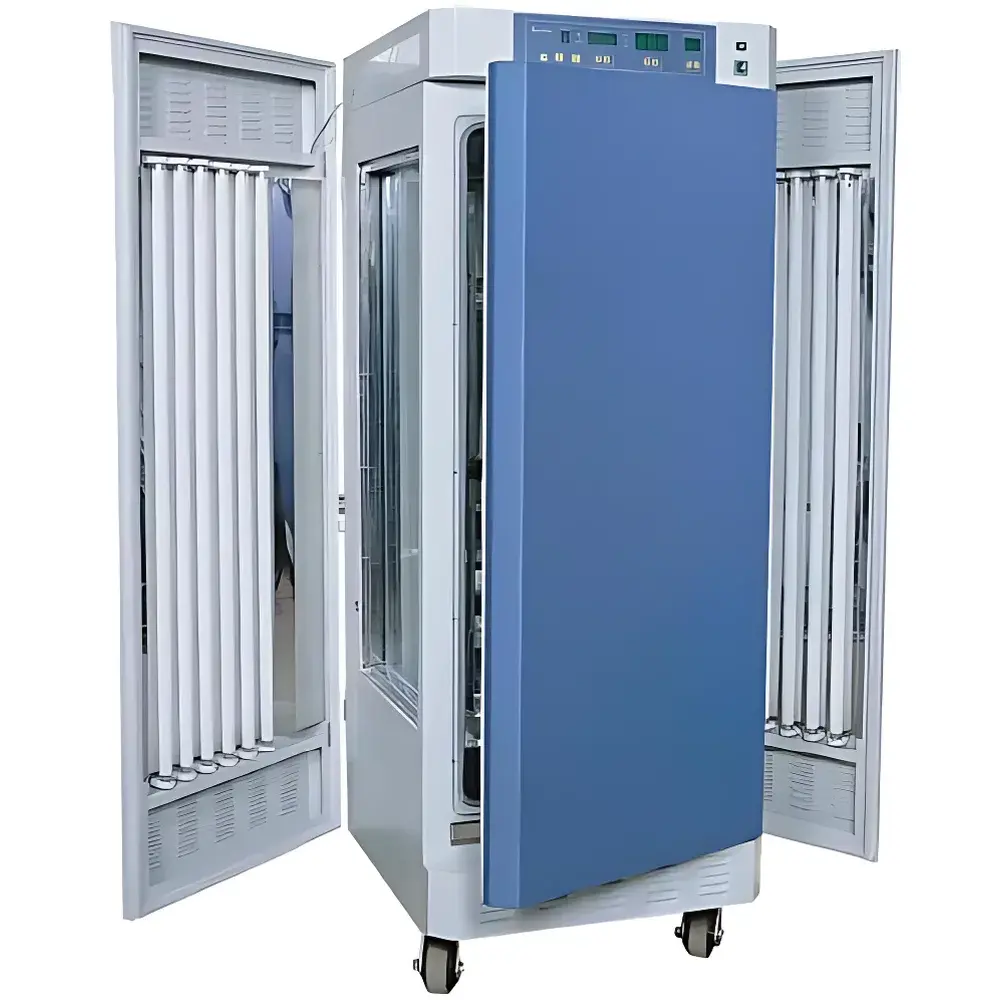
Yiheng MGC Series Plant Growth Chamber / Artificial Climate Chamber
| Brand | Yiheng |
|---|---|
| Origin | Shanghai, China |
| Model | MGC Series |
| Temperature Range | 4–50 °C (dark), 10–50 °C (with light) |
| Humidity Range | 50–90 %RH |
| Humidity Accuracy | ±5–7 %RH |
| Temperature Stability | ±1 °C |
| Temperature Resolution | 0.1 °C |
| Light Intensity | 0–30,000 lx (4-step adjustable, LED source) |
| Power Input | AC 220 V, 50 Hz |
| Internal Volume | 150–850 L |
| Standard Shelves | 3 pcs |
| Compressor & Fan | Imported industrial-grade components |
| Optional Interfaces | RS485 for PC connectivity |
| Optional Add-ons | CO₂ inlet port & IR-based CO₂ controller |
Overview
The Yiheng MGC Series Plant Growth Chamber is an integrated artificial climate chamber engineered for precise, reproducible simulation of environmental conditions required in plant physiology, seed germination, tissue culture, entomological studies, and small-animal husbandry. It operates on a unified microprocessor-controlled architecture that synchronizes temperature, relative humidity, and photosynthetically active light intensity within a single closed-loop system—eliminating the operational inefficiencies and calibration drift associated with discrete, standalone controllers. The chamber employs a non-CFC refrigeration cycle compliant with global ozone-safe standards, featuring a high-efficiency imported hermetic compressor and low-noise axial circulation fans. Its thermodynamic design reduces cooling recovery time by over 40% compared to conventional units, while maintaining stable thermal gradients across the working chamber. The LED illumination system delivers spectrally consistent, dimmable white light (0–30,000 lx) with negligible radiant heat load—ensuring photobiological fidelity without compromising thermal uniformity.
Key Features
- Microprocessor-based dual-loop control system integrating temperature, humidity, and light intensity via real-time cross-parameter compensation algorithms
- Day/night temperature programming capability: independent setpoints for illuminated and dark phases, supporting circadian rhythm studies
- Independent over-temperature cut-off circuit with audible/visual alarm—certified to IEC 61000-4-2 ESD immunity and EN 60335-1 safety requirements
- Optimized air distribution via rear-mounted centrifugal fan and asymmetric baffle ducting, achieving ≤±0.8 °C spatial uniformity (measured per ISO 15502:2018 Annex B)
- Electropolished mirror-finish stainless steel interior (AISI 304) with radius-rounded corners for GLP-compliant cleaning and residue-free decontamination
- Imported key components: Danfoss or Panasonic compressors; ebm-papst or Ziehl-Abegg fans—rated for ≥20,000 h MTBF under continuous operation
- RS485 serial interface (Modbus RTU protocol) enabling integration into centralized lab monitoring systems (optional)
Sample Compatibility & Compliance
The MGC Series accommodates diverse biological specimens—from Arabidopsis thaliana seedlings and rice callus cultures to Drosophila melanogaster colonies and juvenile rodents—within volumetric configurations ranging from 150 L to 850 L. All models comply with ISO 15502:2018 (laboratory incubators), IEC 61000-6-3 (EMC emissions), and GB/T 2423.1–2008 (environmental testing). For regulated environments, optional CO₂ add-ons include an inlet port and an NDIR-based infrared CO₂ sensor (accuracy ±30 ppm, 0–2,000 ppm range), supporting ASTM E171-22-compliant atmospheric enrichment protocols. Units are designed for GxP-aligned workflows: audit trail logging, user-access levels, and parameter lockout functions can be enabled via firmware update for FDA 21 CFR Part 11 readiness.
Software & Data Management
When equipped with the RS485 interface and optional Yiheng LabLink™ software, the MGC Series supports remote real-time monitoring, historical trend visualization, and automated report generation (PDF/CSV). Data logging resolution is configurable down to 1-minute intervals, with onboard memory retaining ≥30 days of timestamped records (temperature, humidity, light status, alarm events). The software enforces role-based access control (RBAC) and supports electronic signatures for critical parameter changes—meeting ALCOA+ data integrity principles. Exported datasets conform to ISA-88 batch record structure for seamless LIMS integration. Firmware updates are delivered via secure HTTPS channel with SHA-256 signature verification.
Applications
- Photoperiod-controlled phenotyping of crop mutants under standardized PAR regimes
- Long-term stability testing of biologics requiring controlled humidity and ambient light exposure
- Insect development assays across thermal-humidity-light response surfaces (e.g., mosquito vector competence studies)
- Pre-germination conditioning of recalcitrant seeds under stratification-mimicking cycles
- Non-invasive growth monitoring of 3D organoids using time-lapse imaging within vibration-damped chambers
- Validation of sterilization efficacy in humid-heat cycles (per ISO 11138-1)
FAQ
Does the MGC Series support GLP-compliant data archiving?
Yes—when configured with RS485 and LabLink™ software, it provides full audit trails, electronic signatures, and immutable data export meeting OECD GLP Principles and EU Annex 11 requirements.
Can light intensity be ramped dynamically during experiments?
The standard 4-step LED control is fixed-intensity; however, custom firmware with PWM-driven analog dimming (0–100% linear output) is available under OEM agreement.
What is the maximum permissible ambient operating temperature?
The unit is rated for continuous operation at ambient temperatures between +5 °C and +40 °C, as verified per IEC 60068-2-1 and IEC 60068-2-2 test profiles.
Is CO₂ control compatible with all MGC models?
CO₂ inlet ports are factory-installed on all MGC-H and MGC-HP variants; retrofitting to P-series units requires structural modification and is not recommended.
How is humidity calibrated and validated?
Relative humidity sensors are factory-calibrated against NIST-traceable chilled-mirror hygrometers; users may perform field verification using saturated salt solutions (e.g., Mg(NO₃)₂ for 54% RH, NaCl for 75% RH) per ISO 17025 guidelines.