
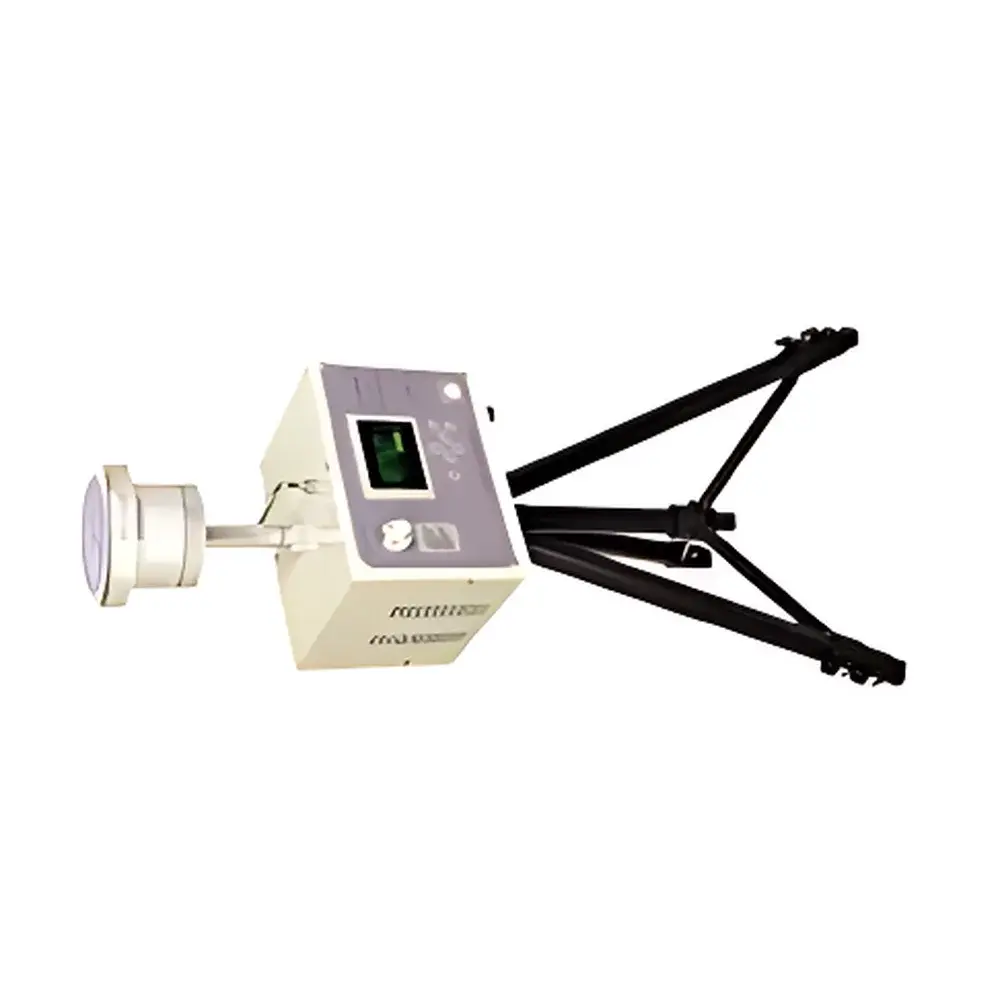
Yinghe 2030B Intelligent TSP/PM₁₀ Air Sampler
| Origin | Jiangsu, China |
|---|---|
| Manufacturer Type | Authorized Distributor |
| Origin Category | Domestic (China) |
| Model | 2030B |
| Pricing | Available Upon Request |
Overview
The Yinghe 2030B Intelligent TSP/PM₁₀ Air Sampler is a precision-engineered environmental monitoring instrument designed for gravimetric sampling of total suspended particulates (TSP) and inhalable particulate matter (PM₁₀) in ambient air. It operates on the principle of constant-flow filtration, drawing ambient air through standardized filter media—typically quartz fiber or polytetrafluoroethylene (PTFE)—at a controlled mid-range volumetric flow rate. The device integrates real-time thermobarometric compensation to automatically convert measured volume to standard temperature and pressure (STP: 273.15 K, 101.325 kPa), ensuring regulatory-compliant data output directly traceable to national metrological standards. Its architecture adheres to the fundamental requirements of gravimetric aerosol monitoring: stable flow delivery, minimal pressure drop across the filter substrate, and robust environmental resilience during extended field deployment.
Key Features
- High-efficiency axial-flow sampling pump engineered for long-term stability, low acoustic emission (≤65 dB(A)), and extended service life under continuous operation
- Integrated PM₁₀ inertial impactor and TSP cyclone assembly mounted directly onto the main chassis—eliminating external tubing and minimizing particle loss due to deposition or re-entrainment
- Microprocessor-controlled mass flow regulation with closed-loop feedback, maintaining setpoint accuracy within ±2% of nominal flow across variable backpressure conditions
- Real-time clock (RTC) module supporting programmable start/stop timing, multi-cycle sequential sampling, and user-defined interval-based acquisition protocols
- OLED display with wide-temperature operational range (–20 °C to +50 °C), high-contrast monochrome interface, and full Chinese-language menu navigation optimized for low-illumination field environments
- Automatic environmental correction: simultaneous measurement and compensation of ambient temperature, atmospheric pressure, and relative humidity for STP-normalized volume calculation
- Uninterruptible sampling logic: automatic resumption from last known state following power interruption, preserving temporal continuity of exposure records
- Built-in non-volatile memory for secure storage of up to 1,000 sampling events—including date/time stamps, flow logs, pressure/temperature readings, and error flags—with optional thermal printer integration
Sample Compatibility & Compliance
The 2030B is validated for use with 47 mm or 90 mm diameter filter substrates compliant with ISO 7708:1995 (Air quality — Particle size fraction definitions for health-related sampling) and US EPA Method IO-3.1 (Determination of PM₁₀ and PM₂.₅ in Ambient Air). It satisfies the performance criteria specified in HJ/T 374–2007 (Technical Requirements and Testing Methods for Particulate Matter Samplers) and JJG 943–1998 (Verification Regulation for Total Suspended Particulate Samplers). Its design supports routine calibration per GB/T 15432–1995 (Ambient Air Quality Standard – TSP Determination) and aligns with QA/QC workflows required under China’s Environmental Monitoring Technical Specifications (HJ 194–2017). While not certified to IEC 61000-6-2/6-3 or ATEX directives, its electrical safety conforms to GB 4793.1–2007 (Safety Requirements for Electrical Equipment for Measurement, Control, and Laboratory Use).
Software & Data Management
Data export is supported via RS-232 serial interface or USB-to-serial adapter, enabling direct transfer to laboratory information management systems (LIMS) or Excel-based analysis platforms. Firmware includes parameter calibration routines accessible only via password-protected engineering mode, ensuring integrity of flow sensor zero/span adjustments and thermobarometric transducer coefficients. All stored sampling records include audit-trail metadata: operator ID (manually entered), calibration certificate reference, filter lot number, and pre-/post-weighing timestamps. While the device does not implement FDA 21 CFR Part 11 electronic signature functionality, its deterministic logging behavior and immutable timestamping support GLP-aligned data review processes.
Applications
The 2030B serves as a primary tool for fixed-site ambient air quality monitoring networks operated by provincial ecological environment bureaus and municipal environmental monitoring centers. It is routinely deployed in urban background, traffic-oriented, and industrial fence-line locations for compliance reporting under China’s Ambient Air Quality Standards (GB 3095–2012). Additional use cases include occupational hygiene surveys in construction, mining, and manufacturing facilities; source apportionment studies requiring co-located TSP/PM₁₀ gravimetric datasets; and method validation exercises for emerging optical or beta-attenuation monitors. Educational institutions utilize it in environmental engineering laboratories to teach aerosol sampling theory, filter handling protocols, and STP conversion mathematics.
FAQ
What filter types are compatible with the 2030B sampler?
Quartz fiber filters (e.g., Pallflex TX40HI20WW), PTFE membrane filters (e.g., Gelman Supor® 450), and cellulose ester filters meeting ISO 12103-1 standards are supported for both TSP and PM₁₀ collection.
Does the instrument support ISO/IEC 17025-accredited calibration?
Yes—calibration must be performed using NIST-traceable primary flow standards (e.g., dry gas meter or critical orifice bank) in accordance with JJG 943–1998 verification procedures; calibration certificates issued by CNAS-accredited labs are accepted.
Can the 2030B operate unattended for 24-hour sampling cycles?
Yes—its internal RTC, battery-backed memory, and auto-resume function enable fully autonomous operation across multi-day campaigns without manual intervention.
Is firmware upgrade capability available?
Firmware updates are provided exclusively by Yinghe Technology Co., Ltd. via authorized service centers; field-upgrade via USB is not supported to maintain regulatory traceability.
What maintenance intervals are recommended?
Pump oil replacement every 6 months, impactor cleaning after each filter change, and annual verification of pressure/temperature sensor drift against reference instruments are advised per HJ 194–2017 guidelines.







