
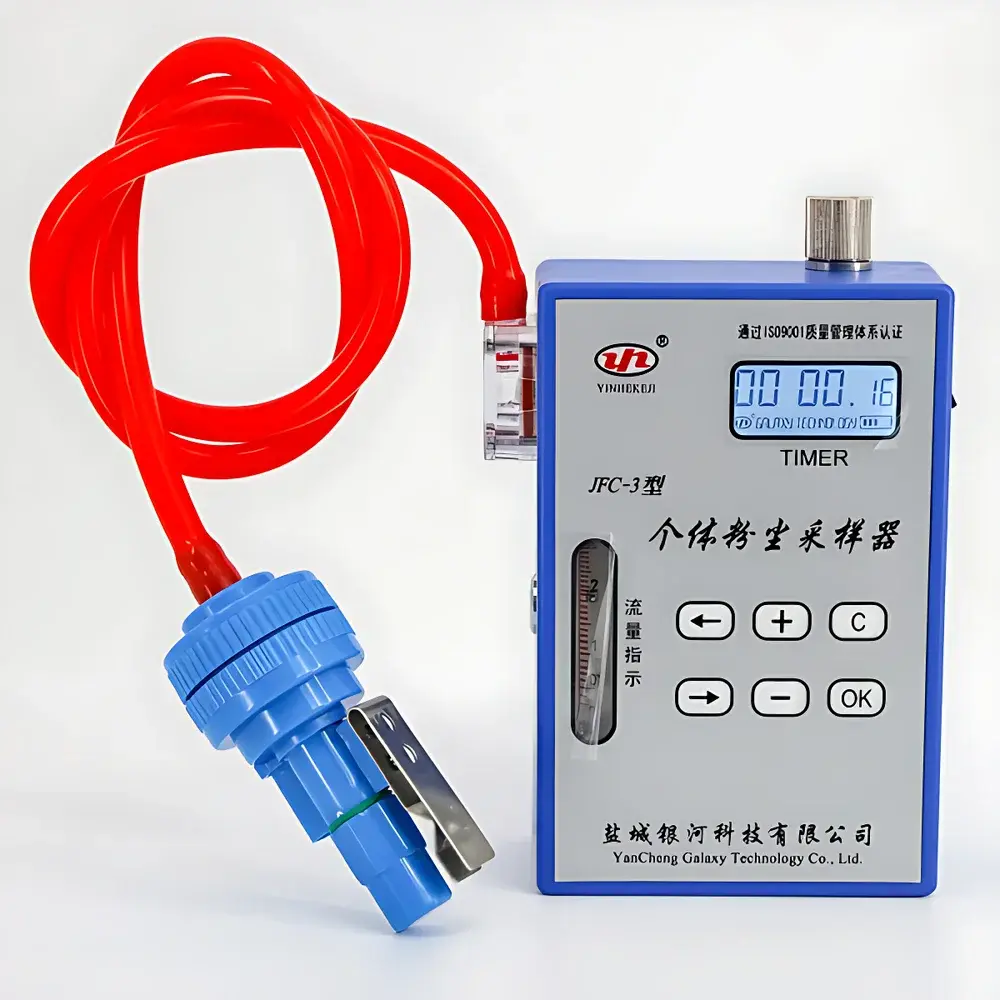
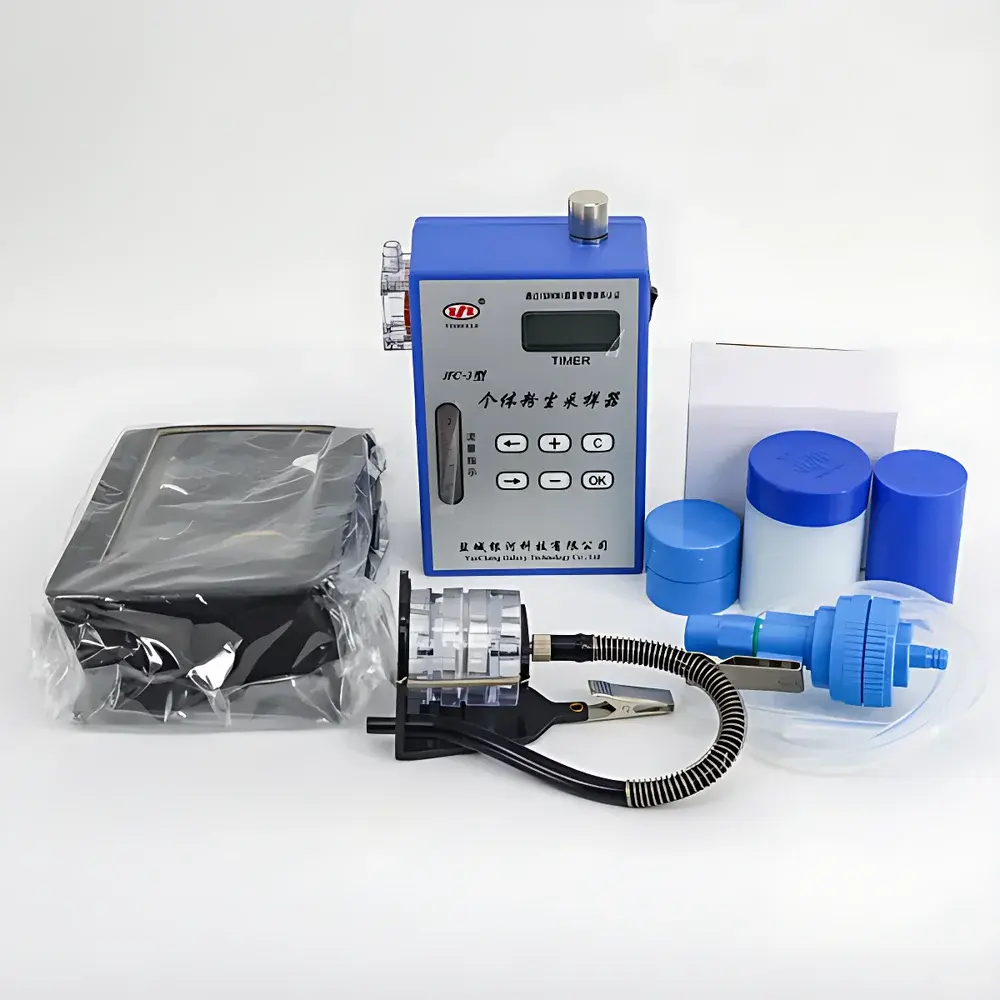
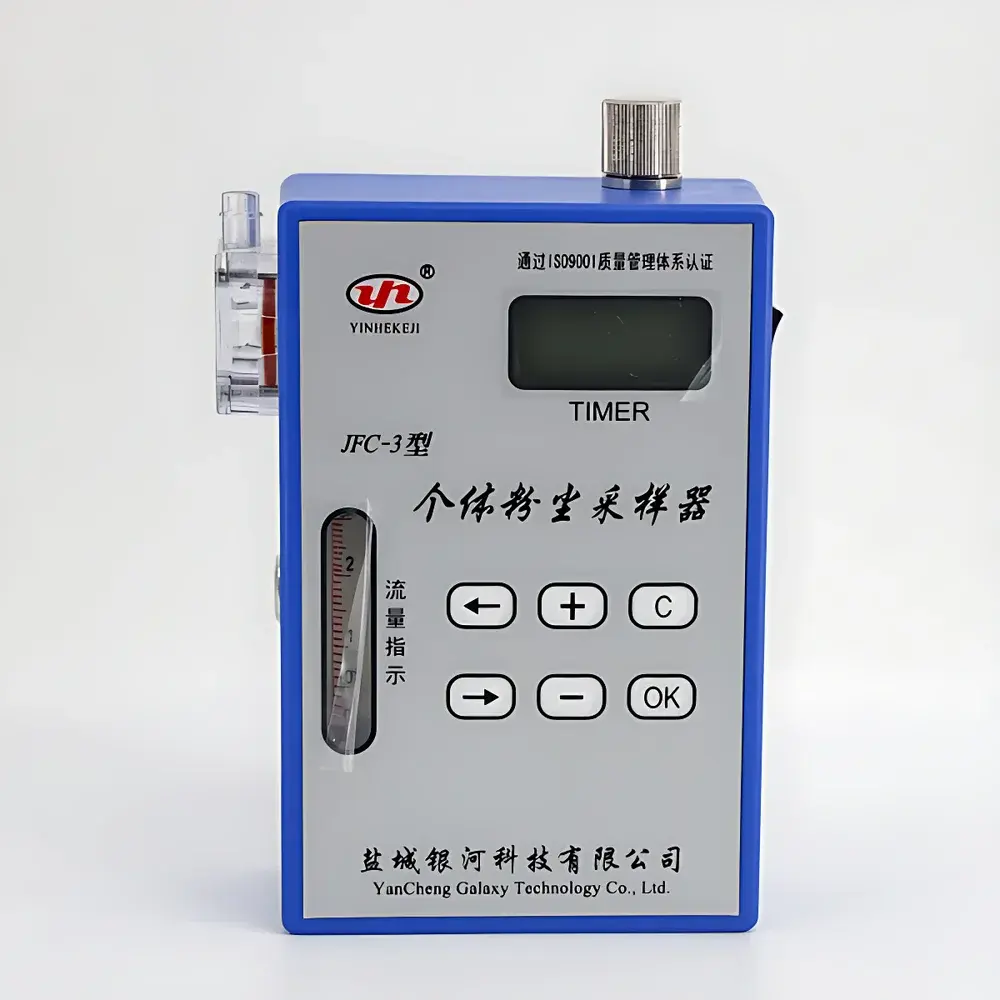
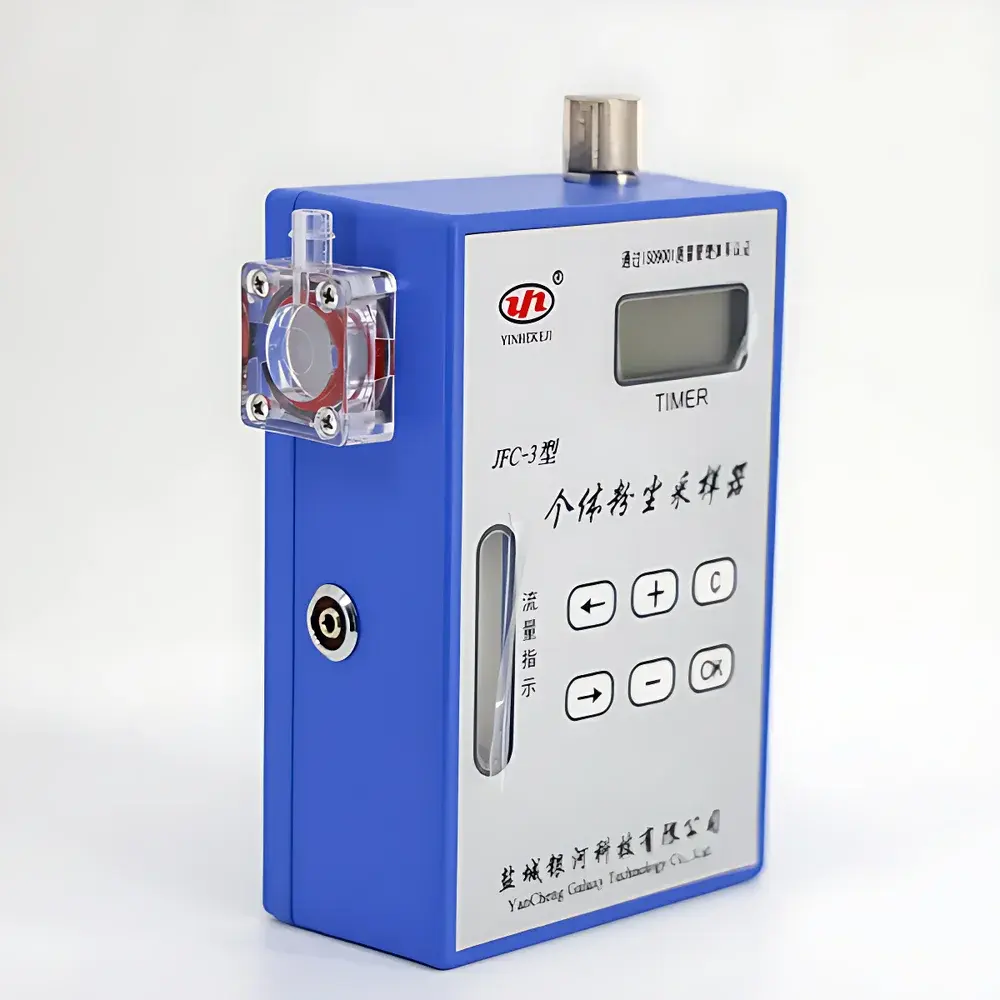
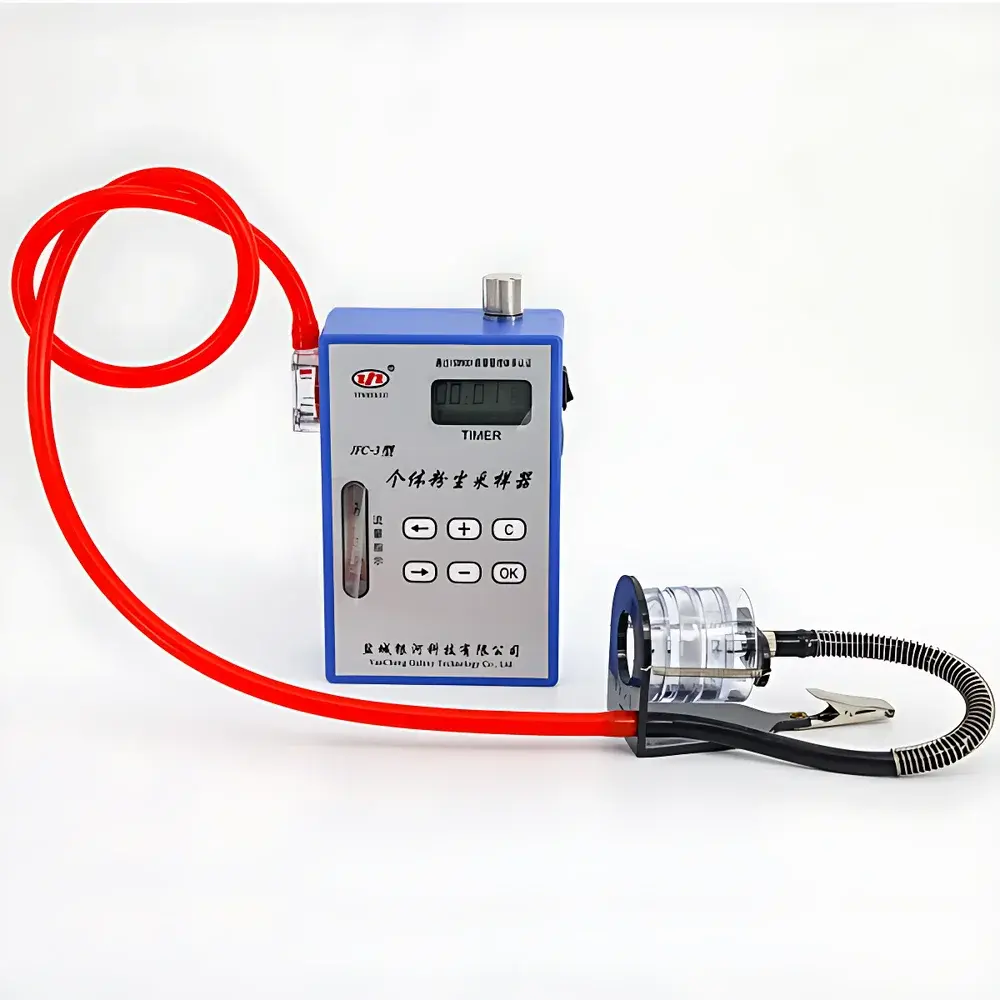
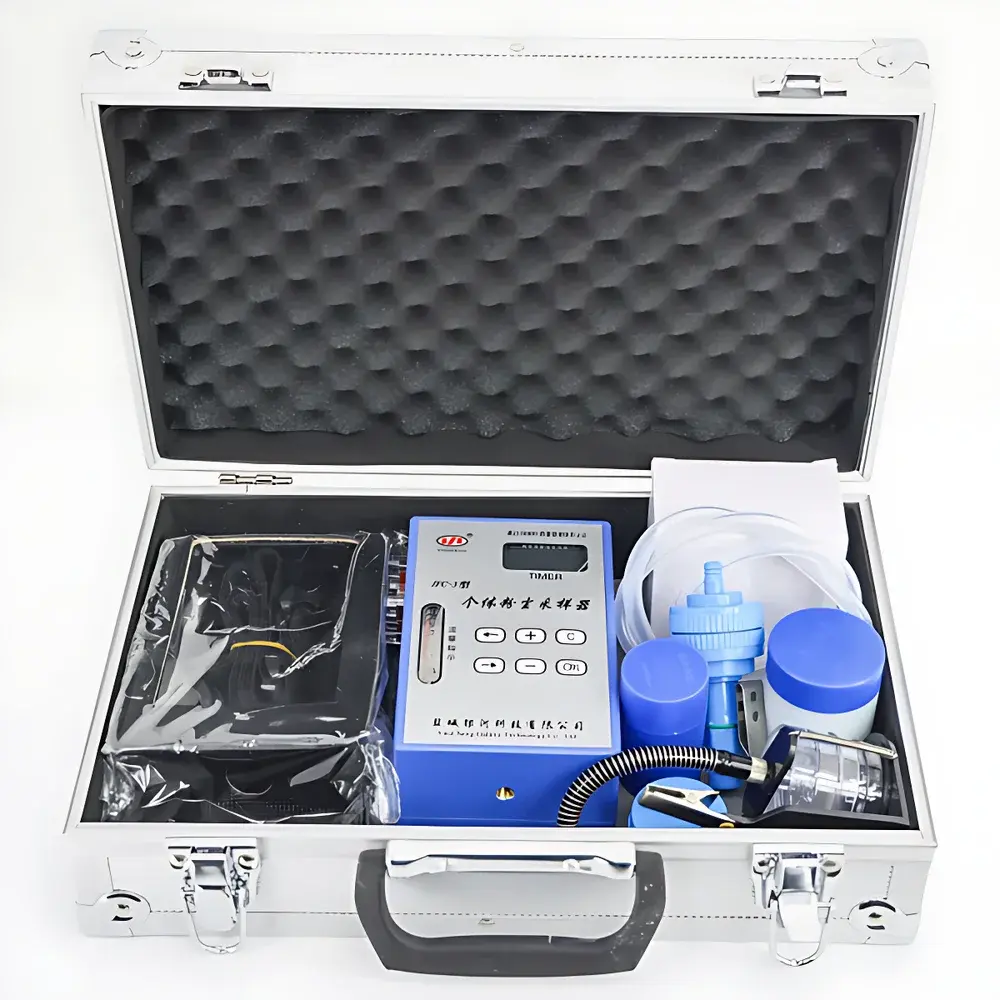
YINHEKEJI JFC-3 Personal Dust Sampler
| Brand | YINHEKEJI |
|---|---|
| Origin | Jiangsu, China |
| Model | JFC-3 |
| Sampling Flow Range | 0.1–3 L/min |
| Maximum Vacuum Pressure | >26 kPa (≥200 mmHg) |
| Flow Accuracy | ≤±2.5% FS |
| Flow Stability | <5% over 8 h |
| Timer Accuracy | ≤±0.1% |
| Operating Temperature | 0–50 °C |
| Power Supply | AC 220 V ±10%, 50 Hz / DC 7.4 V Li-ion rechargeable battery |
| Weight | ≤0.5 kg |
| Dimensions | 137 × 88 × 45 mm |
| Battery Runtime | ≥10 h (continuous or intermittent operation) |
Overview
The YINHEKEJI JFC-3 Personal Dust Sampler is a compact, portable, and field-deployable instrument engineered for quantitative collection of airborne particulate matter—primarily inhalable and respirable dust fractions—in occupational and environmental settings. It operates on the principle of constant-flow volumetric sampling using a precision diaphragm pump coupled with an integrated electronic timer and real-time flow monitoring circuitry. Designed in accordance with international sampling conventions (e.g., ISO 7708:1995 for particle size-selective sampling and EN 481:1993 for workplace aerosol characterization), the JFC-3 supports compliance-driven exposure assessment workflows required under OSHA 1910.1200 (Hazard Communication), NIOSH Manual of Analytical Methods (NMAM) Chapter 0600, and EU Directive 2004/37/EC (carcinogens and mutagens). Its lightweight form factor (≤0.5 kg) and dual-power architecture enable uninterrupted personal sampling across full-shift (8–10 h) monitoring campaigns without compromising flow integrity.
Key Features
- High-Performance Vacuum System: Delivers sustained vacuum pressure exceeding 26 kPa (>200 mmHg), ensuring stable flow delivery even when used with high-resistance filter media (e.g., PVC, mixed cellulose ester, or quartz fiber filters) or cyclonic pre-separators.
- Wide Adjustable Flow Range: Precisely tunable from 0.1 to 3.0 L/min, covering applications from low-flow respirable fraction sampling (e.g., 1.7 L/min per IOM inhalable sampler configuration) to higher-volume total dust collection protocols.
- Flow Accuracy & Stability: Calibrated to ≤±2.5% full-scale (FS) accuracy and maintains <5% deviation over 8-hour continuous operation—critical for meeting NIOSH and ISO-defined acceptance criteria for personal sampling pumps.
- Intelligent Timer Module: High-stability quartz-based timing circuit with ≤±0.1% accuracy ensures precise sample duration control, supporting GLP-aligned documentation requirements and audit-ready data traceability.
- Dual-Power Flexibility: Operates seamlessly on AC mains (220 V ±10%, 50 Hz) or internal 7.4 V lithium-ion rechargeable battery—enabling reliable deployment in remote sites, mobile labs, or locations lacking stable grid access.
- Ergonomic & Field-Ready Design: Compact footprint (137 × 88 × 45 mm), low mass (≤0.5 kg), and belt-clip compatible housing facilitate unobtrusive wear during worker mobility studies and long-term exposure assessments.
Sample Compatibility & Compliance
The JFC-3 is compatible with standard 25-mm and 37-mm diameter filter cassettes—including MCE, PVC, PTFE, and quartz filters—as well as size-selective samplers such as IOM inhalable, GK2.69 respirable, and Dorr-Oliver cyclones. Its flow performance has been validated against gravimetric analysis procedures per ISO 13137:2013 (Workplace air — Requirements for pumped samplers for chemical and biological agents) and supports method validation per ASTM D6330-98 (Standard Practice for Sampling Ambient Air for Particulate Matter). While not CE-marked or FDA-listed (as it is a non-medical, non-diagnostic sampling device), its electrical design conforms to IEC 61010-1 safety standards for laboratory equipment. Documentation packages include factory calibration certificates traceable to national metrology institutes.
Software & Data Management
The JFC-3 operates as a standalone hardware platform without embedded firmware-based data logging. However, it integrates transparently into broader exposure monitoring ecosystems via analog flow output (0–5 V or 4–20 mA optional upon request) and external calibration verification tools. Users routinely pair it with third-party software platforms—including EHS Insight, IHData, and industrial hygiene modules within SAP EHS—using time-stamped calibration logs, manual field sheets, or barcode-linked sample IDs. For regulated environments requiring audit trails, the device supports 21 CFR Part 11–compliant documentation when used in conjunction with validated electronic lab notebooks (ELNs) and controlled procedural SOPs governing pump calibration, filter handling, and chain-of-custody reporting.
Applications
- Occupational hygiene surveys in mining, construction, foundries, and pharmaceutical manufacturing.
- Respirable crystalline silica (RCS) exposure monitoring per OSHA Silica Standard 29 CFR 1926.1153.
- Teaching laboratories for aerosol science, industrial hygiene principles, and NIOSH method training.
- Baseline ambient dust mapping in peri-industrial communities and near-roadway microenvironments.
- Validation of local exhaust ventilation (LEV) system performance through comparative static vs. personal sampling strategies.
FAQ
Is the JFC-3 certified for use in OSHA-compliant exposure assessments?
Yes—the JFC-3 meets the performance specifications outlined in OSHA Technical Manual TED 1-0.15.A and is widely deployed in U.S. industrial hygiene practice for compliant personal sampling when operated within its validated flow range and calibrated per NIOSH BC 001 guidelines.
What filter types are recommended for respirable dust sampling?
For respirable fraction collection, use 37-mm PVC or polyvinyl chloride filters mounted in GK2.69 or Higgins-Dewell cyclones; ensure flow is maintained at 1.7 ± 0.1 L/min and verified with a primary calibrator before and after sampling.
Can the JFC-3 be used with real-time particle counters?
No—it is a gravimetric sampling pump only. Real-time instrumentation requires separate optical or beta-attenuation based monitors; however, the JFC-3 may serve as a reference sampling companion in co-located measurement studies.
How often should the pump be recalibrated?
Per ISO 13137 and AIHA RP-002, recalibration is required before each sampling series, after battery replacement, and at least every 8 hours of cumulative runtime—using a NIST-traceable primary flow calibrator (e.g., dry gas meter or electronic bubble flowmeter).
Related Products







