
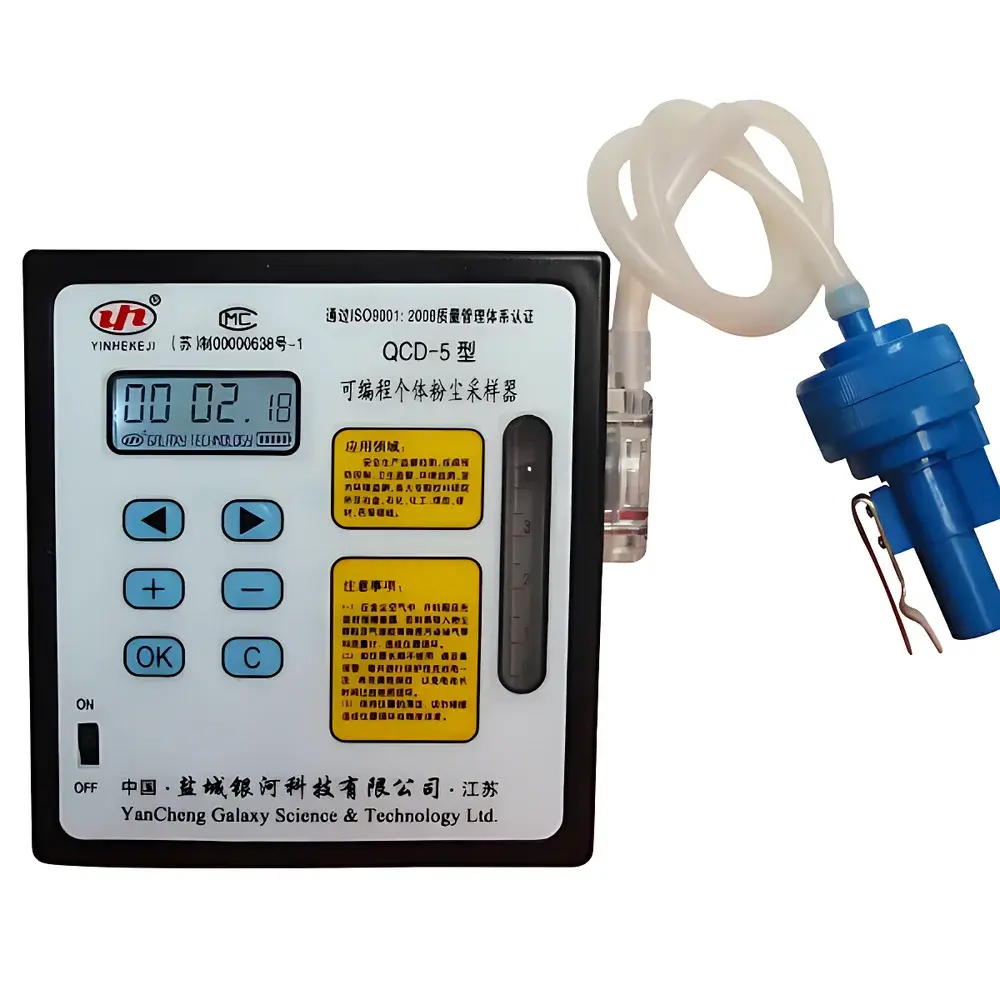
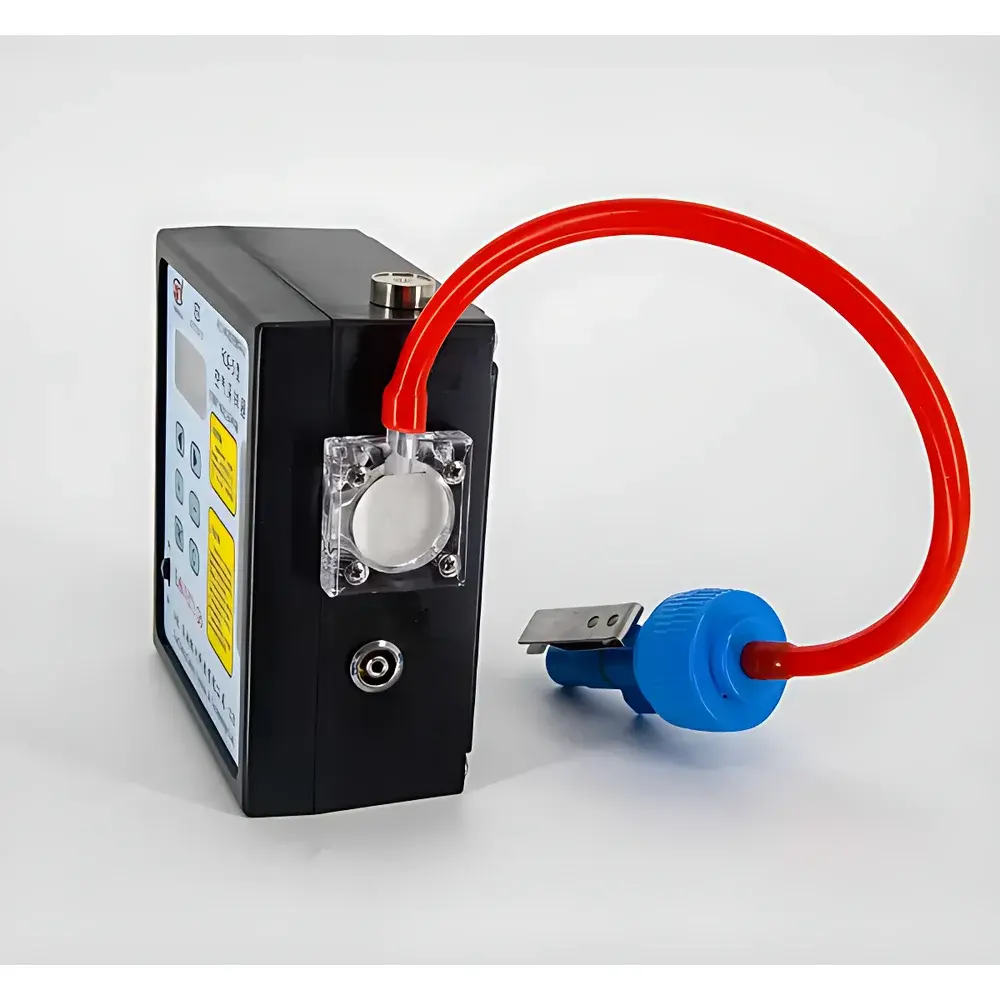
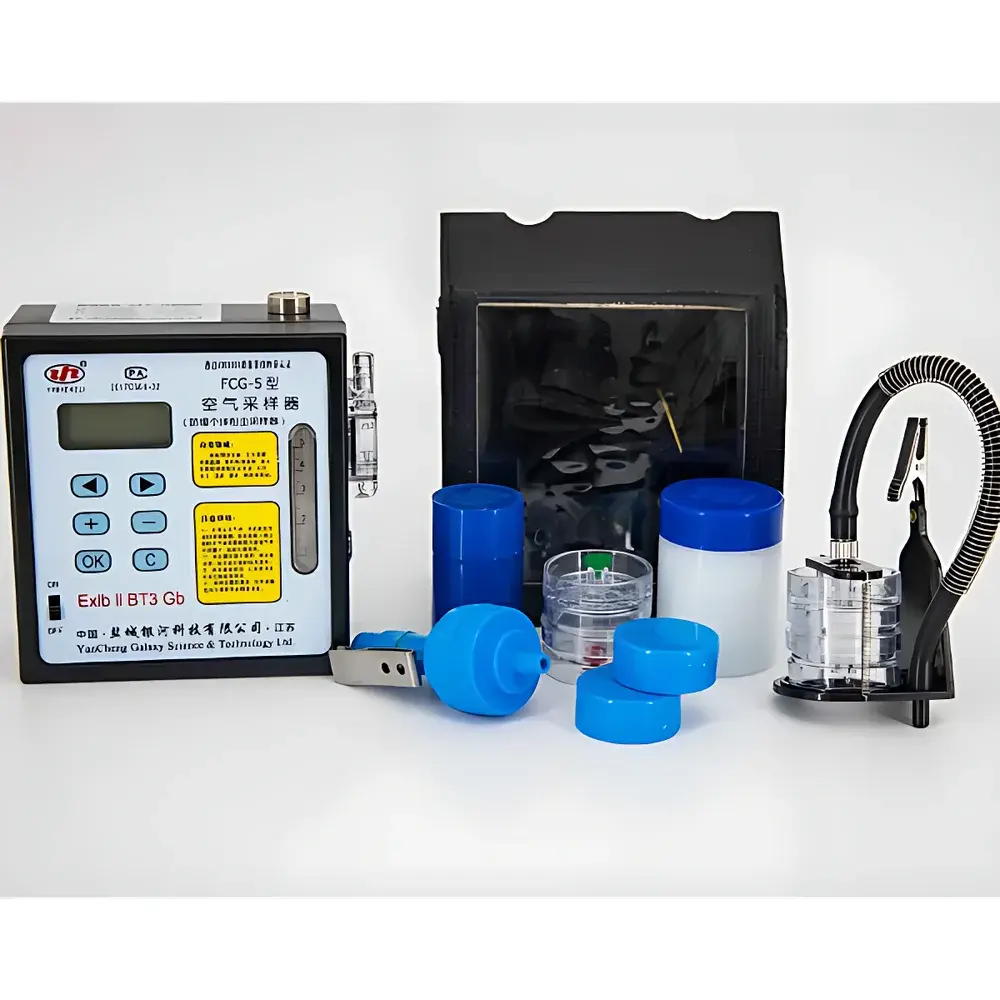
YINHEKEJI QCD-5 Personal Dust Sampler
| Brand | YINHEKEJI |
|---|---|
| Origin | Jiangsu, China |
| Manufacturer Type | Authorized Distributor |
| Country of Origin | China |
| Model | QCD-5 |
| Price Range | USD 140 – 280 |
| Flow Range | 1.0–5.0 L/min |
| Load Capacity | ≥5.0 L/min at 1000 Pa negative pressure |
| Flow Accuracy | ≤±5% |
| Flow Stability | ≤5% |
| Timer Range | 1 min – 99 h 59 min |
| Timer Accuracy | ≤±0.1% |
| Operating Temperature | −10°C to +40°C |
| Ambient Temperature Range | −25°C to +45°C |
| Continuous Operation Time | >8 h |
| Power Supply | Built-in 7.4 V rechargeable Li-ion battery pack |
| Weight | ≤0.7 kg |
| Dimensions | 100 × 50 × 110 mm |
Overview
The YINHEKEJI QCD-5 Personal Dust Sampler is a portable, battery-powered gravimetric sampling instrument engineered for compliant occupational hygiene monitoring in accordance with GBZ/T 192.1–192.5—2007, the Chinese national standard series for dust concentration determination in workplace air. It operates on the principle of constant-flow filtration: ambient air is drawn through a pre-weighed filter membrane (typically 25 mm diameter) at a user-selectable and electronically stabilized flow rate between 1.0 and 5.0 L/min. This enables quantitative collection of total dust, respirable dust (via cyclone or IOM samplers), and metallic particulates—including iron oxide, lead, chromium, and aluminum compounds—for subsequent laboratory analysis by gravimetry, atomic absorption spectroscopy (AAS), or inductively coupled plasma mass spectrometry (ICP-MS). The device employs a high-efficiency diaphragm pump with integrated pressure compensation, ensuring stable volumetric flow under variable filter loading conditions up to 1000 Pa backpressure—a critical requirement for extended-duration personal sampling in industrial environments such as mining, construction, foundries, and powder processing facilities.
Key Features
- Regulatory-aligned flow control: Digital microprocessor-based flow regulation maintains setpoint accuracy within ±5% across the full 1.0–5.0 L/min range, meeting minimum performance criteria specified in ISO 7708:1995 (respirable convention) and GBZ/T 192.2–2007 (respirable dust sampling).
- Extended field autonomy: Integrated 7.4 V lithium-ion battery pack supports continuous operation exceeding 8 hours at 2.0 L/min—sufficient for full-shift (8-hr) personal exposure assessment without interruption.
- Robust mechanical architecture: Compact housing (100 × 50 × 110 mm) and lightweight design (≤0.7 kg) facilitate secure belt-mounting or backpack integration; IP54-rated enclosure provides protection against dust ingress and incidental water splashing.
- Precision timing system: Programmable timer with resolution down to 1 minute and accuracy better than ±0.1%, supporting both fixed-duration and multi-interval sampling protocols required for time-weighted average (TWA) exposure calculations.
- Real-time operational feedback: LCD display indicates elapsed time, remaining battery status (with low-voltage warning icon), and active flow mode; intuitive button interface (OK/C/▲/▼) allows rapid configuration without external software.
Sample Compatibility & Compliance
The QCD-5 is compatible with standard 25 mm diameter filter media—including mixed cellulose ester (MCE), polyvinyl chloride (PVC), and polycarbonate (PC) membranes—as well as certified respirable dust cyclones (e.g., GK2.69, BGI4) and IOM inhalable samplers when used with appropriate adapters. Its flow stability and load capacity satisfy the mechanical performance benchmarks outlined in NIOSH Manual of Analytical Methods (NMAM) Chapter 2 and OSHA Method ID-142 for personal aerosol sampling. While not certified to ATEX or IECEx standards, the unit complies with GB/T 18268.1–2010 (EMC requirements for measurement equipment) and meets essential safety provisions of GB 4793.1–2007 (electrical safety for laboratory instruments). Documentation includes factory calibration certificate traceable to national metrology institutes and conformity statement per China RoHS II.
Software & Data Management
The QCD-5 operates as a standalone hardware platform with no embedded Bluetooth, Wi-Fi, or cloud connectivity. All sampling parameters are configured locally via front-panel controls, and raw data (start time, duration, nominal flow setting) are retained only as visible on the LCD during operation. For regulatory traceability, users must manually record setup parameters and sample identifiers in field logs aligned with GLP-compliant documentation practices. The device supports audit-ready workflows when paired with calibrated secondary flow calibrators (e.g., Gilian Gilibrator-2 or DryCal DC-Lite) before and after each sampling event—procedures recommended under ISO/IEC 17025:2017 for accredited laboratories. No proprietary software is required, eliminating compatibility dependencies or licensing constraints.
Applications
- Personal exposure assessment of respirable crystalline silica (RCS) in quarrying and stone-cutting operations
- Time-weighted average (TWA) monitoring of welding fume metals (Mn, Cr(VI), Ni) per GBZ 2.1–2019 occupational exposure limits
- Baseline dust characterization in pharmaceutical cleanroom gowning rooms and tablet compression suites
- Respirable coal dust sampling in underground mining according to GBZ/T 192.3–2007
- Verification of local exhaust ventilation (LEV) system efficacy through static and personal sampling pairings
FAQ
What filter types are validated for use with the QCD-5?
The sampler is validated for use with 25 mm MCE, PVC, and PC filters meeting ASTM D1506 and ISO 8502-3 specifications. Polyurethane foam (PUF) plugs may be inserted upstream for volatile organic compound (VOC) co-sampling where applicable.
Is the QCD-5 suitable for outdoor ambient air monitoring?
It is designed primarily for occupational personal sampling. For ambient PM10/PM2.5 monitoring, refer to stationary high-volume samplers compliant with HJ 618–2011 and EN 12341.
How often should flow calibration be performed?
Per GBZ/T 192.1–2007, flow calibration must be conducted before and after each sampling session using a NIST-traceable primary standard calibrator, with documented deviation ≤±5%.
Can the QCD-5 be used with conductive tubing to mitigate static charge?
Yes—antistatic silicone or conductive Tygon® tubing (e.g., S-50-HL) is recommended when sampling low-conductivity aerosols (e.g., plastics, carbon black) to prevent particle loss via electrostatic deposition.
Does the device support multi-point sequential sampling?
No—the QCD-5 lacks programmable multi-stage timing. For complex exposure scenarios requiring staggered start times, multiple units or external programmable timers are required.
Related Products







