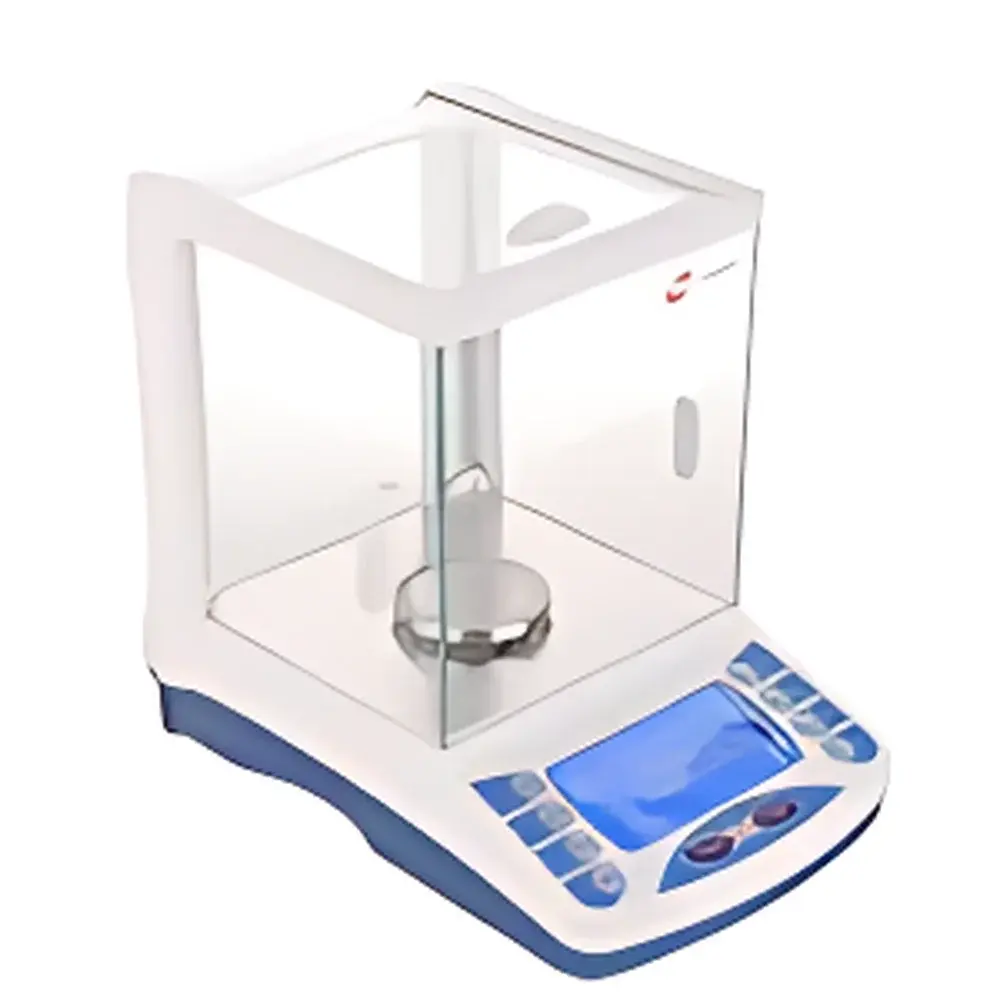
Yoke FA1004B Analytical Balance
| Brand | Yoke |
|---|---|
| Origin | Shanghai, China |
| Manufacturer Type | Direct Manufacturer |
| Model | FA1004B |
| Instrument Type | Analytical Balance |
| Maximum Capacity | 100 g |
| Readability | 0.1 mg |
| Repeatability | ≤ ±0.1 mg |
| Pan Diameter | 80 mm |
| Clear Height Under Pan | 240 mm |
| Dimensions (W×D×H) | 350 × 215 × 340 mm |
| Net Weight | 7.5 kg |
| Power Supply | 220 V / 50 Hz |
| Display | Blue-backlit LCD (120 × 55 mm) |
| Interface | RS232C standard port |
| Calibration | External weight-based automatic calibration system |
| Environmental Protection | Four-sided electrostatic-shielded glass draft shield |
| Sensor Technology | Electromagnetic force compensation transducer |
| Linearity Correction | Four-point linear calibration |
| Functions | Tare, counting, unit conversion (g, oz, ct), adjustable integration time, stability/sensitivity tuning |
Overview
The Yoke FA1004B Analytical Balance is a precision mass measurement instrument engineered for laboratory environments requiring high reproducibility and traceable accuracy in the 0–100 g range. It operates on the principle of electromagnetic force compensation (EMFC), where the downward gravitational force exerted by a sample is dynamically counterbalanced by an opposing electromagnetic force generated within a precision coil assembly. The equilibrium current required to maintain zero deflection is directly proportional to mass and digitally converted into a stable, high-resolution reading with 0.1 mg readability. This method eliminates mechanical wear, ensures long-term drift stability, and delivers consistent performance across ambient temperature fluctuations (10–30 °C) and humidity levels (30–80% RH non-condensing). Designed for routine analytical workflows in regulated and non-regulated settings, the FA1004B meets foundational metrological requirements aligned with ISO/IEC 17025 competence criteria for calibration laboratories and supports GLP-compliant documentation when integrated with validated data acquisition systems.
Key Features
- Electromagnetic force compensation sensor technology—ensures zero mechanical hysteresis and superior long-term stability
- Four-point linear calibration routine—performed using external certified weights to correct for nonlinearity across the full weighing range
- Blue-backlit large-format LCD display (120 × 55 mm)—provides high-contrast, glare-free readability under varied lighting conditions
- Four-sided electrostatic-shielded glass draft enclosure—minimizes air currents and dissipates surface charge to prevent electrostatic interference during low-mass measurements
- Adjustable integration time and stability/sensitivity parameters—enables optimization for volatile samples, powders, or vibration-prone lab benches
- RS232C serial interface—supports bidirectional communication with PCs, label printers, and LIMS for automated data capture and audit trail generation
- Multi-unit conversion capability—switches seamlessly between grams (g), ounces (oz), and carats (ct) without recalibration
- Counting mode with automatic average piece weight calculation—validated for uniform-part inventory control in QC and manufacturing environments
Sample Compatibility & Compliance
The FA1004B accommodates a wide variety of solid and powdered samples within its 80 mm diameter stainless-steel weighing pan and 240 mm vertical clearance—sufficient for standard crucibles, vials, and filtration assemblies. Its draft shield design conforms to general best practices outlined in USP and ASTM E898–18 for analytical balance operation in pharmaceutical and chemical testing labs. While not inherently 21 CFR Part 11 compliant as a standalone device, the RS232 output enables integration with compliant software platforms that enforce electronic signature, audit trail, and user access control protocols. The instrument’s construction adheres to IEC 61010-1 safety standards for electrical equipment used in laboratory environments, and its electromagnetic compatibility (EMC) performance complies with EN 61326-1 for industrial scientific instrumentation.
Software & Data Management
Data export is supported via ASCII protocol over RS232C at configurable baud rates (up to 9600 bps), enabling direct ingestion into spreadsheet applications, statistical process control (SPC) tools, or enterprise-quality management systems (QMS). When paired with third-party compliant software (e.g., LabX, BalanceLink, or custom Python/Node.js scripts), the FA1004B can generate timestamped, user-attributed records with checksum validation—fulfilling basic ALCOA+ (Attributable, Legible, Contemporaneous, Original, Accurate) data integrity principles. Firmware does not support internal storage or password-protected user roles; therefore, role-based access and electronic signatures must be enforced at the host application layer.
Applications
- Quantitative preparation of reference standards and working solutions in pharmaceutical R&D and QC labs
- Weighing of active pharmaceutical ingredients (APIs) and excipients prior to tablet formulation
- Calibration of volumetric glassware using water density correction methods per ISO 4787
- Quality assurance of raw materials in food, feed, and agrochemical production
- Teaching laboratories in universities—supporting experiments in analytical chemistry, physical chemistry, and materials science curricula
- Microsample handling in life science research where sub-milligram repeatability is critical
<li gravimetric analysis in environmental testing (e.g., filter mass change for particulate matter determination)
FAQ
What calibration weights are required for the FA1004B?
A Class M2 or better 100 g external calibration weight (certified per OIML R111) is recommended for full-range verification and adjustment.
Does the FA1004B support internal calibration?
No—it relies exclusively on external weight-based calibration; no motorized or built-in calibration mass is included.
Can the balance operate on DC power or battery backup?
No—it requires continuous 220 V AC, 50 Hz mains supply; no internal battery or DC adapter option is available.
Is the RS232 interface compatible with modern Windows/macOS systems?
Yes—when used with a USB-to-RS232 adapter and terminal emulation software (e.g., PuTTY, Tera Term), it functions reliably across current OS versions.
How often should recalibration be performed?
Per ISO/IEC 17025 and internal SOPs, recalibration is advised before each critical weighing session, after relocation, or following significant environmental shifts—typically verified daily in GxP environments.