Yoke FB-C Series Precision Balance
| Brand | Yoke |
|---|---|
| Origin | Shanghai, China |
| Manufacturer Type | Direct Manufacturer |
| Product Category | Domestic |
| Model | FB-C |
| Instrument Type | Precision Balance |
| Capacity Range | 200–500 g |
| Readability | 1 mg |
| Calibration Method | Internal Calibration |
| Max Capacity | 500 g |
| Measurement Accuracy | 1 mg |
| Repeatability | 1 mg |
| Accuracy Class | Class II (per OIML R76) |
| Pan Diameter | 90 mm |
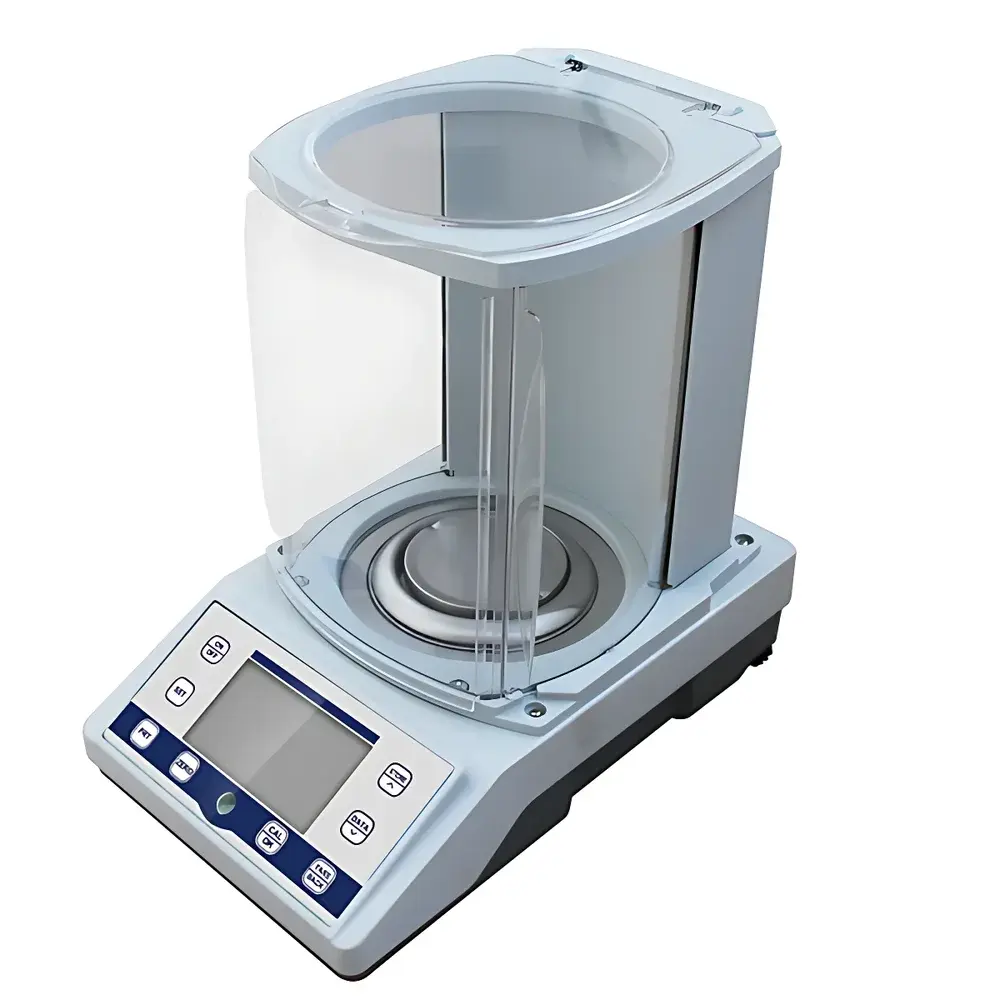
| Dimensions (W×D×H) | 360 × 220 × 350 mm |
| Net Weight (incl. packaging) | 7.5 kg |
| Power Supply | DC 9 V / 1 A |
Overview
The Yoke FB-C Series Precision Balance is an OIML Class II-compliant analytical-grade weighing instrument engineered for laboratories requiring consistent 1 mg readability across capacities from 200 g to 500 g. Built upon a high-stability electromagnetic force compensation (EMFC) sensor architecture, the series delivers metrologically traceable mass measurements under ISO/IEC 17025-aligned conditions. Each unit integrates a sealed draft shield with optimized airflow dynamics to minimize convective disturbances—critical for stable readings in non-climate-controlled lab environments. The balance operates on a 32-bit ARM microcontroller platform, enabling real-time digital filtering, adaptive response tuning, and deterministic data acquisition at ≤1.5 s stabilization time (typical for 90% of loads). Designed for routine QC, formulation, sample preparation, and educational applications, the FB-C Series meets the mechanical and metrological requirements of ISO 9001 internal calibration procedures and supports GLP documentation workflows via audit-ready operation logs.
Key Features
- Electromagnetic force compensation (EMFC) sensor system with CNC-machined precision components ensuring long-term linearity and thermal drift stability
- Internal calibration mechanism with motorized weight deployment—eliminates manual handling and reduces calibration-induced uncertainty
- Sealed acrylic draft shield with ergonomic side-access doors and anti-static surface treatment to mitigate electrostatic interference
- BTN black-on-white LCD display with white LED backlight (128 × 64 pixel resolution), readable at ±60° viewing angles under ambient illumination ≥300 lux
- SMT-based PCB assembly with conformal coating for enhanced humidity resistance (operating range: 10–30 °C, 30–80% RH non-condensing)
- Multi-function weighing modes: piece counting (with auto-average piece weight), checkweighing (HI/OK/LO thresholds), density determination (with auxiliary kit), and animal/dynamic weighing with damping optimization
- RS232 interface compliant with METTLER TOLEDO-compatible ASCII protocol for seamless integration into LIMS or ELN systems
Sample Compatibility & Compliance
The FB-C Series accommodates standard laboratory vessels—including beakers (up to 100 mm height), weighing boats, crucibles, and filtration assemblies—within its 90 mm diameter stainless-steel weighing pan. The draft shield interior volume (≈1.8 L) permits stable measurement of low-density or hygroscopic samples without forced ventilation artifacts. All models conform to OIML R76-1 (2006) Class II accuracy specifications and satisfy the repeatability (≤1 mg) and eccentricity (≤±0.5e) tolerances required for ISO 17025-accredited testing. While not FDA 21 CFR Part 11–certified out-of-the-box, the balance supports ALCOA+ data integrity principles when paired with validated third-party software for electronic signature and audit trail generation. CE marking (2014/30/EU EMC Directive & 2014/32/EU MID) and RoHS compliance are certified per EU Declaration of Conformity.
Software & Data Management
Data output is configurable via RS232 serial communication using standard ASCII command sets (e.g., “S” for stable weight, “W” for gross weight). Units support automatic timestamped data streaming at user-defined intervals (1–10 s), compatible with Excel-based logging, LabVIEW drivers, and common LIMS ingestion modules. Internal memory retains last 100 weight records with timestamps, accessible via front-panel navigation. For regulated environments, optional Yoke BalanceLink™ PC software (v2.1+) provides CSV export, statistical process control (SPC) charts (X̄-R, Cpk), and PDF report generation with operator ID fields—enabling alignment with ISO/IEC 17025 clause 7.7 (result reporting) and USP balance verification protocols.
Applications
- Pharmaceutical: Active pharmaceutical ingredient (API) dispensing, excipient blending, and tablet weight uniformity testing per USP
- Chemistry Labs: Molar mass calculations, stoichiometric reagent preparation, and gravimetric analysis of precipitates
- Materials Science: Powder density characterization, catalyst loading quantification, and thin-film mass deposition monitoring
- Food & Agriculture: Nutrient fortification dosing, moisture content determination (via loss-on-drying protocols), and seed count calibration
- Academic Teaching: Fundamental metrology labs, uncertainty budgeting exercises, and sensor physics demonstrations
FAQ
What calibration standards are required for internal calibration?
Internal calibration uses a built-in reference weight traceable to national standards (NIM, China); no external weights are needed unless performing full verification per ISO 17025 clause 6.5. External calibration with class E2 or better weights is recommended annually.
Is the balance suitable for use in fume hoods?
Not recommended—draft shields are not rated for corrosive vapor exposure; prolonged use in ventilated enclosures may accelerate polymer degradation and affect zero stability.
Can the FB-C Series connect to Windows 11 via USB?
No native USB interface; RS232-to-USB adapters (FTDI chipset, driver-signed for Windows 11) are validated for data capture but do not enable firmware updates.
How is repeatability verified during routine checks?
Using a 100 g test weight (class E2), perform 10 consecutive weighings under identical environmental conditions; standard deviation must remain ≤1 mg per ISO 17025 Annex B.3.
Does the balance support dynamic weighing for live animals?
Yes—the Animal Weighing mode applies adaptive digital damping (adjustable from 0.5–3.0 s response time) to suppress motion-induced oscillation while maintaining 1 mg resolution.