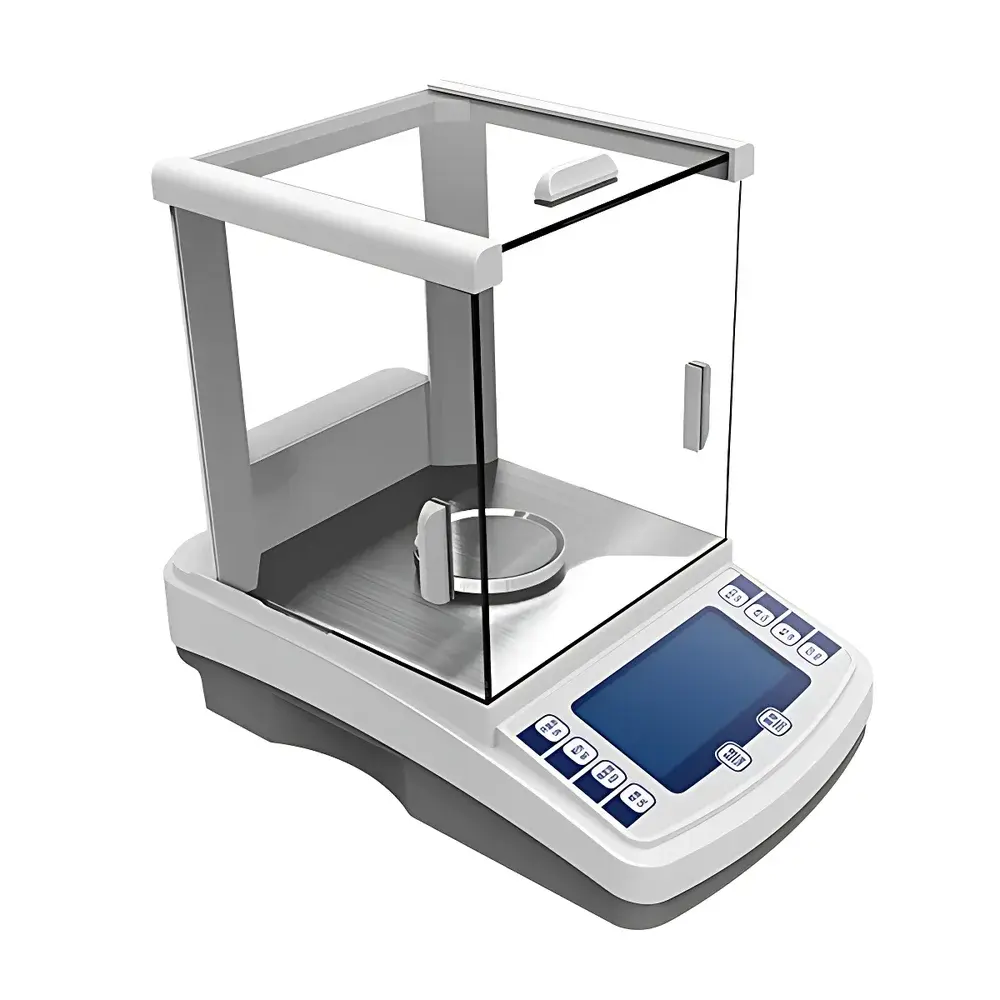
Yoke GL Series 0.1 mg Analytical Balance
| Brand | Yoke |
|---|---|
| Origin | Shanghai, China |
| Manufacturer Type | Direct Manufacturer |
| Product Category | Domestic (China-made) |
| Model Series | GL Series |
| Instrument Type | Analytical Balance |
| Capacity Range | 100–220 g |
| Readability | 0.1 mg |
| Repeatability | 0.1 mg |
| Calibration Method | External Calibration |
| Pan Diameter | 80 mm |
| Working Height Under Draft Shield | 240 mm |
| Dimensions (W×D×H) | 350 × 215 × 340 mm |
| Net Weight | 7.5 kg |
| Power Supply | 220 V / 50 Hz |
| Display | Backlit LCD (120 × 55 mm) |
| Interface | RS232 standard port |
| Unit Conversion | g, oz, ct |
| Compliance | Patented design (ZL201020562335.X) |
Overview
The Yoke GL Series 0.1 mg Analytical Balance is a precision laboratory instrument engineered for high-reproducibility mass measurement in regulated and research-intensive environments. Designed according to fundamental principles of electromagnetic force compensation, the balance delivers stable, drift-resistant readings under variable ambient conditions. Its 0.1 mg readability (100–220 g capacity range) meets the performance requirements for quantitative gravimetric analysis, standard solution preparation, pharmaceutical formulation, and quality control testing per ISO/IEC 17025 and USP <41>. The instrument’s core transduction system integrates sensor firmware developed in collaboration with STL Institute (Germany), enabling multi-point linearity correction and enhanced long-term stability across its operational temperature range (10–30 °C).
Key Features
- High-contrast backlit LCD display (120 × 55 mm) with intuitive icon-driven interface for rapid parameter navigation and real-time status feedback.
- Four-sided electrostatically coated glass draft shield — optically clear, low-reflectivity, and engineered to dissipate surface charge accumulation, minimizing electrostatic interference during microgram-level weighing.
- Electromagnetic force restoration mechanism with STI-optimized firmware ensures consistent sensitivity and repeatability of ±0.1 mg across all models (GL1004B, GL1204B, GL2004B, GL2204B).
- RS232 serial interface compliant with EIA-232 standards, supporting direct connection to thermal printers, LIMS workstations, or PC-based data acquisition systems without driver installation.
- Onboard unit conversion between grams (g), troy ounces (oz), and carats (ct), configurable via front-panel menu — essential for materials science labs handling precious metals, gemstones, or catalysts.
- External calibration architecture compatible with Class E2 or better certified weights; full calibration log retention accessible via serial output.
Sample Compatibility & Compliance
The GL Series accommodates a broad spectrum of sample types—including powders, granules, liquids in tared vessels, and small solid components—within its 80 mm diameter stainless-steel weighing pan and 240 mm vertical clearance beneath the draft shield. All units are manufactured and tested in accordance with JJG 1036–2019 (Chinese National Verification Regulation for Electronic Balances) and conform to international safety standards IEC 61010-1:2010 (Safety Requirements for Electrical Equipment for Measurement, Control, and Laboratory Use). While not FDA 21 CFR Part 11–certified out-of-the-box, the balance supports audit-trail-ready operation when integrated with validated third-party software platforms compliant with GLP/GMP documentation workflows.
Software & Data Management
Data export is natively supported via ASCII-formatted RS232 output, including timestamped weight values, unit identifiers, stability flags, and net/gross/tare status. No proprietary software is required; output is directly ingestible by Excel, LabArchives, or custom Python/Matlab scripts using standard serial communication protocols. Optional CSV logging mode enables batch export of sequential measurements with user-defined delimiters and header fields. Firmware revision history and calibration event timestamps are stored in non-volatile memory and retrievable via command-line query (e.g., “ID?”, “CAL?”), facilitating traceability during internal audits or ISO 17025 accreditation assessments.
Applications
- Preparation of reference standards and volumetric solutions in pharmaceutical QC laboratories (aligned with USP <1251>).
- Gravimetric determination of moisture content, ash residue, or volatile organic loss per ASTM E180–22 and ISO 536.
- Weighing of catalysts, nanomaterials, and thin-film substrates where sub-milligram resolution is critical to stoichiometric accuracy.
- Calibration of pipettes and burettes using the gravimetric method described in ISO 8655–6 and CLSI EP10-A3.
- Educational use in university analytical chemistry labs requiring NIST-traceable, entry-level analytical instrumentation with industrial-grade durability.
FAQ
What calibration weights are recommended for external calibration?
Class E2 stainless-steel weights (certified to OIML R111) are recommended for full-range verification. A 100 g E2 weight is sufficient for GL1004B/GL1204B; GL2004B/GL2204B require a 200 g or 220 g E2 weight.
Is the balance suitable for use in a fume hood?
No — the draft shield design assumes stable air currents. Operation inside a fume hood introduces turbulence and thermal gradients that compromise repeatability and settling time.
Does the instrument support internal calibration?
No — the GL Series implements external calibration only, as confirmed by hardware design and firmware architecture.
Can the RS232 interface be used with modern Windows/macOS systems?
Yes — via USB-to-RS232 adapters compliant with FTDI or Silicon Labs chipsets; no additional drivers required on Windows 10/11 or macOS 12+.
What environmental conditions are required for optimal performance?
Ambient temperature: 10–30 °C (±0.5 °C/hour max drift); relative humidity: 20–80% RH non-condensing; vibration-isolated benchtop surface recommended.