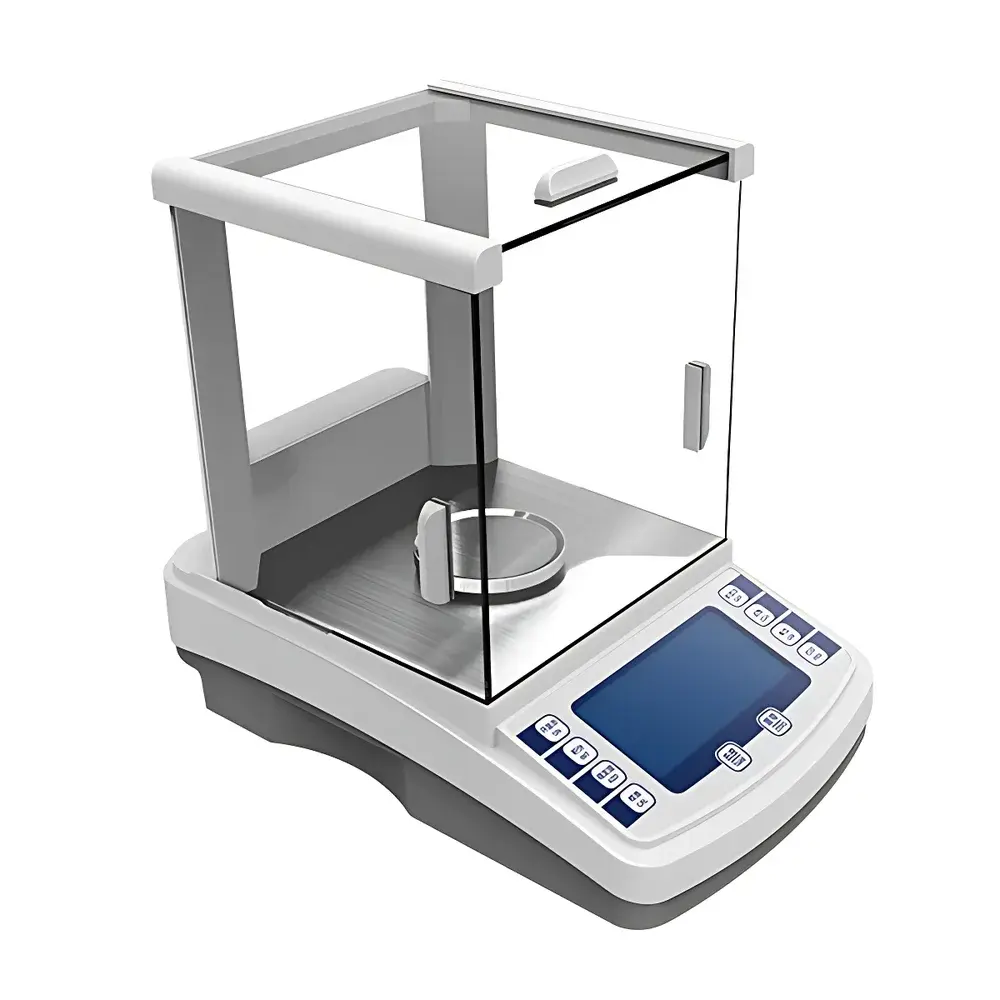
Yoke GL-C Series Internal Calibration Analytical Balance
| Brand | Yoke |
|---|---|
| Origin | Shanghai, China |
| Manufacturer Type | Direct Manufacturer |
| Product Category | Domestic |
| Model Series | GL-C |
| Instrument Type | Analytical Balance |
| Capacity Range | 100–220 g |
| Readability | 0.1 mg |
| Internal Calibration | Yes |
| Repeatability | 0.1 mg |
| Pan Diameter | 80 mm |
| Dimensions (W×D×H) | 350 × 215 × 340 mm |
| Net Weight | 8 kg |
| Working Height Under Draft Shield | 240 mm |
| Compliance | ISO 9001, GLP-compliant design, ASTM E898-22 recommended practices for analytical balance verification |
Overview
The Yoke GL-C Series Internal Calibration Analytical Balance is a precision mass measurement instrument engineered for laboratories requiring consistent, traceable, and operator-independent weighing performance. Built upon electromagnetic force restoration (EMFR) sensor technology, the GL-C series delivers high-resolution static mass determination with 0.1 mg readability across capacities from 100 g to 220 g. Unlike external calibration workflows that introduce procedural variability and environmental sensitivity, the integrated motor-driven internal calibration mechanism—activated at user-defined intervals or automatically upon power-on, temperature drift detection, or time-based scheduling—ensures continuous metrological integrity without manual weight handling. The balance conforms to fundamental principles outlined in ISO/IEC 17025:2017 (clause 6.4.8 on equipment verification), supports routine performance verification per USP and EP 2.1.5, and provides foundational compliance readiness for GLP and GMP environments where audit trails and calibration documentation are mandatory.
Key Features
- Electromagnetic force compensation sensor architecture delivering long-term stability, low thermal drift (<0.5 µg/°C), and high reproducibility (≤0.1 mg standard deviation under controlled conditions)
- Full-height, five-sided transparent draft shield with optimized airflow geometry to minimize convection currents and electrostatic interference during microgram-level measurements
- Backlit 128×64 pixel LCD display with adjustable contrast and large-character mode for ergonomic viewing under varied ambient lighting conditions
- Integrated self-diagnostic system performing real-time monitoring of sensor linearity, zero stability, overload status, and temperature compensation coefficients
- Four-point linear calibration routine executed automatically during internal calibration, correcting for nonlinearity across the full span with NIST-traceable reference standards embedded in firmware
- Rugged die-cast aluminum base and stainless-steel weighing pan (Φ80 mm) designed for chemical resistance and mechanical durability in QC and R&D settings
Sample Compatibility & Compliance
The GL-C series accommodates a broad range of sample types—including powders, granules, liquids in tared vessels, and small solid components—within its 240 mm working height envelope beneath the draft shield. Its sealed sensor chamber and conformal coating on internal PCBs provide protection against dust ingress (IP42-rated enclosure) and incidental moisture exposure. The balance meets mechanical safety requirements per EN 61010-1 and electromagnetic compatibility per EN 61326-1. While not certified to OIML R76 or NTEP, it is validated for use in non-regulated quality control labs, academic research, and method development where ISO/IEC 17025-aligned uncertainty budgets are maintained manually or via third-party calibration services. Documentation includes factory calibration certificate (as-shipped), linearity test report, and temperature drift characterization data.
Software & Data Management
The GL-C features RS232 serial interface (standard) and optional USB-to-serial adapter support for direct connection to LIMS, ELN, or statistical process control platforms. Weighing data output follows ASCII-based SCS protocol (Standard Communication Standard), enabling seamless integration with LabWare, STARLIMS, and custom Python/Matlab acquisition scripts. All internal calibration events—including timestamp, ambient temperature at execution, and deviation from nominal reference value—are logged in non-volatile memory and exportable as CSV. Audit trail functionality satisfies FDA 21 CFR Part 11 requirements when paired with validated host software implementing electronic signatures and role-based access controls. Firmware updates are performed via UART bootloader using manufacturer-provided utility tools.
Applications
- Pharmaceutical formulation: Active pharmaceutical ingredient (API) dispensing, excipient ratio verification, and content uniformity testing per USP
- Chemical synthesis: Stoichiometric reagent weighing, catalyst loading, and yield calculation in bench-scale reactions
- Materials science: Density determination of ceramics and polymers using pycnometry protocols
- Food & beverage QA: Nutrient labeling compliance checks, moisture content analysis via gravimetric loss-on-drying
- Environmental testing: Filter weighing for total suspended solids (TSS) and particulate matter (PM2.5/PM10) analysis per EPA Method 160.1
- Academic teaching labs: Fundamental metrology instruction, uncertainty propagation exercises, and calibration hierarchy demonstrations
FAQ
What does “internal calibration” mean for the GL-C series?
Internal calibration refers to an automated procedure wherein the balance engages a built-in, factory-adjusted reference mass and actuator to verify and adjust its weighing response without requiring external weights or operator intervention.
Is the GL-C series compliant with 21 CFR Part 11?
The hardware supports Part 11 requirements (audit trail, electronic signature readiness, data integrity); full compliance requires implementation of validated software controls on the connected host system.
Can the GL-C be used in a fume hood?
No—draft shields are not rated for volatile organic solvent environments; operation inside a fume hood compromises temperature stability and may damage internal electronics due to corrosive vapors.
How often should internal calibration be performed?
Yoke recommends calibration upon startup, after significant ambient temperature shifts (>2°C), and at least once per shift in regulated environments—frequency must be justified by risk assessment and documented in SOPs.
Does the GL-C support density determination mode?
No—density measurement requires auxiliary modules (e.g., density kit, sinker assembly) and dedicated firmware; this model supports only basic mass, percentage, and counting functions.