
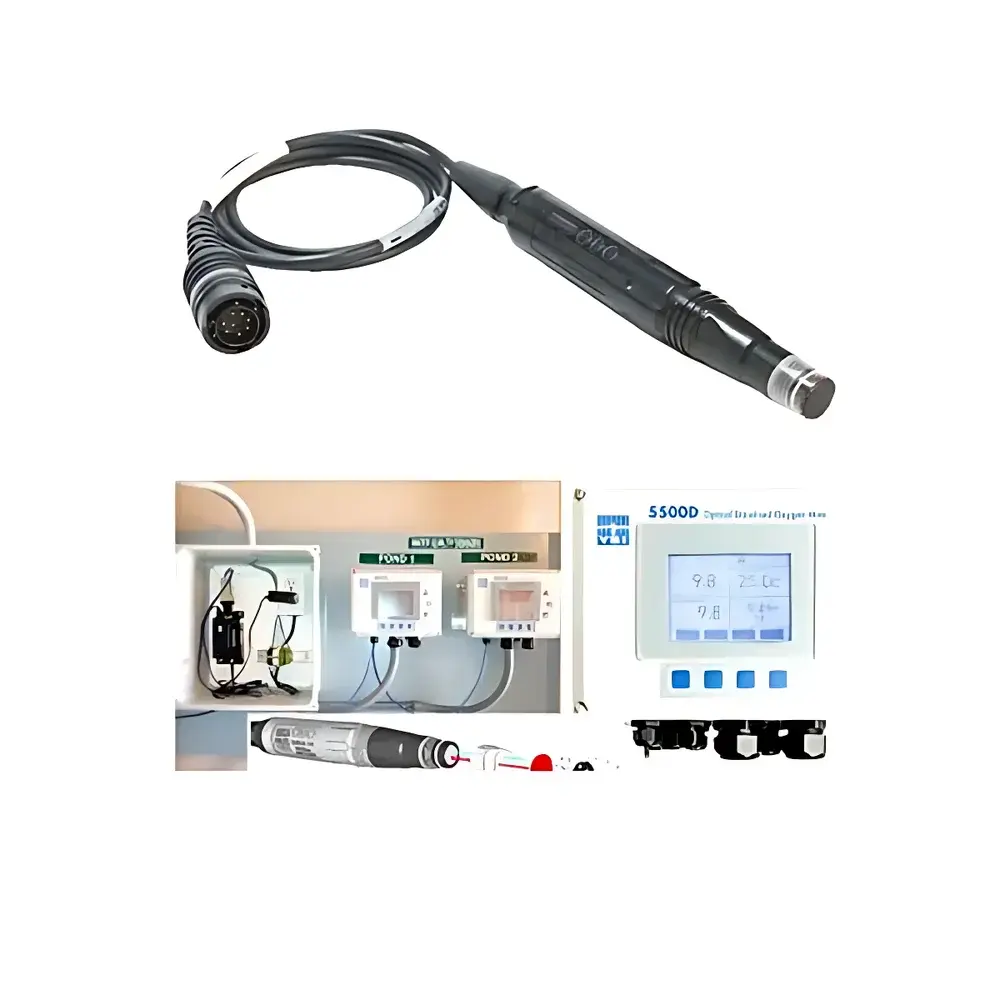
YSI 5500D Optical Dissolved Oxygen Monitor
| Origin | USA |
|---|---|
| Manufacturer Type | Authorized Distributor |
| Origin Category | Imported |
| Model | 5500D |
| Instrument Type | Laboratory & Field-Deployable Multi-Channel Monitor |
| Measurement Principle | Optical Luminescence Quenching (Ruthenium-based Sensor) |
| Dissolved Oxygen Range | 0–50 mg/L (or 0–500% air saturation) |
| Accuracy | ±1% of reading or ±0.1 mg/L (whichever is greater) for 0–20 mg/L |
| Resolution | 0.01 mg/L (≤20 mg/L), 0.1 mg/L (>20 mg/L) |
| Temperature Range | 0–45 °C |
| Temp. Accuracy | ±0.2 °C |
| Repeatability | 0.1% RSD |
| Detection Limit | <2 ppb (O₂ in water) |
| Communication | RS-485, RS-232, Ethernet (TCP/IP), Optional Wireless Module |
| Enclosure Rating | NEMA 4X, IP65, CE, ULC/CSA CUL, ETL, RoHS |
| Power Options | 12 VDC (backup capable) or 100–240 VAC auto-switching |
| Data Storage | 2000 measurement records, 1250 alarm/event logs, 1000 configuration change entries, 500 GLP-compliant audit trails |
| Software | AquaManager® (Windows 2000/XP/Vista/7/10), AquaViewer® (iOS/Android) |
Overview
The YSI 5500D Optical Dissolved Oxygen Monitor is an industrial-grade, multi-channel environmental monitoring system engineered for continuous, high-reliability dissolved oxygen (DO) and temperature measurement in aquaculture, wastewater treatment, research laboratories, and recirculating aquaculture systems (RAS). Unlike traditional electrochemical (Clark-type or polarographic) sensors, the 5500D employs solid-state optical luminescence quenching technology—based on a ruthenium complex immobilized in a hydrophobic polymer matrix—to quantify DO concentration. This principle relies on the dynamic quenching of photoluminescent emission by molecular oxygen, enabling precise, drift-free measurements without membrane replacement, electrolyte refills, or mechanical stirring. The system’s architecture supports up to four independent optical DO/temperature probe inputs, making it suitable for distributed pond, tank, or raceway monitoring networks where spatial resolution and long-term stability are critical.
Key Features
- Optical DO sensing with zero membrane maintenance, no electrolyte consumption, and no polarization delay—reducing total cost of ownership and field service intervals.
- Multi-channel capability: Configurable as single-, dual-, or quad-input units (models 5500D-DC/AC, 5500D-02-DC/AC, 5500D-04-DC/AC) for scalable deployment across heterogeneous water bodies.
- NEMA 4X and IP65-rated enclosure ensures robust operation in humid, saline, or outdoor environments—including coastal hatcheries and open-air ponds.
- Integrated temperature compensation (0–45 °C) with ±0.2 °C accuracy, supporting automatic DO correction per Winkler-derived solubility models.
- Programmable alarm thresholds (high/low DO, temperature, feed events) with relay outputs (8 configurable channels, 5 A @ 230 V AC/DC) for direct integration with aerators, pumps, or feeders.
- Comprehensive event logging: calibration history, alarm triggers, feed timer activations, and parameter deviations—all time-stamped and GLP-compliant.
- Flexible communication stack: native RS-485 Modbus RTU, RS-232 ASCII, and Ethernet TCP/IP; optional wireless bridge (YSI 5402 Serial-to-Ethernet module) enables remote SCADA integration.
Sample Compatibility & Compliance
The YSI 5500D is validated for use in freshwater, brackish, and marine matrices—including high-turbidity shrimp ponds, biofilter effluents, and laboratory mesocosms. Its optical sensor exhibits minimal fouling susceptibility and maintains performance under biofilm accumulation, eliminating routine cleaning cycles required by electrochemical probes. The system conforms to multiple regulatory and quality frameworks: CE marking for EMC and LVD compliance; UL/cUL and ETL listings for electrical safety; RoHS Directive 2011/65/EU for hazardous substance restriction; and design alignment with ISO 5814:2012 (water quality — determination of dissolved oxygen — electrochemical probe method) and ASTM D888-22 (standard test methods for dissolved oxygen in water), though optical methodology falls outside the scope of those standards’ procedural definitions. For GLP/GMP environments, AquaManager® software supports 21 CFR Part 11-compliant user authentication, electronic signatures, and full audit trail retention.
Software & Data Management
AquaManager® desktop software (Windows-compatible) provides centralized configuration, real-time visualization, historical trend analysis, and automated reporting. It supports multi-device topology mapping—displaying live status indicators (e.g., DO level, alarm state, connectivity) across dozens of tanks or ponds on a single georeferenced dashboard. Configuration changes, calibration events, and alarm conditions are logged with immutable timestamps and operator IDs. AquaViewer®, the companion mobile application (iOS and Android), delivers secure, role-based access to live and archived data via HTTPS, enabling remote decision-making during off-hours or emergency response. Both platforms support scheduled email/SMS alerts (up to 10 recipients per system via AquaManager) triggered by user-defined conditions—including low DO thresholds, temperature excursions, or feed cycle deviations. Data export is available in CSV, PDF, and XML formats for third-party LIMS or ERP integration.
Applications
- Aquaculture operations: Real-time DO optimization in high-density shrimp (Litopenaeus vannamei) and finfish (e.g., salmon, tilapia) production—reducing hypoxia-induced mortality and improving feed conversion ratios (FCR).
- Wastewater treatment plants: Monitoring DO in activated sludge basins and denitrification zones to maintain optimal nitrification/denitrification balance per EPA guidance.
- Research laboratories: Long-duration incubation studies requiring stable, non-invasive DO profiling in microcosms or bioreactors.
- Environmental monitoring networks: Deployed in estuarine transects or reservoir stratification studies where sensor longevity and minimal site visits are essential.
- Recirculating Aquaculture Systems (RAS): Closed-loop integration with oxygen injectors, UV sterilizers, and automated feeders using programmable logic via relay outputs and Modbus registers.
FAQ
Does the YSI 5500D require calibration in the field?
Yes—two-point calibration (zero and span) is recommended before initial deployment and at regular intervals per operational protocol; however, optical sensors exhibit significantly lower drift than electrochemical alternatives, extending recalibration intervals to 2–4 weeks under stable conditions.
Can the 5500D interface with existing SCADA or PLC systems?
Yes—via native Modbus RTU over RS-485 or Modbus TCP over Ethernet; register maps and communication protocols are documented in the YSI Integration Guide (P/N 626320-UG) and supported by standard industrial automation toolkits.
Is temperature measurement integrated into each DO probe?
Yes—each optical DO/temperature probe (e.g., model 626250-x) contains a calibrated Pt1000 RTD embedded adjacent to the sensing element, ensuring accurate, co-located thermal compensation.
What is the maximum cable length between the 5500D display unit and a probe?
Up to 60 meters using shielded, twisted-pair cable (YSI P/N 626250-60); signal integrity is maintained via differential signaling and built-in noise rejection circuitry.
How does the system handle data continuity during power outages?
The 5500D retains all stored logs and configurations in non-volatile memory; when powered by 12 VDC backup, it continues logging and alarming for up to 72 hours depending on relay activity and communication load.







