
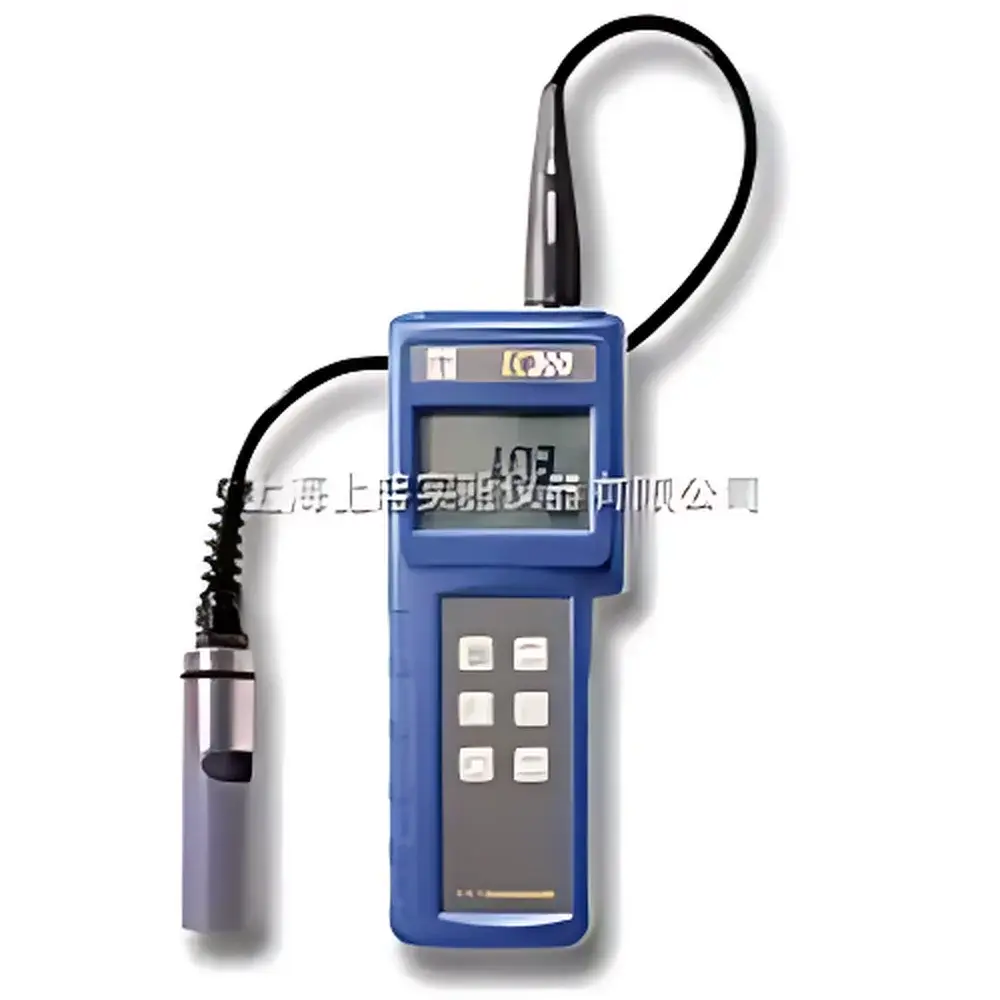
YSI EC300CC-04 Portable Conductivity Meter
| Origin | USA |
|---|---|
| Manufacturer Type | Authorized Distributor |
| Origin Category | Imported |
| Model | EC300CC-04 |
| Detection Parameters | Multi-parameter |
| Portability | Portable |
| Conductivity Range | 0–200 mS/cm |
| TDS Range | 0–100 g/L |
| Resistivity Range | 0–100 kΩ·cm |
| Salinity Range | 0–100 ppt |
| Temperature Range | 10–110 °C |
| Accuracy | ±0.5% of reading (typical) |
| Minimum Resolution | 0.001 µS/cm |
Overview
The YSI EC300CC-04 is a field-deployable, multi-parameter conductivity meter engineered for precision and reliability in environmental monitoring, water quality assessment, aquaculture, wastewater treatment, and industrial process control. Based on four-electrode (tetrapolar) AC conductivity measurement technology, the EC300 eliminates polarization errors and electrode fouling effects—enabling stable, drift-free measurements across wide dynamic ranges. Unlike two-electrode systems, its patented stainless-steel probe with integrated temperature sensor delivers simultaneous, compensated readings of conductivity, salinity, total dissolved solids (TDS), and temperature—calculated per ASTM D1125 and ISO 7888 standards. Designed for rugged field use, the instrument features an IP65-rated enclosure, robust mechanical architecture, and battery-powered operation optimized for extended deployments without external power sources.
Key Features
- Four-electrode conductivity cell with platinum-black coated electrodes for high stability, low maintenance, and resistance to surface contamination
- Integrated NTC thermistor for automatic temperature compensation (ATC) across 10–110 °C, supporting linear and non-linear (e.g., NaCl-based) compensation algorithms
- Automatic range switching across four conductivity decades: 0–499.9 µS/cm, 500–4999 µS/cm, 5.00–49.99 mS/cm, and 50.0–200.0 mS/cm
- Stainless-steel probe body with stress-relieved cable interface—reducing mechanical fatigue at the connector junction and extending service life of standard 4 m or optional 10 m cables
- Onboard calculation of derived parameters: specific conductance (at 25 °C), salinity (in ppt, per PSS-78), and TDS (with user-selectable conversion factor: 0.30–1.00 g/L, default 0.65)
- High-resolution display showing primary and secondary parameters simultaneously; data logging capability via optional PC interface (RS232)
- Operational ambient range: 0–50 °C, ≤95% RH non-condensing; powered by a single 9 V alkaline battery (typical 150-hour runtime)
Sample Compatibility & Compliance
The EC300CC-04 is validated for aqueous samples including freshwater, seawater, brackish effluents, cooling tower water, boiler feedwater, and nutrient solutions. Its tetrapolar geometry ensures minimal interference from electrochemical noise, biofilm buildup, or suspended solids—making it suitable for long-term immersion in natural and engineered water bodies. The instrument complies with key international water quality testing frameworks: ASTM D1125 (Standard Test Methods for Electrical Conductivity of Water), ISO 7888 (Water Quality — Determination of Electrical Conductivity), and US EPA Method 120.1. While not certified for GLP/GMP environments, its traceable calibration protocol supports audit-ready documentation when used with NIST-traceable reference standards (e.g., KCl solutions at 1413 µS/cm and 12.88 mS/cm).
Software & Data Management
Data export is supported via RS232 serial interface using YSI’s legacy ProComm software (Windows-compatible), enabling time-stamped data capture, calibration history archiving, and CSV export for post-processing in Excel or LIMS platforms. The firmware supports up to three-point conductivity calibration with manual entry of reference values and temperature offsets. All calibration events—including date, operator ID (user-entered), standard value, measured value, and deviation—are retained in non-volatile memory. Though lacking native 21 CFR Part 11 compliance (e.g., electronic signatures or audit trail encryption), the device meets baseline data integrity requirements for routine QA/QC applications under ISO/IEC 17025-accredited laboratories when paired with documented SOPs.
Applications
- Field-based monitoring of river, lake, and estuarine conductivity gradients for hydrological and ecological studies
- Salinity profiling in aquaculture ponds and marine hatcheries to maintain optimal osmoregulatory conditions
- Routine verification of reverse osmosis (RO) and deionization (DI) system performance in pharmaceutical and semiconductor clean water loops
- Wastewater influent/effluent characterization per municipal discharge permits (e.g., NPDES)
- Educational laboratory instruction in environmental science and analytical chemistry curricula
- Industrial cooling water management to detect scaling potential and corrosion risk indicators
FAQ
What calibration standards are recommended for the EC300CC-04?
NIST-traceable KCl solutions: 1413 µS/cm (25 °C), 12.88 mS/cm (25 °C), and optionally 80 mS/cm for high-salinity validation.
Can the EC300CC-04 measure resistivity directly?
No—it calculates resistivity inversely from conductivity (ρ = 1/σ) and displays it as a derived parameter in kΩ·cm units.
Is the probe suitable for continuous immersion?
Yes; the stainless-steel construction and IP65-rated housing support prolonged submersion, though periodic cleaning and recalibration are advised per ISO 5667-3 guidelines.
Does the instrument support user-defined TDS conversion factors?
Yes; the TDS multiplier can be adjusted between 0.30 and 1.00 g/L per ppm, accommodating different ionic matrices (e.g., NaCl vs. CaCO₃-dominated waters).
How is temperature compensation applied?
Automatically via built-in NTC sensor; users may select linear (2%/°C) or non-linear (PSS-78 seawater model) compensation modes depending on sample type.
Related Products





