
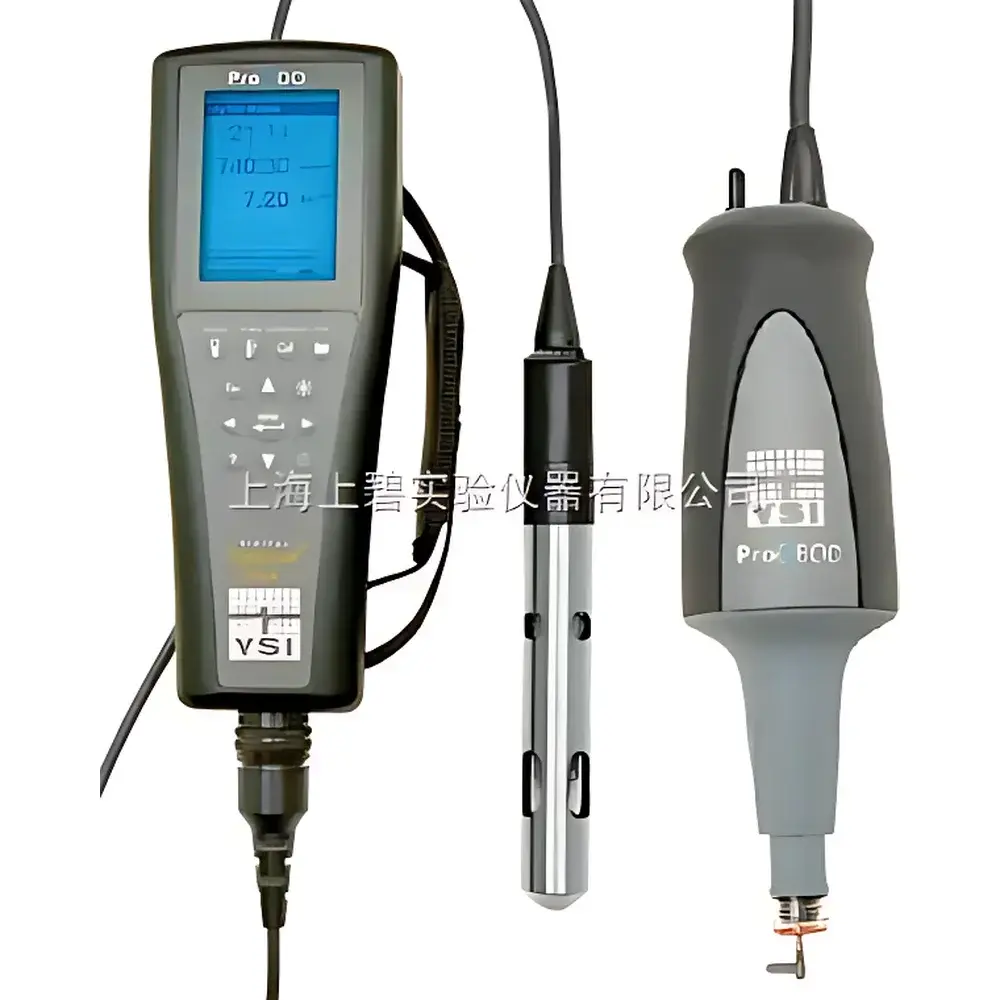
YSI ProODO and ProOBOD Optical Dissolved Oxygen Meters
| Origin | USA |
|---|---|
| Manufacturer Type | Authorized Distributor |
| Product Origin | Imported |
| Model | 626250-50 |
| Instrument Type | Laboratory |
| Measurement Principle | Fluorescence Lifetime Quenching (Non-consumptive Optical Sensing) |
| DO Range | 0.00–50.00 mg/L (0–500% saturation) |
| Accuracy | ±0.1 mg/L or ±1% of reading (0–20 mg/L) |
| Resolution | 0.01/0.1 mg/L (selectable) |
| Temperature Range | 5–70 °C |
| Temp Accuracy | ±0.2 °C |
| Barometric Pressure Range | 50–110 kPa |
| Pressure Accuracy | ±0.2 kPa (0–50 °C) |
| Response Time | T90 = 25 s, T95 = 45 s |
| Calibration | Single-point or two-point (including zero) for DO |
| Compliance | RoHS, CE, WEEE, C-Tick, VCCI, IP67, MIL-STD-810G drop-tested (1 m), ISO 9001-compatible GLP logging |
Overview
The YSI ProODO and ProOBOD optical dissolved oxygen (DO) meters represent the evolution of field-deployable, high-fidelity water quality instrumentation. Unlike traditional electrochemical sensors—such as galvanic or polarographic cells—that consume oxygen during measurement and require frequent maintenance, calibration, and membrane replacement, these instruments employ solid-state fluorescence lifetime quenching technology. A blue LED excites an oxygen-sensitive ruthenium-based luminophore immobilized on the sensor tip; molecular oxygen quenches the resulting red fluorescence in a predictable, temperature-compensated manner. The decay time (nanosecond-scale lifetime) is measured precisely and converted to DO concentration using factory-calibrated algorithms. This principle eliminates flow dependence, eliminates stirring artifacts, requires no warm-up time, and delivers exceptional long-term stability with minimal drift—enabling reliable operation across extended deployments without recalibration.
Key Features
- Optical DO sensing with zero oxygen consumption—ideal for low-flow, stagnant, or microcosm applications where electrochemical probes fail.
- Extended measurement range: 0–50 mg/L DO (0–500% air saturation), supporting hypoxic, normoxic, and hyperoxic environments—including aquaculture, wastewater nitrification zones, and oxygen-rich algal blooms.
- Smart digital sensor architecture: Calibration coefficients, serial number, and sensor history are embedded in onboard memory—ensuring plug-and-play compatibility with any ProPlus-series host instrument, even if previously uncalibrated.
- Ruggedized IP67-rated housing with dual-compartment design: Battery compartment and electronics chamber are physically isolated and sealed—preventing circuit damage even if battery leakage or immersion occurs.
- Ergonomic overmolded rubber grip and military-grade MS connector (MIL-C-38999 Series I) rated for >300,000 mating cycles; waterproof, vibration-resistant, and field-serviceable.
- Integrated barometric pressure sensor (±0.2 kPa accuracy) enables automatic, real-time compensation for altitude and weather-driven atmospheric fluctuations—critical for regulatory reporting under EPA Method 360.1 and ASTM D888.
- 2000-point internal data logger stores timestamped DO, temperature, pressure, salinity (manually entered, 0–70 ppt), site ID, and user-defined metadata—fully compliant with GLP audit trails per ISO/IEC 17025 requirements.
Sample Compatibility & Compliance
The ProODO probe is compatible with standard 300-mL BOD bottles (via ProOBOD adapter kit, model 626401), making it suitable for both field grab sampling and laboratory BOD5 incubation protocols. Its non-invasive optical surface allows direct immersion in natural waters (freshwater, estuarine, seawater), activated sludge, effluent streams, aquaculture tanks, and bioreactors. All configurations meet RoHS, CE, WEEE, C-Tick, and VCCI electromagnetic compatibility directives. The IP67 ingress protection rating and 1-meter drop resistance (per MIL-STD-810G) ensure operational integrity in harsh environmental monitoring conditions—from riverbanks to wastewater treatment plants. Data integrity is preserved via password-protected user accounts and full GLP logging (calibration dates, operators, standards used), satisfying documentation requirements for ISO 9001-certified labs and EPA-regulated compliance programs.
Software & Data Management
Data transfer and configuration are managed via YSI’s Data Manager software (v5.x), delivered with USB cable and communications cradle (model 605604). The software supports hierarchical folder structures (up to 100 custom-named sites/folders), batch export to CSV or Excel, graphical overlay of multi-parameter time series (DO vs. temp vs. pressure), and automated report generation with metadata embedding. USB 2.0 interface powers the instrument during download—eliminating battery drain during data offload. All communication adheres to YSI’s proprietary but openly documented ASCII protocol, enabling integration with third-party SCADA or LIMS platforms via serial-to-USB translation. Audit logs record all calibration events, parameter changes, and user logins—supporting 21 CFR Part 11 readiness when paired with institutional electronic signature policies.
Applications
- Regulatory water quality monitoring (EPA Region-specific NPDES, TMDL, and ambient monitoring programs)
- Wastewater treatment process control—especially in aeration basins, anoxic zones, and final effluent discharge points
- Aquaculture and hatchery management: real-time DO optimization to prevent hypoxia stress in finfish and shellfish operations
- Academic research: limnology, biogeochemistry, sediment-water interface studies, and climate-driven deoxygenation modeling
- Ecological field surveys: benthic habitat assessment, wetland health evaluation, and stormwater impact analysis
- Industrial process water monitoring: pharmaceutical clean utilities, power plant condensate systems, and food processing lines
FAQ
How does optical DO sensing differ from electrochemical methods?
Optical sensing measures fluorescence lifetime quenching by O2, requiring no oxygen consumption, membrane, electrolyte, or polarization time—resulting in superior stability, lower maintenance, and immunity to H2S or chloride interference.
Can the ProODO be used for BOD5 testing?
Yes—when paired with the ProOBOD adapter (model 626401), it fits standard 300-mL BOD bottles and provides traceable, temperature-compensated DO readings before and after 5-day incubation per Standard Methods 4500-O G.
Is salinity compensation automatic?
No—salinity must be manually entered (0–70 ppt) prior to measurement; the instrument applies standardized correction algorithms based on the UNESCO equation for oxygen solubility.
What is the expected service life of the optical sensor element?
The luminophore layer is rated for ≥12 months of continuous field use; replacement sensors are field-swappable and retain calibration memory.
Does the instrument support multi-parameter logging with other YSI sensors?
Yes—when used with a ProPlus host (not included), it interoperates seamlessly with pH, conductivity, turbidity, and ORP smart sensors via the same digital bus and Data Manager platform.
Related Products







