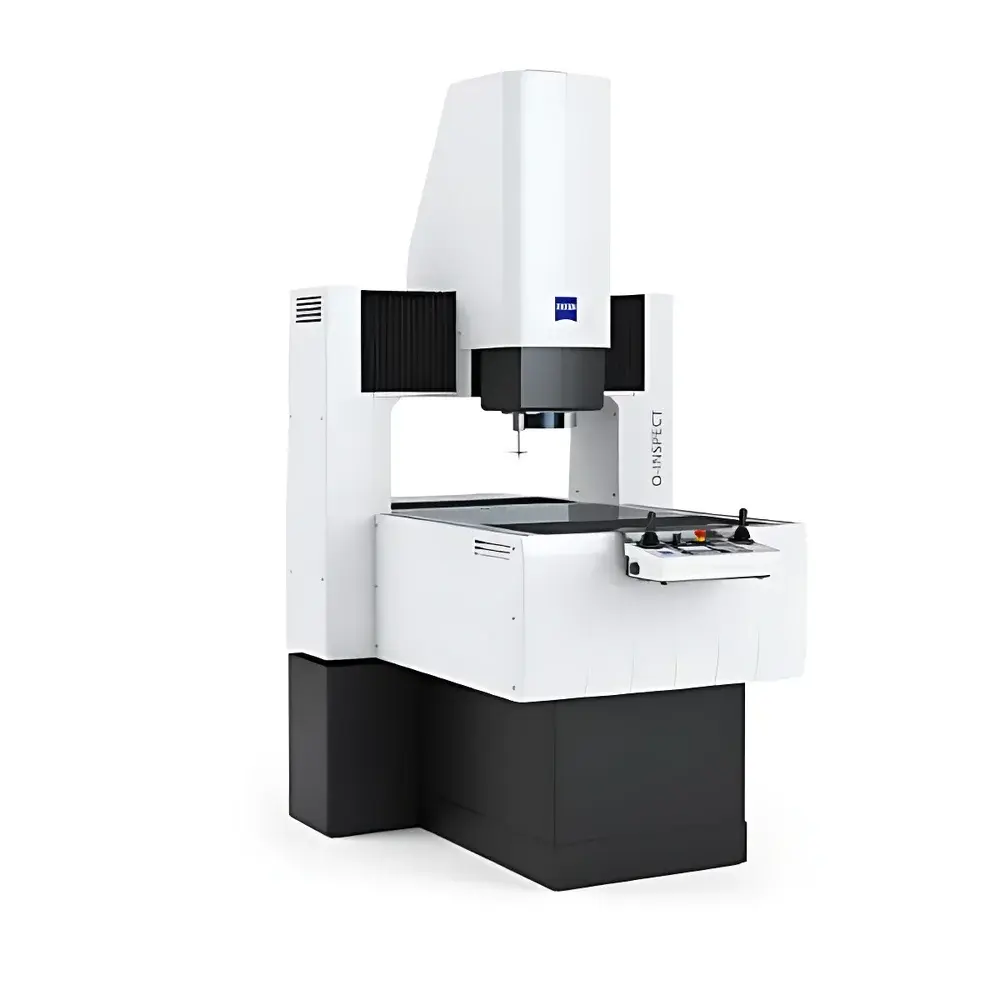
ZEISS O-INSPECT Multisensor Coordinate Measuring Machine
| Brand | ZEISS |
|---|---|
| Origin | Shanghai, China |
| Manufacturer Type | Original Equipment Manufacturer (OEM) |
| Product Origin | Domestic (China) |
| Model | O-INSPECT |
| Operation Mode | Fully Automatic |
| Sensor Options | ZEISS Discovery V12, scout 160, scout 240 |
| Optical Resolution Enhancement | Up to 2.4× vs. standard 100-type sensor |
| Field of View | 4× wider than conventional optics |
| Illumination System | Multi-angle, multi-mode LED-based coaxial & ring lighting |
Overview
The ZEISS O-INSPECT Multisensor Coordinate Measuring Machine (CMM) is an engineered solution for high-precision geometric metrology in production-integrated and laboratory environments. Combining optical imaging, tactile probing, and optional X-ray or laser scanning capabilities within a single platform, it operates on the principle of multisensor data fusion—enabling traceable, NIST-aligned dimensional verification across complex freeform and prismatic parts. Unlike legacy vision systems limited to 2D edge detection, the O-INSPECT implements calibrated photogrammetric measurement with sub-pixel edge localization algorithms, delivering certified uncertainty budgets compliant with ISO 15530-3 and VDI/VDE 2634 Part 2. Its rigid granite base, thermally stabilized bridge structure, and air-bearing linear drives ensure mechanical stability under varying workshop conditions (20 ± 1 °C, 40–60% RH), supporting repeatable measurements down to 0.5 µm length measurement uncertainty (LMU) at 20 °C.
Key Features
- Fully automated operation with programmable measurement sequences, including part loading/unloading via integrated conveyor or robotic interface (optional)
- ZEISS Discovery V12 optical system featuring apochromatic telecentric lenses and motorized zoom, delivering a field of view up to 4× larger than conventional optics while maintaining edge fidelity across the entire image plane
- Modular sensor architecture supporting interchangeable imaging units: scout 160 (1.6× higher optical resolution vs. standard 100-type) and scout 240 (2.4× enhancement), both compliant with ISO 10360-7 for optical CMM performance verification
- Adaptive multi-mode illumination system with independently controllable coaxial, ring, backlight, and structured light sources—optimized for contrast enhancement on reflective, matte, textured, or multi-material surfaces
- Integrated tactile probe head (ZEISS VAST XT) for contact-based feature verification, enabling hybrid GD&T evaluation per ASME Y14.5 and ISO 1101 standards
- Real-time thermal drift compensation using embedded temperature sensors and material-specific expansion modeling
Sample Compatibility & Compliance
The O-INSPECT accommodates parts ranging from miniature components (e.g., medical stents, watch gears) to mid-sized assemblies (up to 600 mm × 600 mm × 600 mm work envelope). It supports metallic, ceramic, polymer, and composite materials—including transparent polymers (via backlighting) and anodized aluminum (via polarized ring lighting). All measurement routines are designed for compliance with ISO/IEC 17025 accreditation requirements, and software workflows include full audit trails, electronic signatures, and calibration certificate linkage per ISO 9001 and IATF 16949 quality management frameworks. Optional FDA 21 CFR Part 11 compliance packages support pharmaceutical and regulated medical device manufacturing environments.
Software & Data Management
Calypso metrology software serves as the unified interface for programming, execution, and reporting. It provides GD&T-aware feature recognition, statistical process control (SPC) dashboards, and automated report generation in PDF, Excel, or XML formats. Measurement programs are version-controlled and exportable for cross-site replication. Raw image datasets, coordinate point clouds, and probe logs are stored in vendor-agnostic HDF5 format, ensuring long-term archival integrity. Calibration data—including lens distortion maps, illumination response curves, and probe qualification records—are digitally signed and time-stamped to satisfy GLP/GMP documentation requirements.
Applications
- Automotive: Verification of injection-molded plastic housings, stamped sheet metal flanges, and powertrain components against CAD-defined tolerances
- Electronics: Dimensional validation of PCB fiducials, SMT component placement accuracy, and connector pin geometry
- Medical Devices: First-article inspection of orthopedic implants, dental prosthetics, and microfluidic chips under ISO 13485 protocols
- Aerospace: Inspection of turbine blade root profiles, composite layup alignment markers, and fastener hole positioning
- Tool & Die: In-process verification of mold cavity geometry and electrode wear tracking
FAQ
Is the ZEISS O-INSPECT certified for ISO 10360 compliance?
Yes—the system undergoes annual performance verification per ISO 10360-7 (optical CMMs) and ISO 10360-2 (tactile probing), with certificates traceable to PTB or NIST reference standards.
Can measurement programs be transferred between different O-INSPECT units?
Yes—Calypso programs are hardware-agnostic and portable across identical model configurations; sensor-specific parameters are auto-adjusted during import based on installed hardware IDs.
What environmental conditions are required for optimal performance?
Operation is validated at 20 ± 1 °C ambient temperature with ≤0.5 °C/h drift; humidity control between 40–60% RH is recommended to minimize condensation risk on optical surfaces.
Does the system support automated pass/fail decision logic?
Yes—tolerance-based rule sets can be embedded directly into measurement routines, triggering configurable outputs (e.g., PLC signals, email alerts, database flags) upon nonconformance detection.
How is illumination calibrated for consistent contrast across batches?
Each illumination mode undergoes factory photometric characterization; user-level intensity calibration is performed using ZEISS-certified grayscale targets traceable to CIE Standard Illuminant D65.