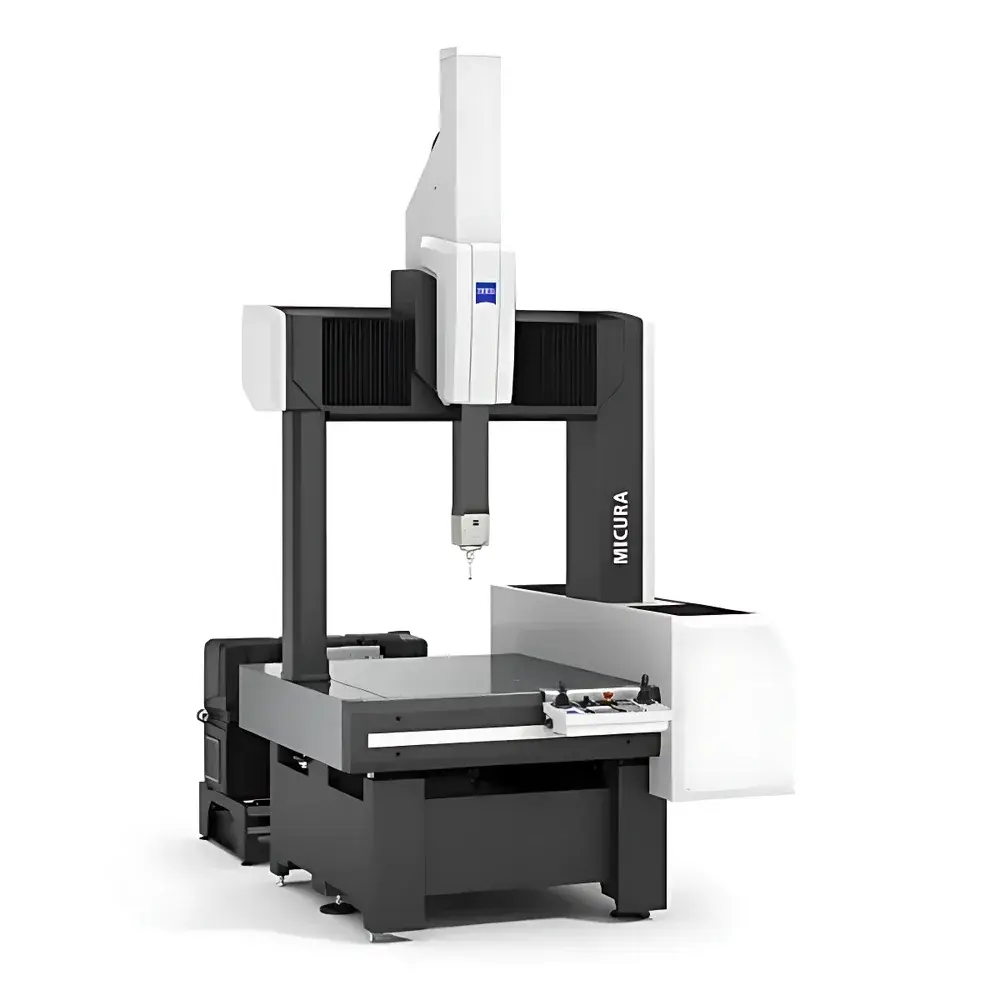
ZEISS MICURA Bridge Coordinate Measuring Machine
| Brand | ZEISS |
|---|---|
| Origin | Shanghai, China |
| Manufacturer Type | Original Equipment Manufacturer (OEM) |
| Regional Classification | Domestic Production |
| Model | MICURA |
| Configuration | Bridge-Type |
| Operation Mode | Fully Automatic |
| Instrument Orientation | Vertical CMM |
| Measurement Principle | Contact-Based Tactile Probing |
| Measuring Volume (X×Y×Z) | 500 × 700 × 600 mm |
| Volumetric Accuracy | < 1 µm (MPEE per ISO 10360-2) |
| Probe Systems | ZEISS VAST XT gold or VAST XTR gold active scanning probes |
| Maximum Scanning Speed | Up to 500 points/second |
| Minimum Probe Tip Diameter | 0.3 mm |
| Optional Rotary Axis | ZEISS RT-RB-100-1 4-axis rotary table |
| Compliance | ISO 10360, VDI/VDE 2617, ASTM E1379, GLP/GMP-ready data traceability |
Overview
The ZEISS MICURA Bridge Coordinate Measuring Machine is an ultra-precision, vertically oriented CMM engineered for high-reproducibility geometric metrology in demanding industrial environments. Built on ZEISS’s proprietary kinematic bridge architecture and integrated with high-stiffness granite base and air-bearing guideways, the MICURA delivers sub-micrometre volumetric measurement uncertainty — certified to MPEE < 1 µm per ISO 10360-2 — across its full measuring volume of 500 × 700 × 600 mm. Its compact footprint belies exceptional metrological performance, making it especially suited for quality assurance of miniaturised, high-tolerance components in electronics, medical device manufacturing, precision optics, and automotive powertrain systems. The system operates exclusively via tactile probing, leveraging ZEISS’s advanced active scanning technology to capture dense point clouds with deterministic repeatability, enabling both dimensional verification and comprehensive GD&T evaluation — including form (e.g., roundness, flatness, cylindricity), orientation (e.g., perpendicularity, parallelism), and location (e.g., position, concentricity) characteristics — all within a single setup.
Key Features
- Bridge-type mechanical design with thermally stable granite structure and precision-ground linear axes, minimising Abbe error and thermal drift.
- ZEISS VAST XT gold or VAST XTR gold active scanning probes — fully integrated with real-time dynamic compensation — support scanning speeds up to 500 points per second while maintaining traceable uncertainty budgets.
- VAST navigator technology enables adaptive motion control: the system automatically modulates probe velocity based on local surface curvature, feature complexity, and specified tolerance zones — accelerating measurement on low-risk geometries while conserving accuracy on critical surfaces.
- Sub-0.3 mm probe tip compatibility (including ruby, ceramic, and diamond stylus options) facilitates access to deep grooves, narrow slots, and micro-features typical in MEMS, semiconductor packaging, and implant-grade orthopaedic components.
- Optional ZEISS RT-RB-100-1 high-accuracy rotary table provides continuous 360° rotation and ±100° tilt, extending the system to full 4-axis measurement capability without compromising volumetric accuracy or requiring re-certification.
- Integrated thermal compensation using multi-point sensors and material-specific expansion algorithms ensures stability under ambient fluctuations common in production-floor environments (18–22 °C operating range).
Sample Compatibility & Compliance
The MICURA accommodates workpieces up to 50 kg (standard configuration) and supports fixturing solutions ranging from modular kinematic nests to custom vacuum chucks and magnetic bases. It is routinely deployed for first-article inspection and statistical process control (SPC) of machined aluminium housings, injection-moulded polymer connectors, sintered ceramic insulators, and laser-welded battery tabs. All measurement procedures comply with ISO 10360 series (particularly parts 2, 4, and 7), VDI/VDE 2617 guidelines for CMM validation, and ASTM E1379 for coordinate metrology system qualification. When operated with ZEISS CALYPSO software configured in audit-trail mode, the system meets FDA 21 CFR Part 11 requirements for electronic records and signatures — supporting regulated industries subject to GLP and GMP audits.
Software & Data Management
Controlled exclusively by ZEISS CALYPSO v7.x or later, the MICURA supports script-based programming (CALYPSO Script), automated report generation (PDF, Excel, XML), and direct integration with enterprise MES/QMS platforms via OPC UA or RESTful APIs. Measurement programs include full GD&T evaluation per ASME Y14.5 and ISO 1101, with configurable reporting of Cp/Cpk, process capability indices, and deviation heatmaps. All raw point data, calibration logs, environmental metadata, and operator credentials are time-stamped and cryptographically signed to ensure full data lineage — essential for ISO 9001:2015 clause 7.1.5.2 and IATF 16949 traceability mandates.
Applications
- Precision verification of optical lens mounts and alignment features in photonic assemblies.
- GD&T validation of fuel injector nozzles, turbocharger vanes, and EV motor stator laminations.
- First-article inspection of hermetically sealed medical device enclosures (e.g., pacemaker casings, endoscope distal tips).
- Form analysis of micro-electro-mechanical systems (MEMS) actuators and RF filter cavities.
- Tooling certification and wear monitoring of high-pressure die-casting dies and EDM electrodes.
FAQ
What is the maximum permissible error (MPE) for volumetric length measurement on the MICURA?
The certified MPEE is less than 1 µm across the full 500 × 700 × 600 mm measuring volume, verified per ISO 10360-2 using calibrated step gauges and artefacts traceable to PTB and NIST standards.
Can the MICURA perform non-contact measurements?
No — the MICURA is a dedicated tactile CMM; it does not incorporate optical, laser, or vision-based sensors. Non-contact functionality requires integration with a separate ZEISS METROTOM or COMET system.
Is the RT-RB-100-1 rotary table included as standard equipment?
The RT-RB-100-1 is an optional accessory. When installed, it extends the system to 4-axis operation and requires recalibration per VDI/VDE 2617 Part 10.
Does the MICURA support automated calibration of probe tips?
Yes — dynamic probe calibration is performed automatically during program execution using ZEISS’s spiral scanning and tangential approach routines, reducing manual intervention and improving long-term reproducibility.
What environmental conditions are required for optimal performance?
A temperature-controlled environment (20 ± 1 °C, with gradient ≤ 0.5 °C/h) and vibration-isolated foundation (ISO 230-2 Class 3) are recommended for achieving published accuracy specifications.