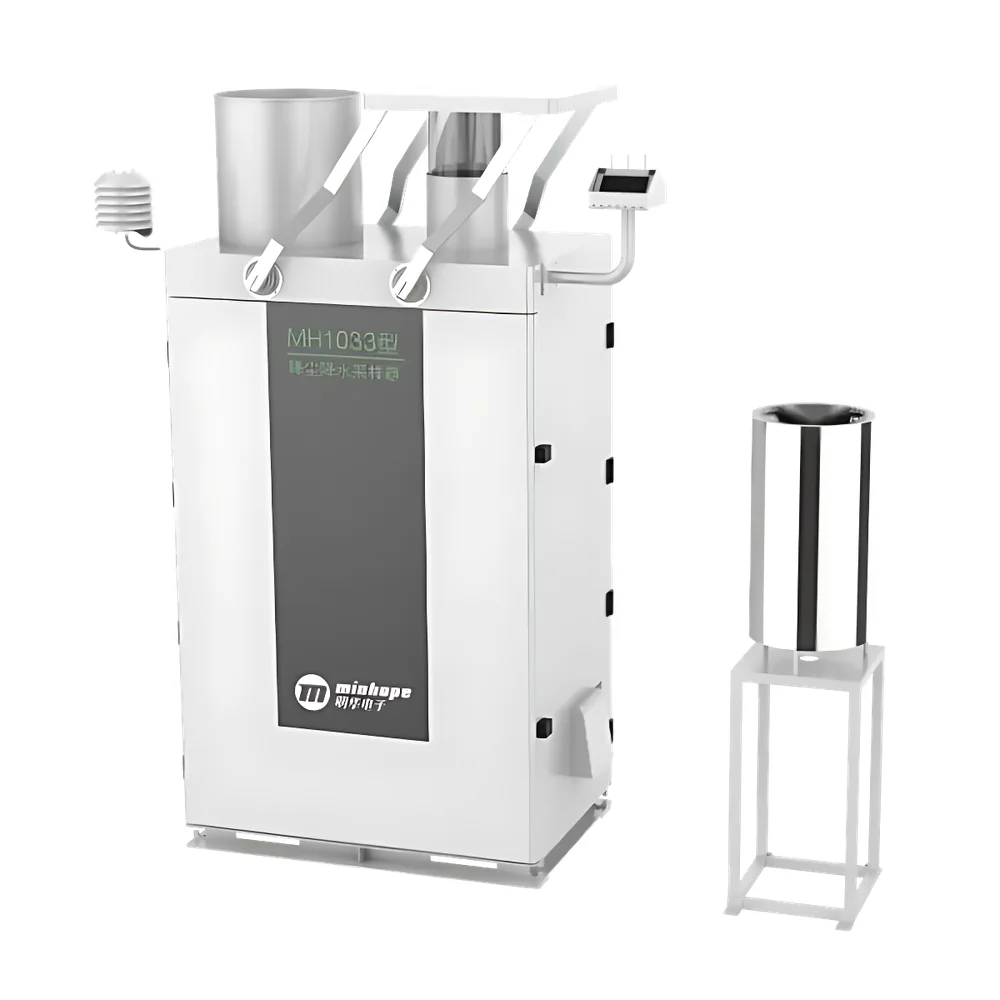
Minhope MH1033 Atmospheric Deposition Sampler

| Brand | Minhope |
|---|---|
| Origin | Shandong, China |
| Manufacturer Type | Authorized Distributor |
| Country of Origin | China |
| Model | MH1033 |
| Pricing | Available Upon Request |
| Compliance | HJ/T 174–2005, GB 13580.1–1992 to GB 13580.4–1992, GB/T 19117–2017 |
| Operating Modes | Rainfall-triggered, Time-based, Event-based, Interval-based |
| Sample Preservation | Refrigerated (4 °C ±1 °C), Humidity-controlled |
| Cover Actuation | Motorized Linear Actuator |
| Environmental Protection | Heated Lid & Forced-air Desiccation |
Ask about pricing, availability and specifications.
Overview
The Minhope MH1033 Atmospheric Deposition Sampler is an engineered field-deployable instrument designed for standardized, long-term monitoring of wet and dry atmospheric deposition—specifically rainfall, snowmelt, and bulk particulate fallout (commonly termed “dustfall” or “settled dust”). It operates on a gravimetric and volumetric collection principle: precipitation is captured in a calibrated open-top collector with automated lid control, while dry deposition is collected concurrently via passive settling onto a fixed-area, inert-surface tray beneath the same sheltered housing. The system integrates environmental conditioning—including programmable lid heating (to prevent freezing or condensation-induced contamination) and forced-air desiccation—to maintain sample integrity under variable ambient conditions. Its architecture conforms to the metrological and procedural requirements defined in Chinese national standards for atmospheric deposition monitoring, including HJ/T 174–2005 (Technical Requirements and Test Methods for Automatic Rainwater Samplers), the GB 13580 series (Methods for Sampling and Analysis of Atmospheric Precipitation), and GB/T 19117–2017 (Specifications for Acid Rain Observation). As such, it serves as a compliant platform for regulatory reporting, trend analysis, and source apportionment studies in environmental quality monitoring networks.
Key Features
- Motor-driven linear actuator lid mechanism: Ensures repeatable, low-backlash opening/closing with position feedback and mechanical end-stop protection—designed for >100,000 operational cycles under outdoor exposure.
- Integrated refrigerated sample storage: Maintains collected precipitation at 4 °C ±1 °C for up to 72 hours post-collection, minimizing microbial activity and analyte degradation (e.g., NH₄⁺, NO₃⁻, SO₄²⁻).
- Dual-path environmental conditioning: Independent heating circuit (up to +15 °C above ambient) for the collector rim prevents ice bridging; tangential fan-driven airflow across desiccant chambers reduces internal relative humidity to <40% RH during dry periods.
- Multi-mode sampling logic: Supports time-scheduled (e.g., 24-h composite), rain-event-triggered (≥0.5 mm threshold), cumulative rainfall-triggered (e.g., per 5 mm increment), and user-defined interval protocols—all programmable via local keypad or remote command.
- Robust enclosure: IP65-rated stainless-steel and UV-stabilized polymer housing rated for continuous operation between −30 °C and +55 °C, with corrosion-resistant fasteners and sealed cable entries.
Sample Compatibility & Compliance
The MH1033 accommodates standard 300 mm diameter polyethylene or fluoropolymer-coated collection funnels (ISO 9060-compliant geometry) and interchangeable 500 mL or 1 L HDPE sample bottles with leak-proof screw caps. Dry deposition trays conform to GB/T 19117–2017 dimensional specifications (200 mm × 200 mm × 25 mm depth) and are supplied with pre-weighed, ash-free quartz fiber filters for gravimetric mass determination. All wet chemistry analyses—including conductivity (GB 13580.3), pH (GB 13580.4), major ions, and trace metals—are supported by documented chain-of-custody procedures aligned with GLP principles. Data logs meet minimum audit-trail requirements per ISO/IEC 17025:2017 Annex A.2.11 for environmental testing laboratories.
Software & Data Management
The embedded controller records timestamped event logs (lid status, temperature, humidity, rainfall accumulation, battery voltage) at user-configurable intervals (1 min to 24 h). Local data export is supported via USB-C mass storage mode (CSV format), while optional 4G LTE or LoRaWAN modules enable secure TLS 1.2 transmission to centralized platforms (e.g., custom LIMS or cloud dashboards). Firmware supports remote configuration updates and diagnostic telemetry. All stored parameters comply with IEC 62443-3-3 security profile SL2 for industrial control systems. No proprietary software installation is required—data files adhere to UTF-8 encoding and include metadata headers referencing applicable GB/HJ standards.
Applications
- Long-term acid rain monitoring networks operated by provincial ecological environment monitoring centers.
- Source-receptor modeling for regional air pollution studies, particularly where crustal elements (Ca, Mg, Al), sea-salt ions (Na⁺, Cl⁻), or anthropogenic markers (SO₄²⁻, NO₃⁻, NH₄⁺) require quantification in bulk deposition.
- Validation of atmospheric chemistry transport models (e.g., CMAQ, WRF-Chem) through comparison of modeled vs. observed deposition fluxes.
- Compliance monitoring for industrial emission permits requiring annual deposition load assessments near stack zones.
- Baseline characterization in ecological restoration projects—especially in semi-arid or high-altitude regions where dry deposition contributes >40% of total nutrient or contaminant input.
FAQ
Does the MH1033 support simultaneous wet and dry deposition collection during the same deployment cycle?
Yes. The instrument’s dual-compartment design allows concurrent operation: the upper funnel collects precipitation while the lower tray captures settled particulates—both housed within a single weatherproof enclosure with shared environmental controls.
Is calibration documentation provided for traceable measurement uncertainty?
Each unit ships with a factory calibration certificate referencing NIM-traceable rain gauge simulators and temperature/humidity standards. Field recalibration procedures for lid actuation timing and refrigeration setpoint are detailed in the technical manual.
Can the system be integrated into existing SCADA or EMS platforms?
Yes—via Modbus RTU over RS-485 (standard) or optional MQTT/JSON over TCP/IP. Register maps and API endpoints are published in the Integration Guide (Rev. 3.1).
What maintenance intervals are recommended for extended unattended operation?
Desiccant replacement every 90 days; funnel cleaning after each precipitation event exceeding 20 mm; annual verification of refrigeration performance and lid actuator torque.
Is the MH1033 suitable for coastal or high-salinity environments?
Yes—the housing uses marine-grade 316 stainless steel fasteners and electropolished aluminum structural components. All electronics are conformally coated to IPC-CC-830B Class 3 standards for salt fog resistance (per ASTM B117, 500-hour test).