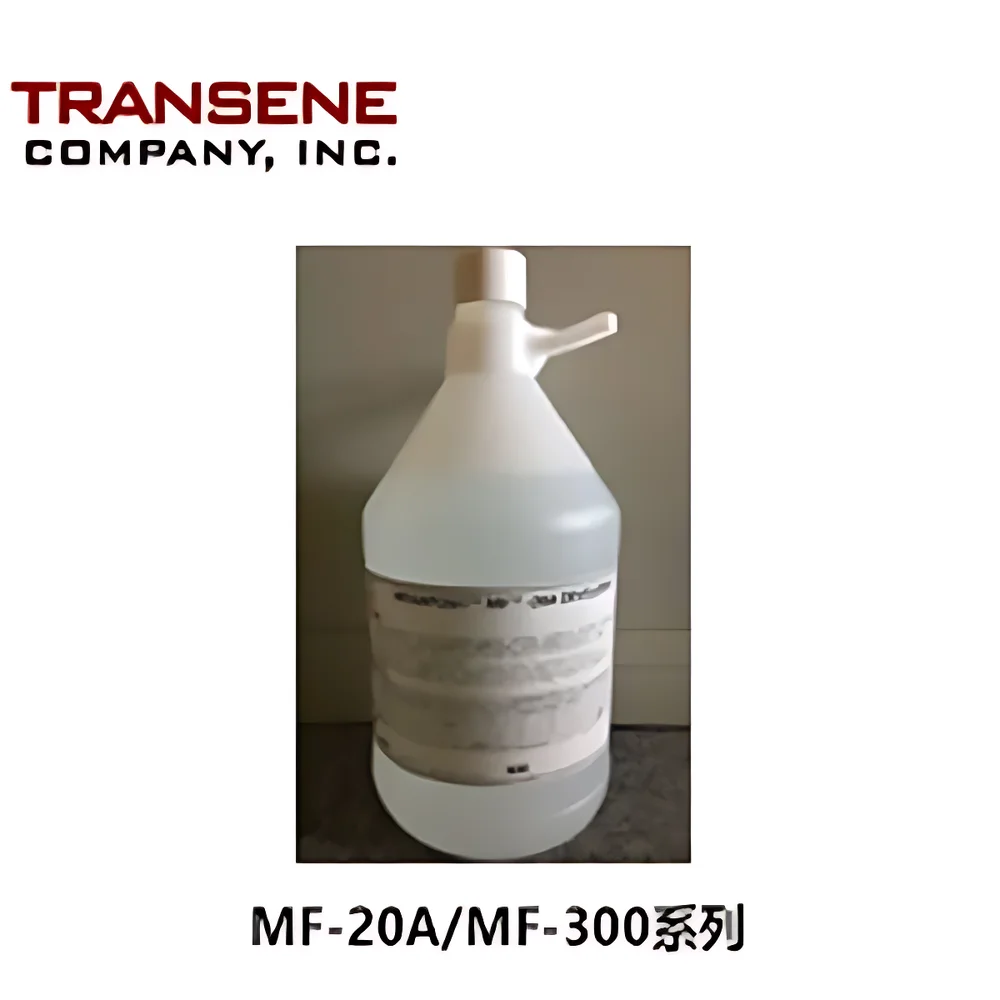
MicroChem MF-20A / MF-300 Series Semiconductor Photoresist Developer (MIF Grade)

| Brand | MicroChem Corp |
|---|---|
| Origin | Germany |
| Product Line | MF-20A Series (MF-21A: 0.21N, MF-24A: 0.24N, MF-26A: 0.26N) / MF-300 Series (MF-319: 0.237N, MF-321: 0.21N, MF-322: 0.268N) |
| Purity Grade | Metal-Ion-Free (MIF) |
| Compliance | Semiconductor-grade reagent per SEMI C1–C12 specifications |
| Packaging | Sealed HDPE or fluoropolymer-lined containers (1L, 4L, 20L, and bulk options) |
Ask about pricing, availability and specifications.
Overview
The MicroChem MF-20A and MF-300 Series are high-purity, metal-ion-free (MIF) aqueous alkaline developers engineered specifically for advanced photolithography processes in semiconductor front-end manufacturing. These formulations utilize precisely controlled tetramethylammonium hydroxide (TMAH) concentrations—ranging from 0.21N to 0.268N—to deliver consistent dissolution kinetics across g-line, i-line, KrF, and ArF photoresists. Unlike conventional developers containing trace alkali metal cations (e.g., Na⁺, K⁺), the MIF grade eliminates risks of metallic contamination that can induce gate oxide defects, junction leakage, or threshold voltage instability in sub-100 nm node devices. Each lot undergoes rigorous certification per SEMI C1 (chemical purity), C7 (particulate content), and C12 (metal impurity limits ≤ 10¹⁰ atoms/cm² surface equivalent), ensuring compatibility with 300 mm wafer fabs operating under ISO Class 1 cleanroom protocols.
Key Features
- Metal-ion-free (MIF) formulation certified to SEMI C12 specifications, with total metallic impurities < 10 ppt (by ICP-MS) for Fe, Al, Cu, Ni, Cr, Zn, Na, K, Ca, and Mg
- Precision-normalized TMAH concentration: ±0.002N tolerance across all variants (MF-21A, MF-24A, MF-26A, MF-319, MF-321, MF-322)
- Low-particulate (< 0.5 particles/mL ≥ 0.2 µm, measured per SEMI C7) achieved via sub-micron filtration and Class 10 cleanroom bottling
- Stabilized pH profile (pH 13.4–13.8 at 23°C) with minimal drift over 12-month shelf life when stored unopened at 15–25°C
- Compatible with automated wet-processing tools including Tokyo Electron’s CLEAN TRACK™, Lam Research’s SOLA™, and SCREEN’s D-300 series track systems
- Traceability documentation includes CoA (Certificate of Analysis), CoC (Certificate of Conformance), and full elemental impurity reports per ICH Q3D guidelines
Sample Compatibility & Compliance
These developers are validated for use with industry-standard positive-tone chemically amplified resists (CARs), including but not limited to: TOK’s SAL601 and UVIII series, JSR’s APEX-E and AR-P series, Shin-Etsu’s SEPR series, and Dow Electronic Materials’ XP series. All MF-series lots comply with SEMI standard C1 (specifications for electronic chemicals), C7 (particulate requirements), and C12 (trace metal limits). The MIF designation confirms conformance with SEMI C12 Annex A for ultra-low-metal applications in logic, memory (DRAM/NAND), and advanced packaging (e.g., Fan-Out Wafer-Level Packaging). Batch-specific data supports FDA 21 CFR Part 11-compliant electronic record retention in GMP-aligned environments.
Software & Data Management
While the MF-series itself is a consumable reagent, its integration into fab-wide process control relies on traceability via MicroChem’s LotLink™ digital platform. Each container bears a unique QR-coded label linking to real-time access of analytical data—including ICP-MS spectra, particle count logs, conductivity profiles, and thermal stability test results. This system enables seamless audit readiness for ISO 9001:2015, IATF 16949, and internal fab QA workflows. Data exports support CSV, PDF, and XML formats compatible with MES platforms such as Applied Materials’ EnduraLink and KLA’s 5D Inspector.
Applications
- Front-end-of-line (FEOL) lithography for 28 nm to 3 nm logic nodes
- High-aspect-ratio patterning in 3D NAND and DRAM capacitor stacks
- Backside illumination (BSI) CMOS image sensor development requiring ultra-low metal budgets
- Advanced packaging lithography for redistribution layers (RDL) and through-silicon vias (TSV)
- Research and development of EUV resists where developer-induced metal migration must be excluded
- Qualification of new resist platforms under JEDEC JESD22-A108 accelerated corrosion testing protocols
FAQ
What does “MIF” stand for, and why is it critical for advanced nodes?
MIF stands for Metal-Ion-Free. In sub-7 nm technology nodes, even parts-per-quadrillion levels of Fe or Cu can catalyze oxidation or cause parametric shifts in FinFET threshold voltage. MIF developers eliminate this risk by substituting TMAH for NaOH/KOH-based systems.
Are MF-26A and MF-319 interchangeable in production?
No—they differ in nominal TMAH strength (0.26N vs. 0.237N) and dissolution rate profiles. Process qualification requires matching the developer to the resist’s deprotection kinetics; substitution mandates full lithographic requalification per SEMI E10.
How is lot-to-lot consistency verified?
Each production lot undergoes dual-certification: (1) in-house QC using calibrated conductivity meters and titration standards traceable to NIST SRM 919a, and (2) third-party verification at an ISO/IEC 17025-accredited lab for metals, anions, and organics.
Do these developers require special handling or storage conditions?
Yes. Store unopened containers in temperature-controlled environments (15–25°C), away from direct sunlight. Avoid repeated freeze-thaw cycles. Once opened, use within 30 days under nitrogen blanket to prevent CO₂ absorption and carbonate formation.
Is technical support available for process integration?
Yes. MicroChem provides application engineering support—including resist-developer compatibility mapping, defect root-cause analysis, and SPC charting templates—for qualified fab customers under NDA.