

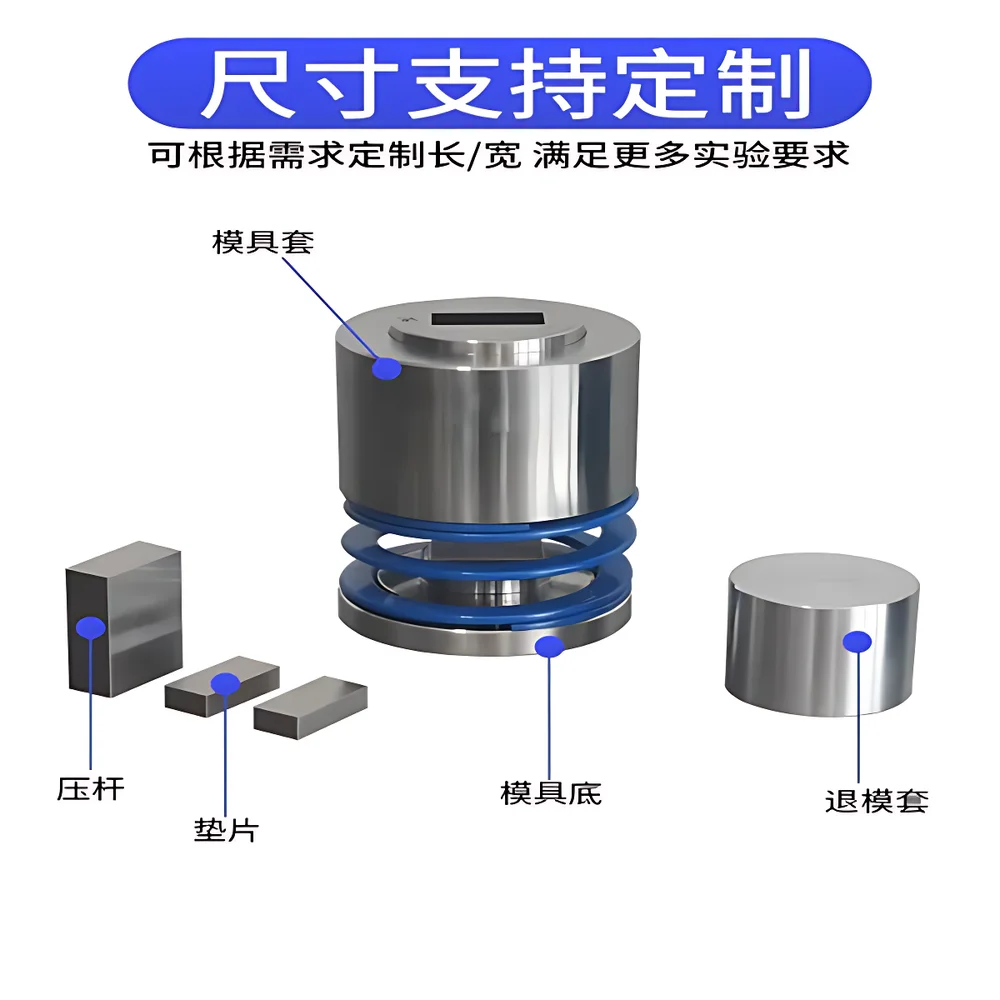
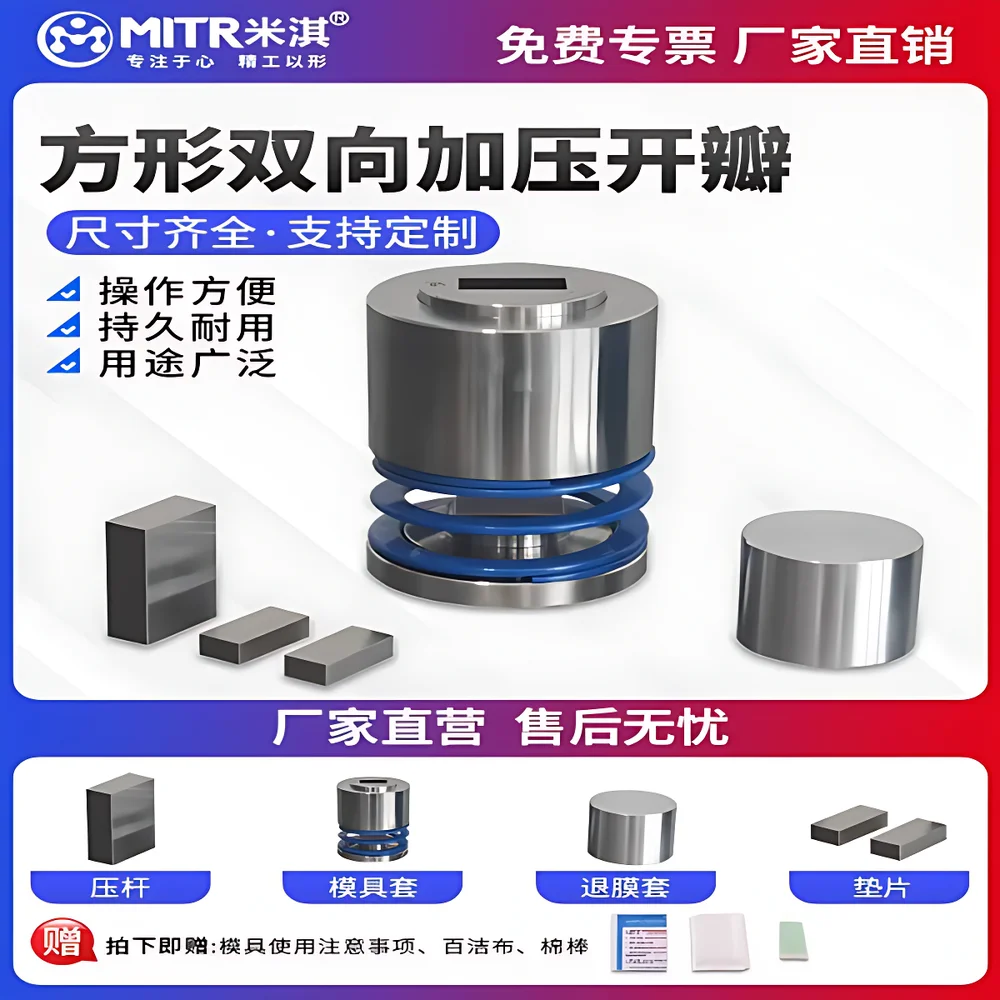
Mitri MC-8 Dual-Action Hydraulic Pellet Press Die Set for FTIR/KBr Spectroscopy Sample Preparation

| Brand | Mitri |
|---|---|
| Model | MC-8 |
| Type | Square-Profile, Two-Directional Compression Die |
| Material | Hardened Tool Steel (HRC 58–62) |
| Maximum Rated Pressure | 30 Ton (300 kN) |
| Compatible Press Stroke | ≥40 mm |
| Cavity Dimensions | 13 mm × 13 mm × 5 mm (W × L × H) |
| Die Pin Diameter Options | 5 mm, 6 mm, 8 mm, 10 mm, 13 mm |
| Surface Finish | Ground & Polished (Ra ≤ 0.4 µm) |
| Compliance | ISO 9001–certified Manufacturing |
| Origin | Hunan, China |
Ask about pricing, availability and specifications.
Overview
The Mitri MC-8 Dual-Action Hydraulic Pellet Press Die Set is a precision-engineered tooling system designed specifically for reproducible, high-integrity sample preparation in Fourier Transform Infrared (FTIR) spectroscopy, X-ray fluorescence (XRF), and elemental analysis workflows. Unlike single-action dies, the MC-8 employs symmetrical, two-directional compression—applying force simultaneously from both top and bottom punches—to eliminate density gradients, minimize die-wall friction, and ensure uniform compaction across the entire pellet cross-section. This principle of balanced axial loading conforms to ASTM E1712–22 guidelines for pressed-pellet homogeneity in analytical reference material preparation. The square-profile cavity (13 mm × 13 mm) supports standardized sample geometry for consistent beam path interaction in transmission-mode IR cells and automated stage positioning in benchtop spectrometers. Constructed from vacuum-hardened tool steel (HRC 58–62), the die set maintains dimensional stability under repeated loads up to 300 kN, with surface roughness controlled to Ra ≤ 0.4 µm to prevent powder adhesion and facilitate clean ejection.
Key Features
- Dual-action compression architecture eliminates axial density variation and reduces preferred orientation effects in crystalline powders
- Interchangeable punch diameters (5 mm to 13 mm) enable scalable pellet mass generation while preserving pressure equivalence across geometries
- Ground-and-polished cavity walls minimize shear-induced particle fracture and preserve native particle morphology during compaction
- Integrated alignment sleeves ensure coaxial punch travel within ±2 µm tolerance, preventing off-axis loading and premature die wear
- Corrosion-resistant surface treatment (black oxide + optional passivation) extends service life in ambient lab environments with controlled humidity (<40% RH)
- Tool-free disassembly design allows rapid cleaning and inspection without torque-sensitive reassembly
Sample Compatibility & Compliance
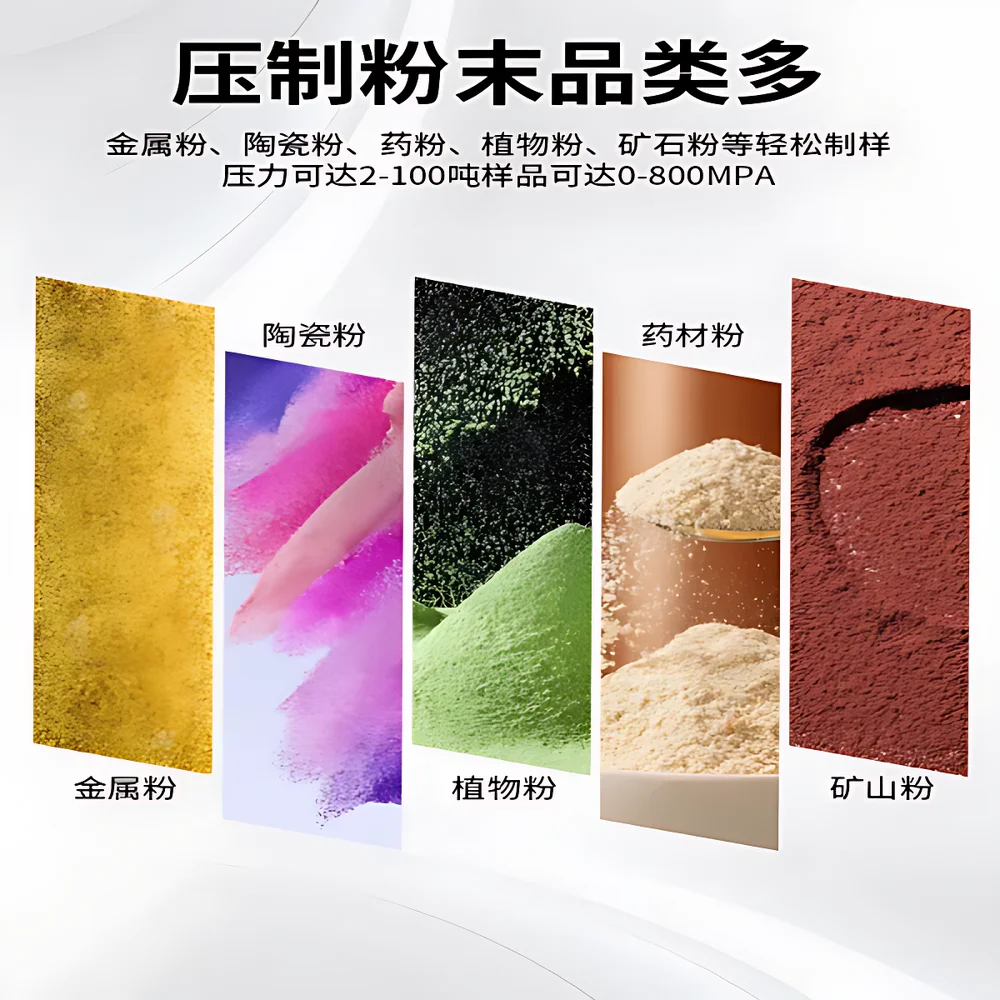
The MC-8 die set is validated for use with KBr, NaCl, CsI, and polyethylene matrices, as well as inorganic oxides (e.g., Al2O3, SiO2) and metal powders (Al, Mg, Zn) when paired with appropriate dry or alcohol-based lubricants (e.g., microcrystalline cellulose, stearic acid in ethanol). Powder feedstock must be pre-sieved to 30–75 µm per ISO 13320:2020 laser diffraction requirements; particles 75 µm induce localized stress concentrations that compromise cavity integrity. The system complies with GLP documentation standards for traceable sample preparation—each die batch carries a serialized calibration certificate referencing hardness verification (Rockwell C scale) and cavity dimension metrology (CMM traceable to NIST SRM 2191c). It is not rated for explosive, pyrophoric, or highly corrosive compounds (e.g., alkali metals, anhydrous halides).
Software & Data Management
While the MC-8 is a mechanical die set (not instrument-integrated), its operational parameters are fully compatible with digital press controllers (e.g., Carver 4350, Specac Atlas) supporting ASTM E2921–21-compliant pressure ramp logging. Users may assign unique identifiers to each die via Mitri’s optional QR-coded asset tags—enabling linkage to LIMS entries for audit trails covering usage count, last cleaning date, and operator ID. All maintenance logs—including ethanol wipe frequency, desiccant replacement, and post-use visual inspection records—align with FDA 21 CFR Part 11 electronic record retention requirements when stored on validated network drives.
Applications
- Preparation of transparent KBr pellets for quantitative FTIR analysis of organic functional groups (e.g., carbonyl stretching at 1700 cm−1)
- Homogeneous dispersion of catalysts (e.g., Pt/C, Ni/Al2O3) in inert matrices for in situ DRIFTS studies
- High-density sintering of ceramic precursors (BaTiO3, YSZ) prior to XRD phase identification
- Standardized pellet fabrication for certified reference materials (CRMs) under ISO Guide 35 protocols
- Controlled compaction of pharmaceutical excipients (lactose, microcrystalline cellulose) in formulation development
FAQ
What is the maximum recommended operating pressure for the 5 mm punch configuration?
The 5 mm diameter punch is rated for sustained use up to 150 kN (15 Ton); exceeding this threshold increases risk of punch deformation or catastrophic failure.
Can I use aqueous lubricants with this die set?
No—water-based agents accelerate surface oxidation. Only anhydrous ethanol solutions or volatile organic solvents (e.g., acetone, chloroform) are acceptable for cleaning and lubrication.
How often should the die cavity be inspected for micro-scratches or pitting?
Visual inspection under 10× magnification is required before each use; metrological verification (CMM or optical profilometry) is recommended every 200 compressions or quarterly, whichever occurs first.
Is the MC-8 compatible with hydraulic presses lacking dual-action capability?
Yes—but unilateral compression will produce non-uniform pellets with edge cracking and reduced spectral transmission; dual-action operation is mandatory for ISO/IEC 17025-accredited laboratories.
Does Mitri provide calibration services for used die sets?
Yes—Mitri offers third-party accredited recalibration (ISO/IEC 17025:2017) including hardness re-verification, cavity dimensional mapping, and surface finish assessment upon return shipment.

