

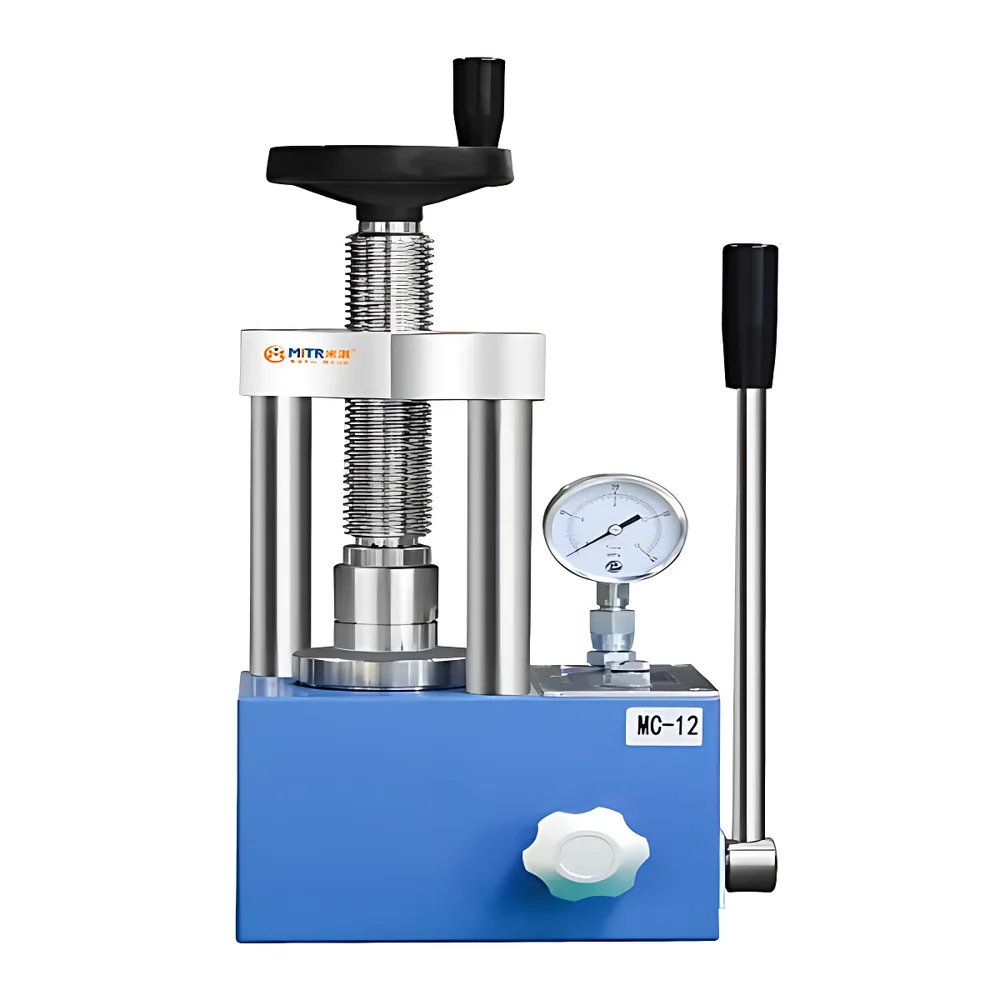
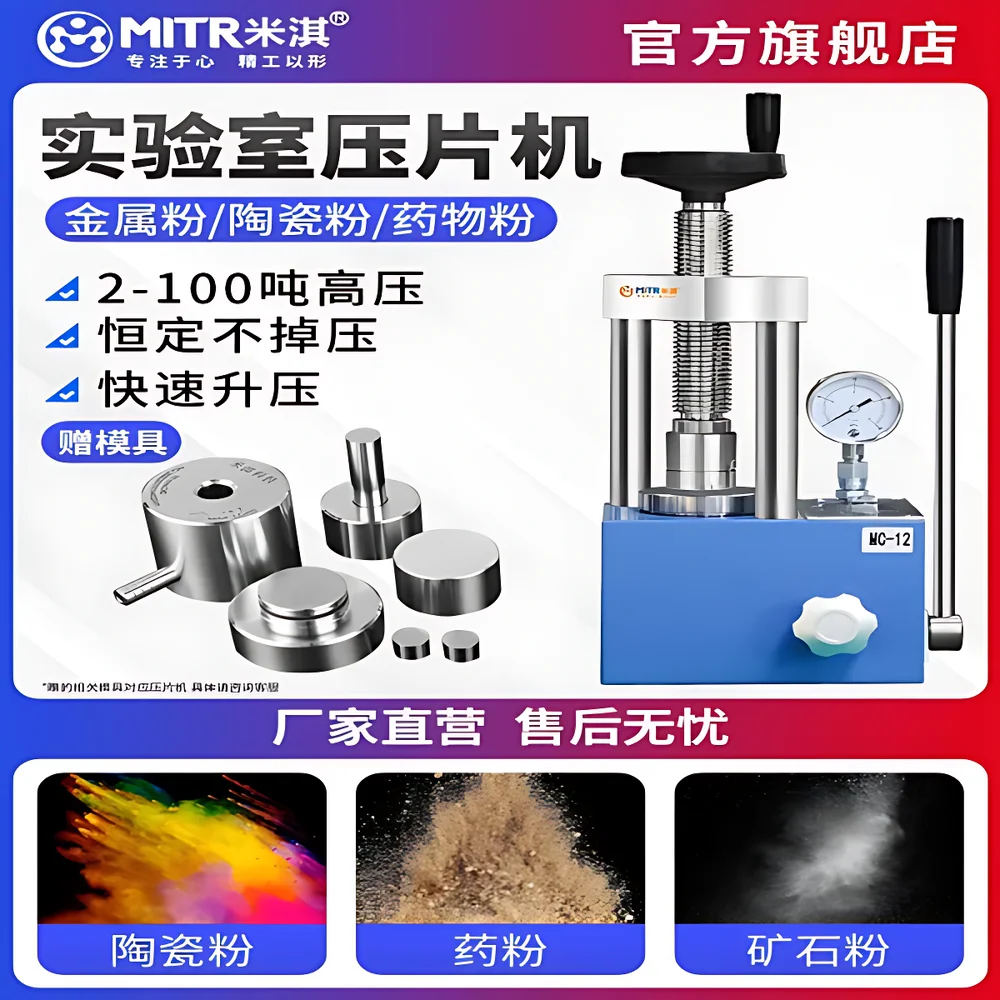
Mitri MJ-4 Manual Powder Pellet Press for FTIR Sample Preparation (3–15 Ton Force Range)

| Brand | Mitri |
|---|---|
| Model | MJ-4 |
| Max Applied Force | 3–15 Ton (adjustable via manual hydraulic lever) |
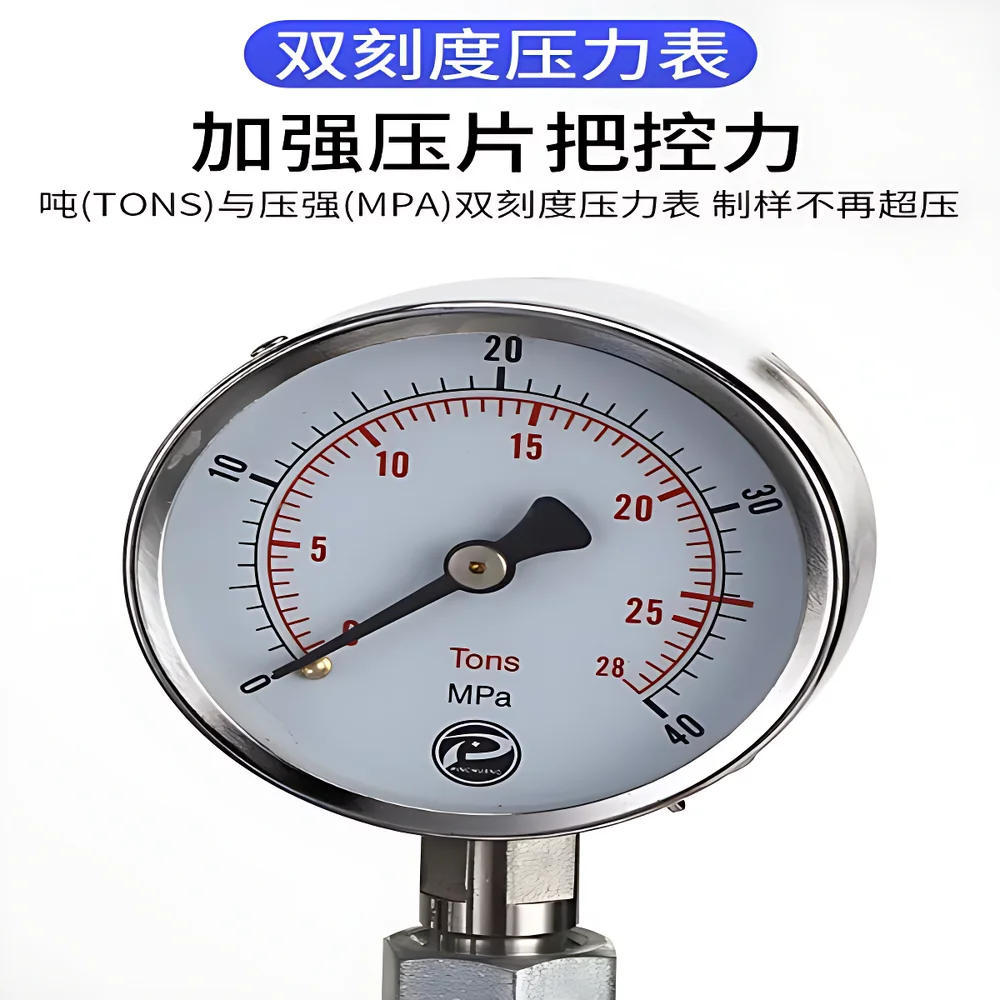
| Force Display | Digital LED readout (0.1 Ton resolution) |
| Die Cavity Diameter Options | 6 mm, 8 mm, 10 mm, 13 mm, 16 mm, 20 mm (interchangeable) |
| Maximum Recommended Powder Particle Size | 30–75 µm |
| Minimum Safe Operating Die Diameter | ≥6 mm |
| Material Construction | Hardened H13 tool steel (piston, die, anvil) |
| Compliance | Designed per ISO 17025 laboratory practice guidelines for sample preparation |
| Origin | Hunan, China |
| Manufacturer Type | OEM/ODM producer |
Ask about pricing, availability and specifications.
Overview
The Mitri MJ-4 Manual Powder Pellet Press is a precision-engineered laboratory instrument designed specifically for reproducible, high-integrity pellet fabrication in Fourier Transform Infrared (FTIR) spectroscopy workflows. It operates on a manually actuated hydraulic principle: user-applied force is amplified through a dual-stage lever system and transmitted via a hardened steel piston to compress powdered samples within interchangeable die cavities. Unlike motorized or pneumatic presses, the MJ-4 delivers full tactile control over compression rate and dwell time—critical parameters for minimizing thermal degradation, particle rearrangement, and binder-induced spectral interference in IR-transparent KBr or CsI matrices. Its digital force display enables traceable, repeatable load application across analytical batches, supporting method validation under GLP and GMP-aligned laboratory environments.
Key Features
- Manually adjustable force range from 3 to 15 metric tons, calibrated and displayed in real time on a high-contrast LED screen (0.1-ton resolution)
- Interchangeable die sets (6–20 mm cavity diameters) fabricated from vacuum-hardened H13 tool steel (HRC 58–62), optimized for dimensional stability and surface finish retention
- Integrated safety interlock mechanism preventing over-travel beyond rated mechanical limits for each die size
- Low-friction polished anvil and piston surfaces reduce shear-induced powder segregation and ensure uniform density distribution across pellet cross-sections
- Compact benchtop footprint (280 × 180 × 420 mm) with non-slip rubber base and ergonomic lever geometry for operator fatigue reduction during extended use
- Digital force logging capability via optional RS-232 interface (compatible with LabVIEW and custom Python-based acquisition scripts)
Sample Compatibility & Compliance
The MJ-4 is validated for use with common IR matrix materials including potassium bromide (KBr), cesium iodide (CsI), and polyethylene (PE) dispersions. It supports powder particle size distributions between 30 and 75 µm—within the optimal range specified by ASTM E1252 for minimal scattering artifacts in mid-IR transmission measurements. Particles below 30 µm risk die cavity blockage and piston seizure; particles above 75 µm may cause localized stress concentrations leading to micro-cracking or uneven compaction. The press complies with fundamental mechanical safety requirements outlined in ISO 12100 and is routinely deployed in laboratories operating under ISO/IEC 17025 accreditation frameworks. While not intrinsically rated for hazardous material handling, its design excludes flammable, corrosive, or explosive substances per manufacturer’s operational restrictions.
Software & Data Management
The MJ-4 operates as a standalone mechanical instrument without embedded firmware. However, its digital force transducer output (0–5 V analog or RS-232 TTL serial) is fully compatible with third-party data acquisition systems. Users may integrate it into LIMS or ELN platforms via standard COM port communication, enabling timestamped force logs linked directly to sample IDs. Audit trails—including operator ID, date/time stamp, applied load, and die configuration—are exportable in CSV or XML formats. For regulated environments, the system supports 21 CFR Part 11-compliant electronic signatures when paired with validated software layers such as Thermo Fisher SampleManager or Waters Empower.
Applications
- Routine preparation of homogeneous KBr pellets for quantitative and qualitative FTIR analysis of pharmaceutical APIs, polymers, and inorganic salts
- Controlled compaction of moisture-sensitive powders where vacuum or heated pressing is contraindicated
- Method development for low-volume R&D screening—enabling rapid iteration of pressure/dwell/time parameters without automation overhead
- Calibration reference pellet production for ATR-FTIR and diffuse reflectance (DRIFTS) validation protocols
- Teaching laboratories requiring transparent, hands-on demonstration of powder rheology, densification behavior, and Heckel analysis fundamentals
FAQ
What is the minimum recommended die diameter for safe operation?
The MJ-4 is rated for safe use only with die cavities ≥6 mm in diameter. Sub-5 mm dies are excluded due to excessive stress concentration risks and lack of mechanical redundancy in the piston assembly.
Can I use this press for hygroscopic or reactive samples?
No. The MJ-4 is strictly intended for stable, non-volatile, non-corrosive, and non-explosive powders. Handling hygroscopic or air-sensitive materials requires glovebox integration and inert-atmosphere die kits—not provided with standard configuration.
How should I maintain die surface integrity?
Clean all components with anhydrous ethanol after each use; dry thoroughly with nitrogen or compressed air. Store disassembled in desiccated cabinets at RH <30%. Avoid contact with chlorinated solvents or acidic residues.
Is force calibration traceable to national standards?
Yes—Mitri provides factory calibration certificates traceable to CNAS-accredited metrology labs (certificate included). Annual recalibration is recommended for ISO 17025 compliance.
Does the press support automated pressure ramping or dwell control?
No. The MJ-4 is purely manual. Pressure ramping and dwell timing must be controlled externally by operator judgment and stopwatch, consistent with ASTM D7928 procedural guidance for manual pelletization.

