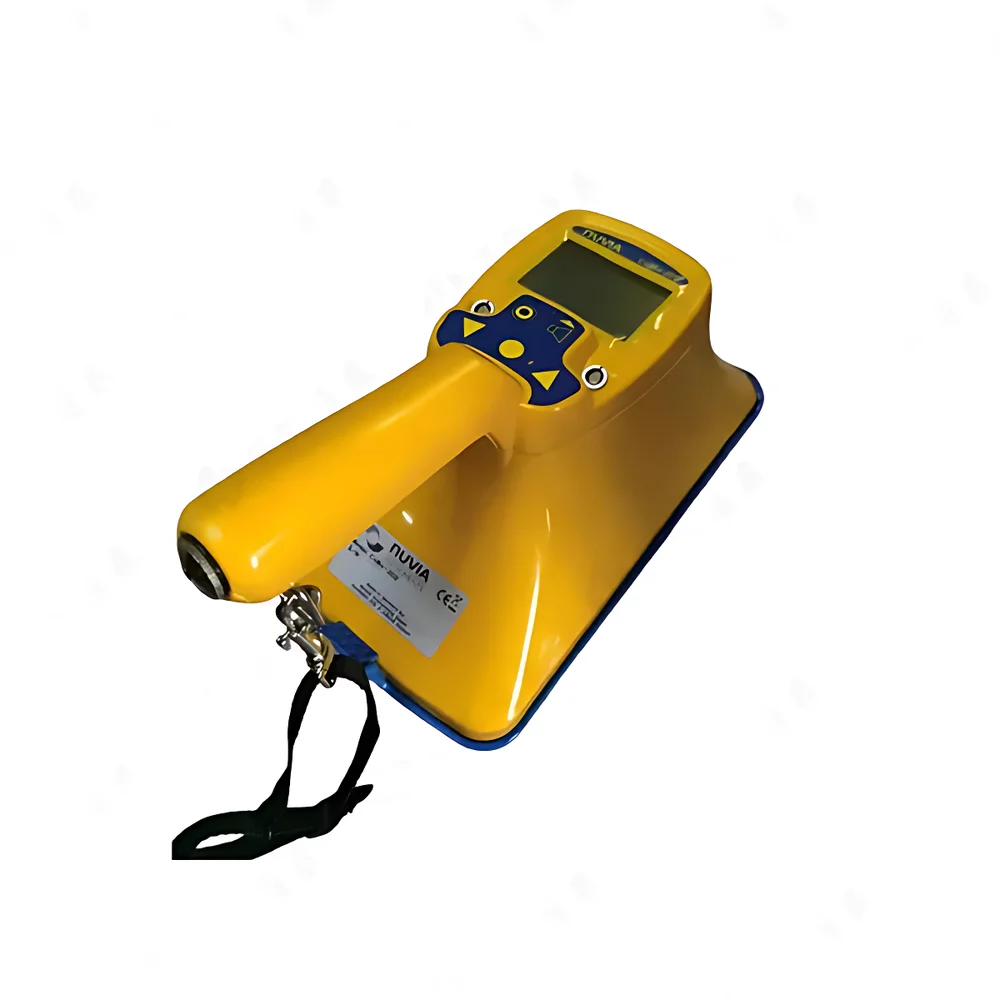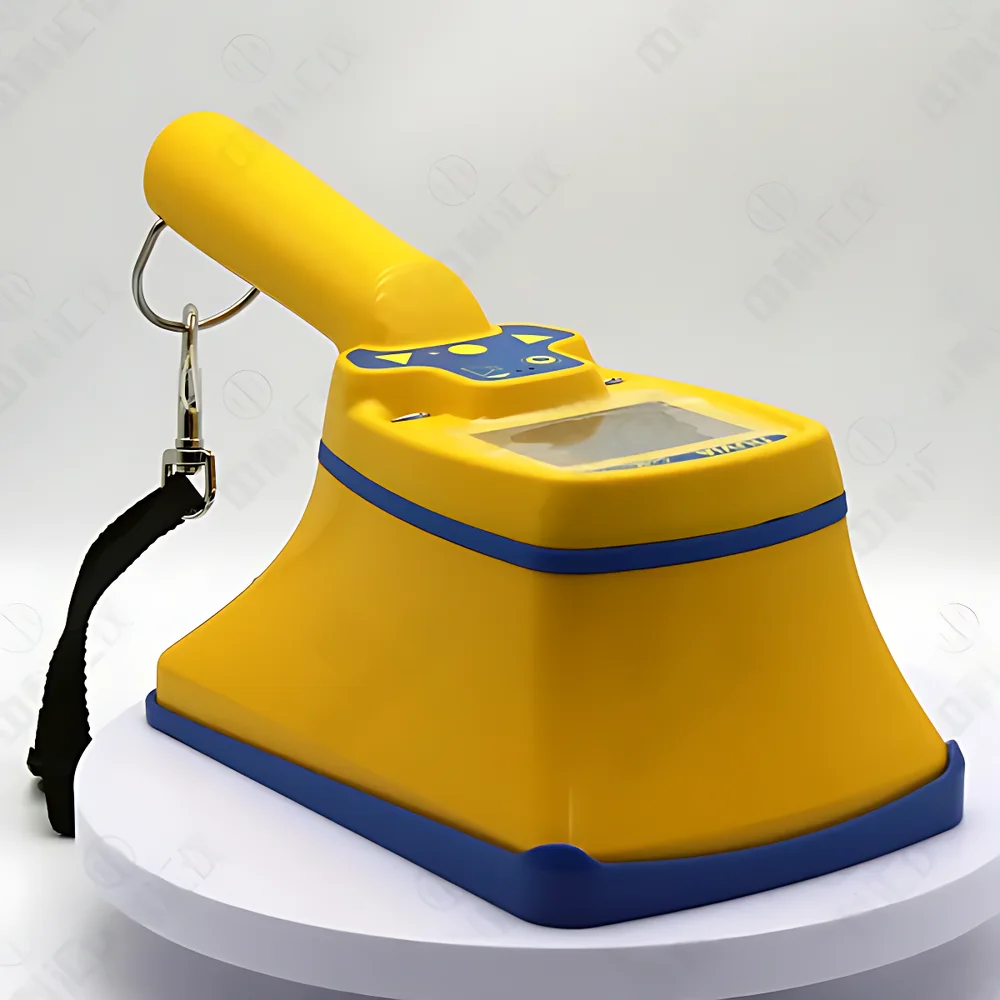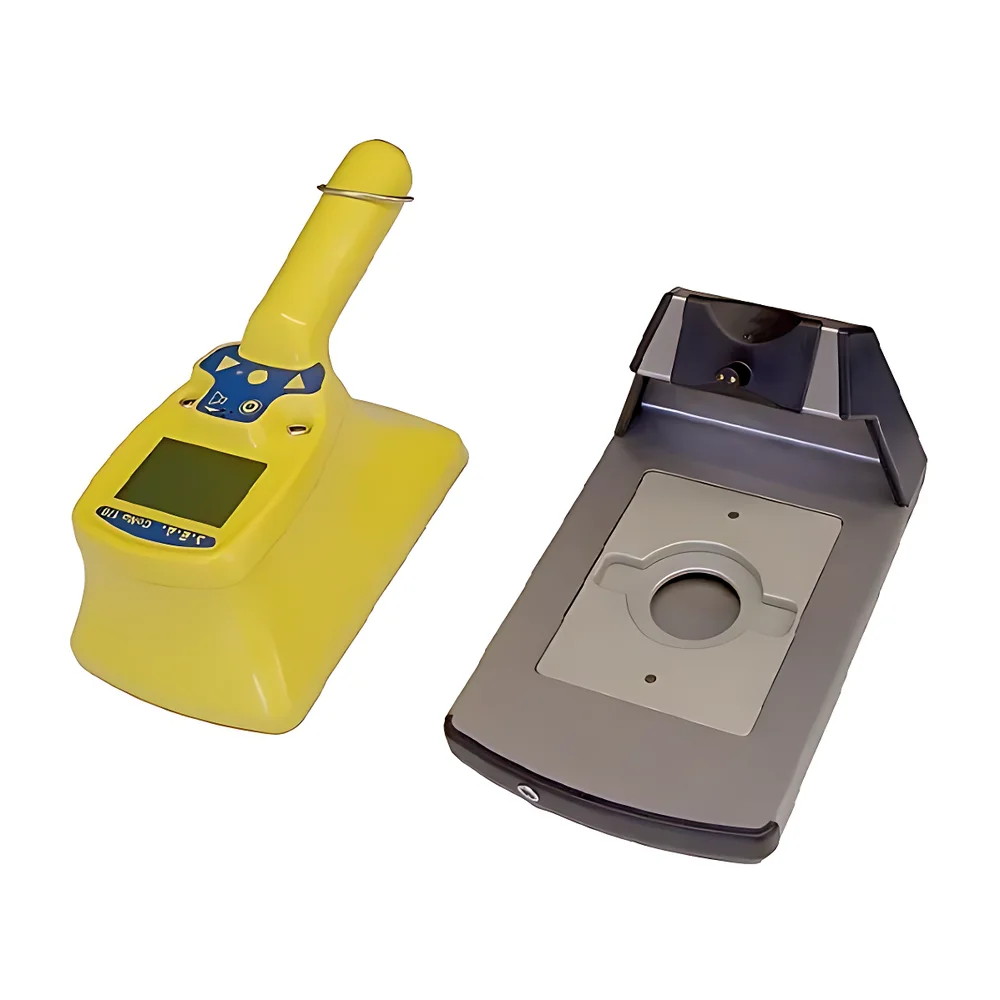
Nuvia CoMo 170 Surface Contamination Monitor

| Brand | Nuvia |
|---|---|
| Origin | Germany |
| Model | CoMo 170 |
| Instrument Type | Portable Alpha/Beta/Gamma Surface Contamination Monitor |
| Detector Type | ZnS(Ag)-coated plastic scintillator (α) + thin plastic scintillator (β/γ) |
| Detection Area | 170 cm² |
| Alpha Sensitivity | ≥0.1 cps (for ²⁴¹Am, 2π geometry) |
| Beta/Gamma Background | 15–25 cps |
| Measurement Units | cps, Bq, Bq/cm², or nSv/h / µSv/h / mSv/h (with optional dose rate probe) |
| Data Storage | 750 measurement records |
| Power Supply | 2×AA 1.5 V alkaline or NiMH rechargeable batteries (up to 50 h operation) |
| Operating Temperature | –10 °C to +40 °C (optional –20 °C variant) |
| Weight | 750 g (including batteries) |
| Display | 128×64 pixel backlit LCD |
| Dimensions (L×W×H) | 280×125×135 mm (including handle) |
| Compliance | Meets IEC 60846-1:2014, IEC 62327:2017, and relevant EURATOM directives for surface contamination monitoring |
Ask about pricing, availability and specifications.
Overview
The Nuvia CoMo 170 is a portable, microprocessor-controlled surface contamination monitor engineered for rapid, reliable quantification of alpha, beta, and gamma-emitting radionuclides on planar surfaces. Unlike conventional GM-based instruments limited to beta/gamma detection, the CoMo 170 integrates dual-layer scintillation detection—ZnS(Ag) for high-efficiency alpha particle capture and a thin plastic scintillator optimized for beta and low-energy gamma photons—enabling simultaneous, spectrally unresolving but quantitatively accurate gross activity assessment. Its 170 cm² active detection area provides statistically robust counting statistics in field-deployed scenarios where speed and representativeness are critical, such as nuclear facility decommissioning, emergency response, border control screening, and routine radiological protection surveys. The instrument operates on fundamental principles of pulse-height-insensitive scintillation counting under fixed geometry, calibrated per ISO 7503-1 for surface activity determination in Bq/cm², with automatic background subtraction and configurable counting protocols aligned with ALARA implementation.
Key Features
- Dual-detector architecture: Integrated ZnS(Ag)/plastic scintillator assembly enables concurrent α, β, and γ surface contamination assessment without external probes or gas supply.
- Large-area detection: 170 cm² active window ensures high geometric efficiency and reduced measurement uncertainty per ISO 7503-2, particularly for heterogeneous or low-activity surfaces.
- Intelligent background management: Real-time β/γ background monitoring with user-defined measurement duration and automatic compensation; alpha background selectable at ≤0.1 cps (²⁴¹Am, 2π).
- Configurable measurement modes: Time-based (1–9999 s) or statistical error-based (1–10% relative standard deviation) acquisition, supporting both regulatory compliance checks and research-grade repeatability.
- Expandable nuclide library: 25 preloaded radionuclides—including ²³⁹Pu, ²⁴¹Am, ⁹⁰Sr/⁹⁰Y, ¹³⁷Cs, and ⁶⁰Co—with editable decay correction, emission probabilities, and self-absorption coefficients for accurate Bq/cm² conversion.
- Robust human interface: Five-button navigation, 128×64 pixel backlit LCD with auto-illumination in low-light environments, and password-protected configuration menus compliant with IEC 62327 security requirements.
- Modular connectivity: Supports optional external probes (e.g., energy-compensated GM dose rate probe, pipe survey probe) with automatic type recognition and seamless unit switching (cps → µSv/h).
Sample Compatibility & Compliance
The CoMo 170 is validated for direct measurement of flat, non-porous surfaces (stainless steel, concrete, painted metal) and indirect analysis via wipe tests (filter paper, cotton swabs) per ASTM D3648-19 and ISO 7503-1. It meets essential performance criteria outlined in IEC 60846-1:2014 (radiation protection instrumentation — ambient and/or directional dose equivalent [rate] meters and/or monitors) and IEC 62327:2017 (hand-held instruments for photon and neutron radiation detection). Its design supports GLP-aligned data integrity: all measurements include timestamp, operator ID (via optional RFID badge integration), detector status, background value, and calibration traceability metadata. The device satisfies EURATOM Basic Safety Standards Directive 2013/59/Euratom requirements for workplace monitoring and is routinely deployed in facilities subject to national regulatory audits (e.g., German BfS, UK ONR, US NRC Appendix A to 10 CFR 20).
Software & Data Management
Data export is facilitated via USB 2.0 interface using Nuvia’s proprietary CoMoSuite software (Windows 10/11 compatible), which provides audit-trail-enabled database management compliant with FDA 21 CFR Part 11 requirements—including electronic signatures, immutable record history, and role-based access control. Each stored entry contains full acquisition parameters, raw counts, net count rate, uncertainty calculation (Poisson statistics), and applied calibration factors. Batch reporting supports customizable templates for regulatory submissions (e.g., EURATOM Form D, NRC Form 5), and trend analysis tools enable longitudinal contamination mapping across multiple locations and time points. Firmware updates preserve metrological traceability and are digitally signed to prevent unauthorized modification.
Applications
- Nuclear power plant maintenance: Routine monitoring of reactor containment surfaces, spent fuel pool walls, and glovebox interiors prior to personnel access.
- Decommissioning & waste characterization: Rapid scanning of dismantled components, concrete rubble, and soil samples to classify material for disposal pathways (LLW/ILW).
- Emergency response: First-responder deployment during radiological dispersal device (RDD) incidents or transport accidents, with real-time alarm thresholds configurable per IAEA EPR-GSR Part 3.
- Medical & research facilities: Verification of lab bench decontamination after handling ³²P, ¹²⁵I, or ²²⁵Ac-labeled compounds; validation of hot cell shielding integrity.
- Border security & customs: High-throughput screening of cargo containers, vehicles, and personal effects at ports of entry using integrated wipe-test workflow.
- Defense & civil protection: Field assessment of equipment and infrastructure following potential CBRN exposure, including fire brigade use (CoMo 170F variant).
FAQ
What radiation types can the CoMo 170 detect simultaneously?
It detects alpha, beta, and gamma emitters concurrently using its hybrid ZnS(Ag)/plastic scintillator detector—no probe swapping or mode switching required.
Does the instrument require gas refilling or high-voltage maintenance?
No. The solid-state scintillation detectors operate at low voltage (<1 kV) and require no gas replenishment, consumables, or periodic recalibration beyond annual traceable verification.
How is background subtraction implemented during measurement?
Users may select either continuous background monitoring (measured before each sample) or stored background values; both support manual override and time-weighted averaging over user-defined intervals.
Can measurement data be integrated into laboratory information management systems (LIMS)?
Yes—CSV and XML export formats are supported, and CoMoSuite includes ODBC-compliant drivers for direct ingestion into enterprise LIMS platforms meeting ISO/IEC 17025:2017 data integrity clauses.
Is the CoMo 170 suitable for outdoor use in extreme temperatures?
Standard units operate from –10 °C to +40 °C; an extended-range variant (–20 °C to +50 °C) is available with enhanced battery thermal management and LCD contrast stabilization.