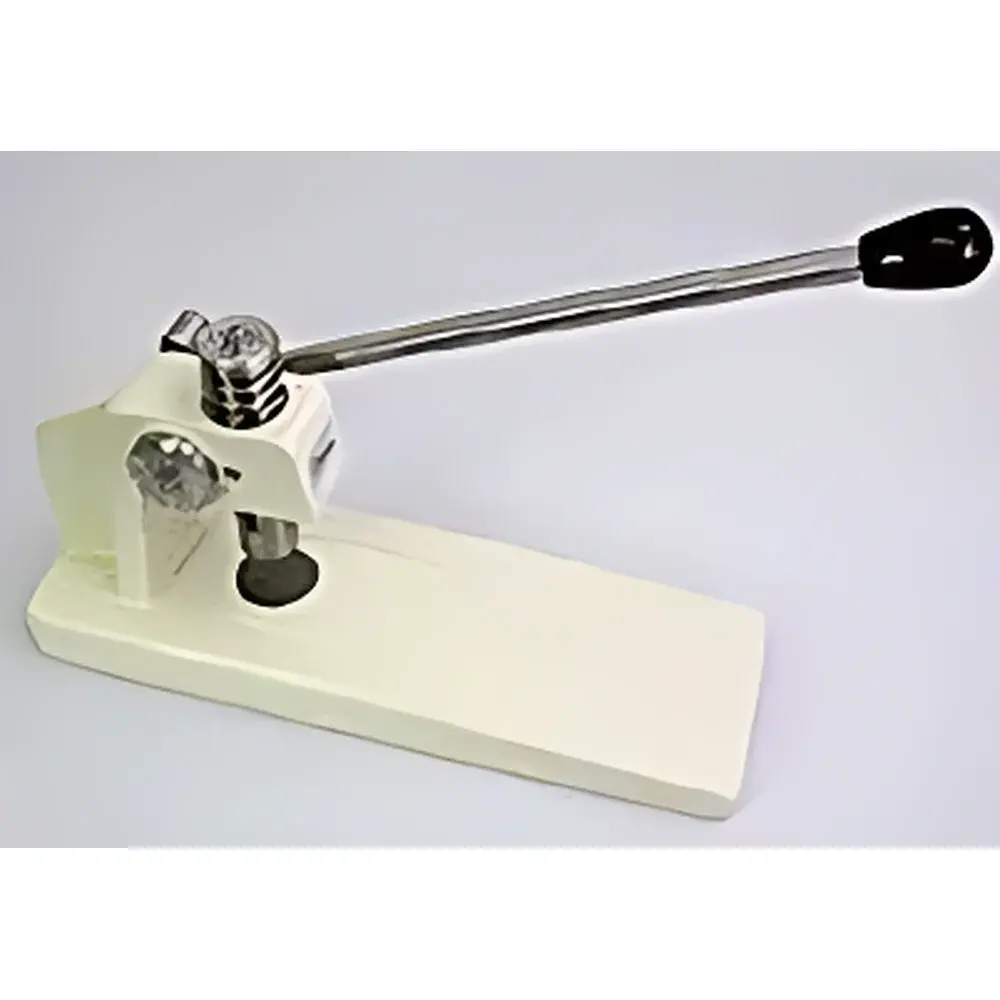
Hosokawa Alpine 0130 Manual Hydraulic Pellet Press

| Origin | Japan |
|---|---|
| Manufacturer Type | Authorized Distributor |
| Origin Category | Imported |
| Model | 0130 |
| Price Range | USD 6,800 – 13,500 |
| Instrument Type | Manual Hydraulic Pellet Press |
| Compatible Pellet Diameters | 1 mm, 3 mm, 7 mm |
| Die Head Material | Stainless Steel (AISI 304) |
| Construction | Compact and Rugged Benchtop Design |
| Maintenance | Tool-Free Disassembly for Cleaning |
Ask about pricing, availability and specifications.
Overview
The Hosokawa Alpine 0130 Manual Hydraulic Pellet Press is a precision-engineered laboratory instrument designed for reproducible, contamination-free sample compaction in analytical preparation workflows. It operates on a manually actuated hydraulic principle—leveraging Pascal’s law to transmit uniform pressure across the die cavity—ensuring high-density, low-porosity pellets suitable for X-ray fluorescence (XRF), Fourier-transform infrared (FTIR), and near-infrared (NIR) spectroscopy. Unlike pneumatic or motor-driven systems, its purely mechanical hydraulic architecture eliminates variability from air supply fluctuations or electronic control drift, making it ideal for regulated environments where traceability and operator consistency are critical. The press delivers stable compression forces up to 15 tons (147 kN), fully adjustable via calibrated handwheel, enabling precise control over final pellet density without requiring external power sources or compressed gas infrastructure.
Key Features
- Compact benchtop footprint (280 × 220 × 410 mm) optimized for space-constrained analytical labs and cleanroom-compatible workflows.
- Rugged cast-iron frame with vibration-dampening base, engineered for long-term dimensional stability under repeated loading cycles.
- Interchangeable stainless-steel (AISI 304) die sets supporting standardized pellet diameters of 1 mm, 3 mm, and 7 mm—each with precisely ground parallel faces and ≤0.5 µm surface roughness for uniform spectral transmission.
- Tool-free disassembly design: Upper and lower die components separate with single-hand operation, permitting rapid cleaning between samples to prevent cross-contamination—a requirement aligned with ISO/IEC 17025:2017 clause 7.2.2 (sample handling).
- Integrated pressure gauge with dual-scale readout (MPa and ton-force), calibrated to NIST-traceable standards and certified per ASTM E4-22 for force verification.
Sample Compatibility & Compliance
The 0130 accommodates a broad range of powdered materials—including inorganic oxides, pharmaceutical APIs, geological powders, polymer blends, and catalyst precursors—provided particle size distribution falls within D90 < 150 µm and moisture content remains below 2 wt%. Its stainless-steel wetted surfaces resist corrosion from halide-containing salts and weak acids, complying with USP guidelines for equipment qualification in pharmaceutical laboratories. The absence of lubricants or elastomeric seals ensures no extractables interfere with elemental analysis by ICP-OES or XRF. For GLP/GMP-regulated applications, the press supports documented operational qualification (OQ) protocols, including force repeatability testing (≤±1.2% RSD over 10 consecutive cycles at 10-ton load) and die alignment verification per ISO 14644-1 Class 5 cleanroom tolerances.
Software & Data Management
As a manually operated system, the 0130 does not incorporate embedded electronics or proprietary software. However, it integrates seamlessly into digital lab infrastructures through manual logbook entries or LIMS-compatible templates. Each compression cycle can be recorded with metadata—including operator ID, date/time stamp, applied load (ton), dwell time, die size, and sample ID—supporting audit trails required under FDA 21 CFR Part 11 when paired with validated electronic record systems. Optional calibration certificates (available upon request) include uncertainty budgets compliant with ISO/IEC 17025 Annex A.2, facilitating metrological traceability to national standards bodies such as NMIJ (Japan) or NIST (USA).
Applications
- XRF quantitative analysis of cement clinker, ores, and fly ash—where homogeneous pellet density minimizes matrix effects and improves calibration linearity (ASTM C114, ISO 29581-2).
- FTIR KBr pellet preparation for polymer identification and crystallinity assessment (ASTM E1252, ISO 18388).
- NIR calibration standard production for agricultural feedstock screening, ensuring batch-to-batch spectral reproducibility.
- Reference material certification workflows under ISO Guide 35, where inter-laboratory pellet density variance must remain below ±0.8%.
- Academic research in solid-state chemistry and battery electrode development, where controlled porosity (<5%) is essential for electrochemical performance correlation.
FAQ
What is the maximum recommended pressure for routine use?
The press is rated for continuous operation up to 12 tons (117.6 kN); exceeding this may accelerate wear on hydraulic seals and compromise long-term force accuracy.
Can the 0130 be used with binder-free compaction?
Yes—its high-pressure capability (up to 15 tons) enables cold sintering of many ceramic and metal oxide powders without organic binders, preserving stoichiometry for elemental analysis.
Is die alignment verification required before each use?
Alignment should be verified during initial installation and after any impact event; routine daily use requires only visual inspection of die face parallelism and absence of particulate debris.
Does the press meet CE or UL safety directives?
While not electrically powered, the unit complies with EN 61000-6-2 (EMC immunity) and EN 61000-6-4 (EMC emission) by default due to zero electronic components; mechanical safety conforms to EN ISO 12100.
How often should hydraulic oil be replaced?
Under normal laboratory use (≤50 cycles/week), mineral-based hydraulic oil should be replaced every 24 months or after 5,000 compression cycles—whichever occurs first—to maintain viscosity stability and seal integrity.