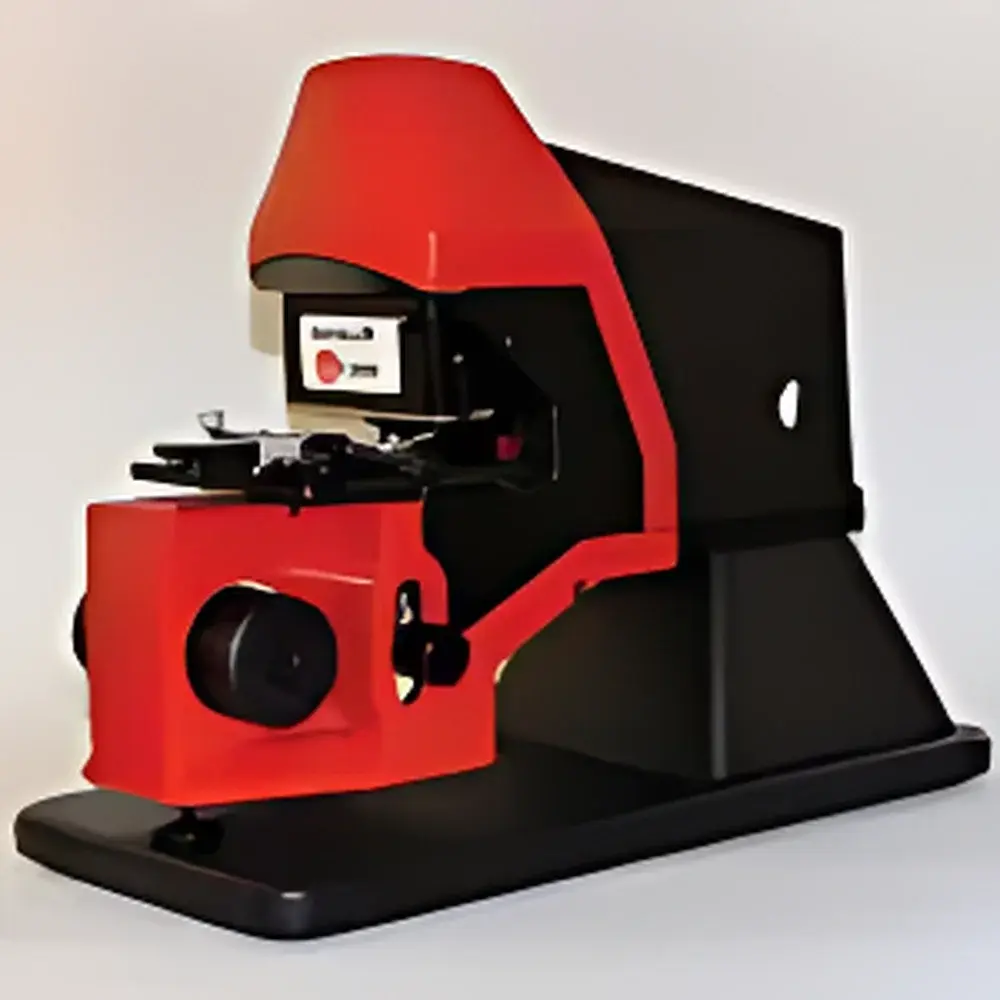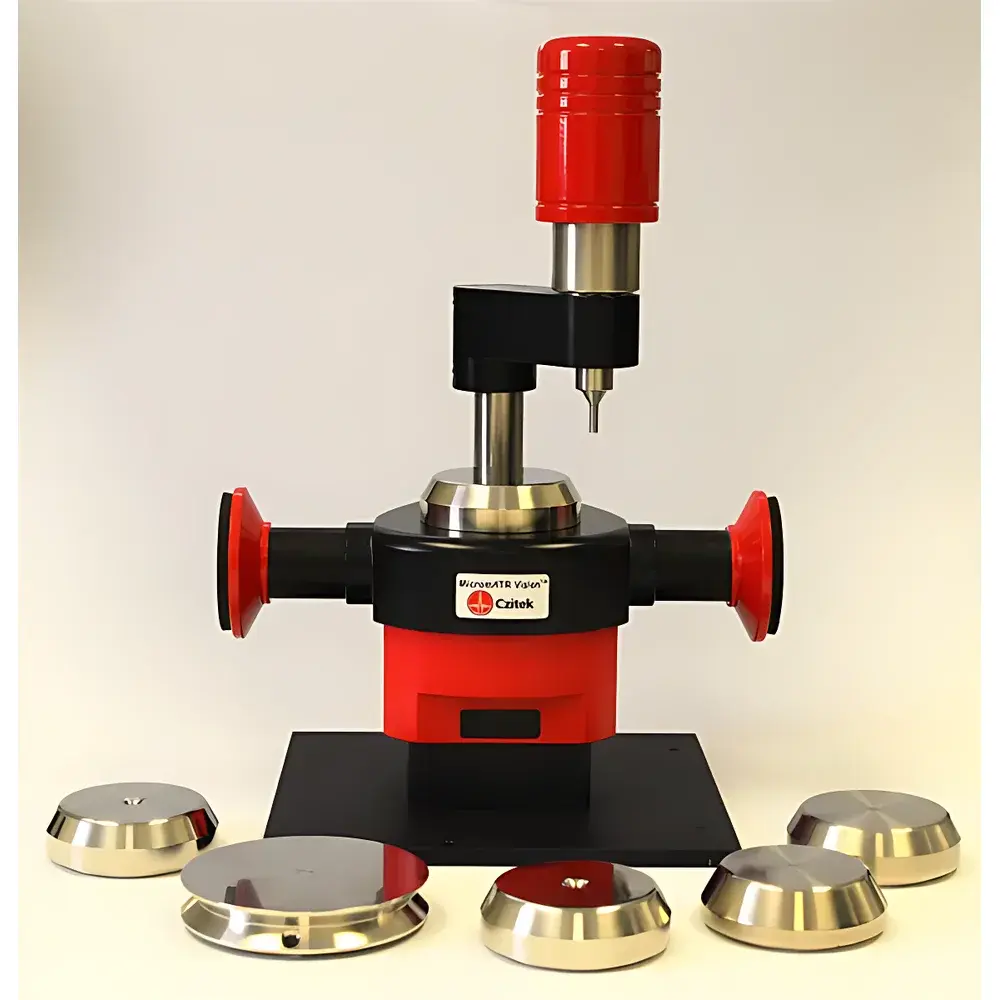
Czitek MicromATR Diamond ATR Accessory with Integrated Video Imaging

| Brand | Czitek |
|---|---|
| Origin | USA |
| Model | MicromATR |
| ATR Crystal Material | Single-Crystal Diamond |
| Reflection Modes | 1×, 3×, and 9× Internal Reflection |
| Spectral Range | Down to 10 cm⁻¹ |
| Compatibility | Fully Interchangeable with SensIR and Smiths Detection ATR Holders |
| Optional Accessories | Integrated Sample Pressure Indicator, Heated Sample Stage |
Ask about pricing, availability and specifications.
Overview
The Czitek MicromATR Diamond ATR Accessory with Integrated Video Imaging is a high-performance attenuated total reflectance (ATR) sampling interface engineered for Fourier-transform infrared (FTIR) spectroscopy. Designed around a monolithic single-crystal diamond internal reflection element (IRE), this accessory leverages diamond’s exceptional chemical inertness, broad mid- to far-IR transparency (extending to 10 cm⁻¹), and high thermal conductivity to enable robust, contamination-resistant analysis of challenging samples—including corrosive liquids, viscous polymers, pastes, gels, and biological tissues. Unlike ZnSe or Ge ATR crystals, diamond exhibits negligible spectral absorption across the entire FTIR range and withstands aggressive solvents, high pressure, and repeated mechanical contact without degradation. The integrated video imaging system provides real-time, high-resolution optical visualization of the sample–crystal contact zone—critical for optimizing contact uniformity, verifying sample placement, and diagnosing interfacial artifacts such as air gaps or crystallization at the IRE surface.
Key Features
- Monolithic single-crystal diamond IRE with polished optical surface, ensuring long-term stability and zero spectral interference from crystal absorption or scattering.
- Modular ATR head design compatible with standard FTIR spectrometer ATR stages; mechanically and optically interchangeable with SensIR and Smiths Detection ATR holders without alignment recalibration.
- Three reflection geometry options: 1× (shallow penetration, ideal for thin films and surface layers), 3× (balanced sensitivity and depth resolution), and 9× (enhanced pathlength for low-absorbing or dilute samples).
- Integrated coaxial video imaging system with adjustable LED illumination, 10×–50× digital zoom, and USB 3.0 output—enabling live monitoring and frame-captured documentation of sample–crystal interface conditions.
- Optional calibrated pressure indicator (0–200 N range, ±2% full-scale accuracy) for quantitative control of contact force during measurement—essential for reproducible spectra of soft or compressible materials.
- Heated sample stage option (ambient to 120 °C, ±0.5 °C stability) with PID temperature control and thermocouple feedback, supporting kinetic studies, phase transition analysis, and solvent evaporation monitoring.
Sample Compatibility & Compliance
The MicromATR accommodates solid, semi-solid, and liquid samples without preprocessing—eliminating the need for KBr pellet preparation or solvent casting. It is routinely employed for QA/QC of pharmaceutical tablets, polymer blend homogeneity assessment, forensic ink differentiation, and in situ monitoring of catalytic reactions. The device complies with ISO 17025 requirements for measurement traceability when used with calibrated reference standards. Its mechanical interchangeability supports adherence to ASTM E1421 and ASTM E2896 for ATR-based FTIR method validation. All electrical components meet UL/CSA safety standards; the heated stage version includes overtemperature cutoff and grounding continuity verification per IEC 61010-1.
Software & Data Management
The video imaging subsystem operates via Czitek’s MicromView™ software (Windows 10/11 compatible), which synchronizes image capture with spectral acquisition timestamps. Users may annotate frames, define regions of interest (ROI), and export time-stamped image–spectrum pairs in HDF5 format. When integrated with commercial FTIR platforms (e.g., Thermo Nicolet iS50, Bruker Tensor II, PerkinElmer Frontier), the MicromATR requires no proprietary drivers—standard USB HID and virtual COM port protocols ensure plug-and-play operation. Audit trails, user access logs, and electronic signatures are supported when deployed within environments governed by FDA 21 CFR Part 11 or EU Annex 11, provided the host FTIR software implements required security controls.
Applications
- Pharmaceutical: Quantitative assay of API distribution in coated tablets; detection of polymorphic transitions during hot-stage ATR-FTIR.
- Polymers: In-line monitoring of crosslinking kinetics in UV-curable resins; identification of plasticizer migration at polymer–adhesive interfaces.
- Forensics: Non-destructive discrimination of toner formulations, automotive paint layers, and counterfeit document inks.
- Materials Science: Characterization of ionic liquid–electrode interfaces in electrochemical cells; hydration dynamics in proton-exchange membranes.
- Food & Agriculture: Rapid authentication of edible oils; detection of adulterants in honey and dairy concentrates.
FAQ
Is the diamond ATR crystal replaceable as a field-serviceable component?
Yes—the diamond IRE is mounted in a precision-machined stainless-steel carrier with removable retaining hardware; replacement can be performed in under 10 minutes using standard Torx tools and does not require optical realignment.
Does the video imaging system affect the FTIR beam path or spectral quality?
No—the imaging optics are coaxially aligned but physically decoupled from the IR beam path; all IR light undergoes total internal reflection exclusively within the diamond IRE, preserving throughput and signal-to-noise ratio.
Can the heated stage be operated simultaneously with pressure monitoring?
Yes—both subsystems operate independently with separate controllers; pressure data and temperature logs are time-synchronized and exportable alongside spectral files.
What spectral resolution is achievable when using the 9× reflection crystal at 10 cm⁻¹?
The 9× geometry maintains full instrument resolution (e.g., 0.25 cm⁻¹ on a 4 cm⁻¹ nominal resolution spectrometer); no resolution degradation occurs due to multiple reflections, as diamond’s low dispersion minimizes phase distortion across the measured range.
Is OEM integration support available for custom FTIR platform developers?
Yes—Czitek provides mechanical drawings, electrical interface specifications (I²C, UART, USB HID), and SDK documentation for embedded integration into third-party spectroscopic systems.