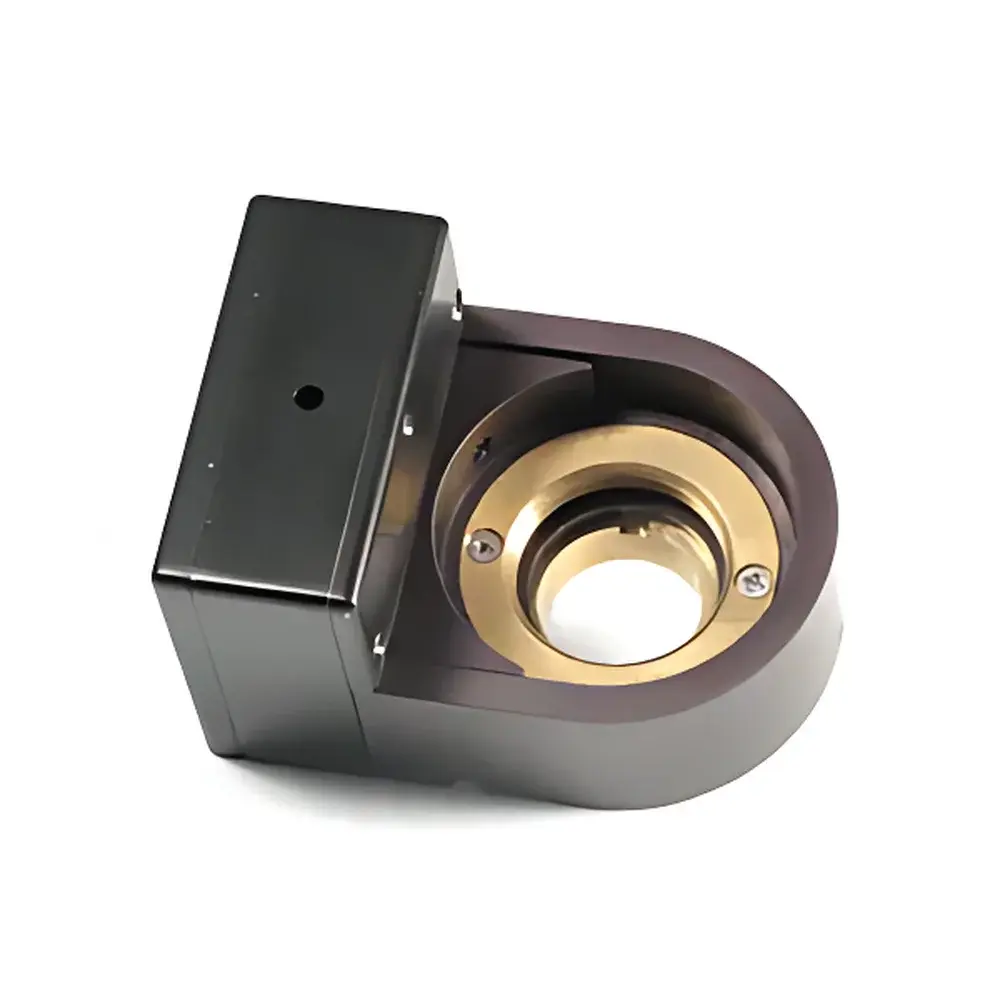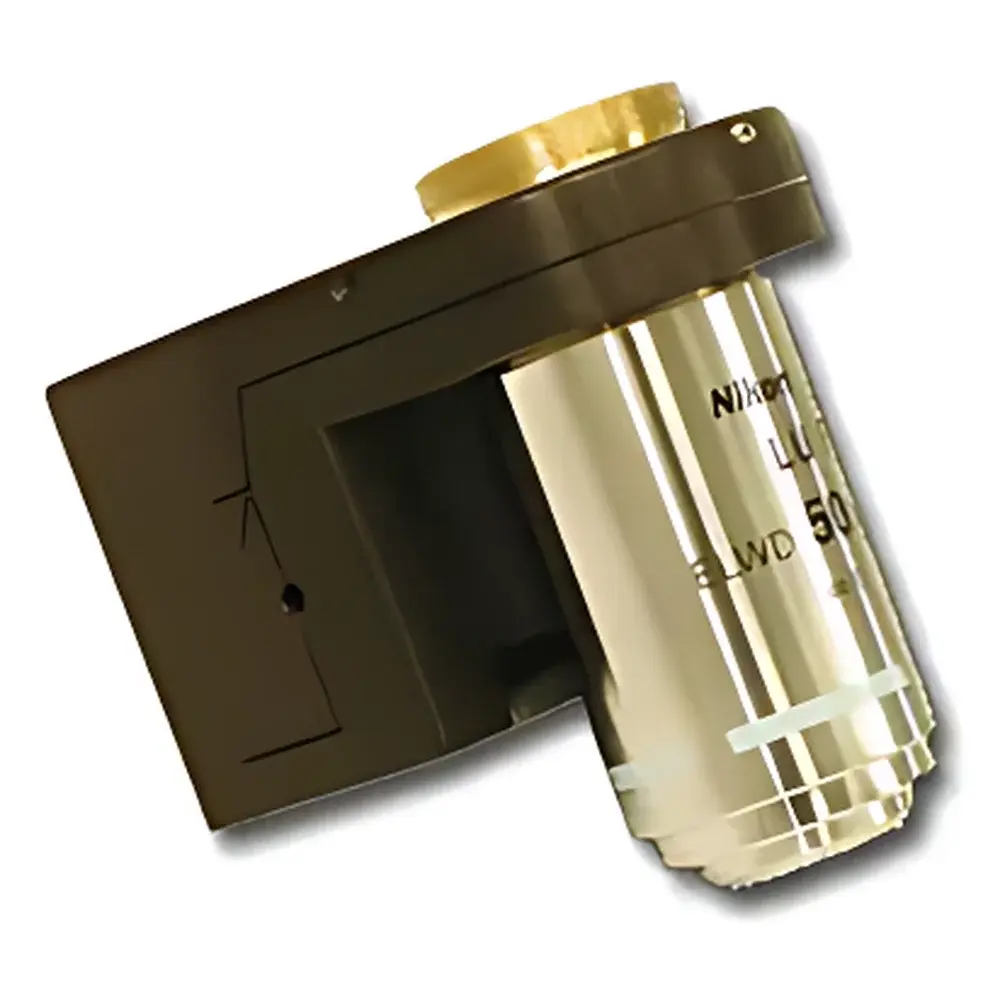
Mad City Labs Nano-F Series Motorized Objective Focusing Positioner

| Brand | Mad City Labs (MCL Think Nano) |
|---|---|
| Origin | USA |
| Model | Nano-F Series |
| Type | Motorized Translation Stage |
| Travel Range | 100 μm or 200 μm |
| Resolution | 0.2 nm (100 μm) / 0.4 nm (200 μm) |
| Resonant Frequency | 500 Hz ±20% |
| Runout (θx) | 6 μrad |
| Runout (θy) | 10 μrad (100 μm) / 25 μrad (200 μm) |
| Stiffness | 1.0 N/μm |
| Max Load | 0.5 kg |
| Body Material | Aluminum and Brass |
| Adapter Threads | RMS, M25, M26 (S-versions) |
| Controller | Nano-Drive® |
| Closed-Loop Feedback | PicoQ® Absolute Position Sensing |
Ask about pricing, availability and specifications.
Overview
The Mad City Labs Nano-F Series is a high-precision, motorized objective focusing positioner engineered for demanding optical microscopy applications requiring sub-nanometer resolution, minimal off-axis motion, and long-term positional stability. Designed as a compact, integrated focusing element, the Nano-F Series operates on piezoelectric actuation principles coupled with proprietary PicoQ® capacitive position sensing—enabling true absolute, drift-free, closed-loop control without homing or reference marks. Its monolithic flexure architecture—validated via extensive finite element analysis (FEA)—delivers exceptional mechanical rigidity and near-zero parasitic motion (<6 μrad angular runout in pitch), ensuring that focal plane shifts remain strictly axial across the full travel range. This eliminates image drift and focus jitter during time-lapse, super-resolution, or multi-channel acquisitions—critical for quantitative imaging workflows where Z-stack fidelity and reproducibility are non-negotiable.
Key Features
- Sub-nanometer resolution: 0.2 nm (Nano-F100) and 0.4 nm (Nano-F200) with 20-bit digital encoding and real-time closed-loop correction
- PicoQ® absolute position sensing: Eliminates cumulative error and enables immediate power-on positioning without initialization routines
- Ultra-low runout: <6 μrad θx, <10 μrad θy (100 μm version); optimized for diffraction-limited imaging and laser coupling stability
- High resonant frequency (500 Hz ±20%): Supports rapid autofocus loops and dynamic Z-scanning at frame rates compatible with sCMOS and EMCCD detectors
- Modular quick-mount adapter system: Standardized threaded interfaces (RMS, M25, M26, M27, M32) enable plug-and-play integration with Olympus, Nikon, Zeiss, Leica, and custom microscope turrets
- Non-rotating cable interface: Clamping mechanism secures the positioner to the adapter without twisting or stressing signal cables—preserving signal integrity and mechanical longevity
- Aluminum-brass hybrid construction: Balances thermal stability, EMI shielding, and weight optimization for vibration-sensitive optical tables
Sample Compatibility & Compliance
The Nano-F Series is designed for compatibility with all major inverted and upright research-grade microscopes, including widefield, confocal, TIRF, light sheet (LSFM), and structured illumination platforms. It meets mechanical interface standards defined in ISO 8039 (microscope mechanical tube length and mounting threads) and conforms to dimensional tolerances specified in ANSI/ISO 10110-7 for optical mount stability. While not a medical device, its closed-loop architecture, deterministic response, and audit-ready position logging (via Nano-Drive® software) support GLP-compliant experimental protocols. The system is compatible with FDA 21 CFR Part 11–enabled data acquisition environments when paired with validated third-party software stacks used in academic core facilities and pharmaceutical imaging labs.
Software & Data Management
Nano-F Series operation is fully supported by the Nano-Drive® controller suite—a Windows-based application offering real-time position monitoring, waveform generation (sine, triangle, ramp), scriptable automation (Python API included), and export of timestamped position data in CSV and HDF5 formats. The software implements hardware-level position noise filtering and supports synchronized triggering with camera exposure, laser TTL pulses, and external DAQ systems. All position commands and sensor readings are logged with microsecond timestamps, enabling retrospective correlation with image metadata—essential for post-acquisition drift correction and QC traceability. Optional Cyto-Lite™ laser integration modules provide direct TTL synchronization for optogenetic or photostimulation experiments requiring precise Z-timing.
Applications
- Confocal and spinning-disk Z-stack acquisition with <10 nm slice repeatability
- STORM, PALM, and other single-molecule localization microscopy (SMLM) techniques requiring stable axial registration across thousands of frames
- Light sheet fluorescence microscopy (LSFM) where objective translation must maintain beam alignment and optical sectioning fidelity
- Automated focus maintenance in long-duration live-cell imaging (>24 h) under environmental control chambers
- Multi-color co-localization studies demanding pixel-perfect Z-registration across emission channels
- Integration into custom optical trapping or holographic optical tweezers (HOT) setups requiring dynamic, feedback-controlled objective positioning
FAQ
Is the Nano-F Series compatible with my microscope’s nosepiece thread?
Yes—the Nano-F100S/Nano-F200S models accept RMS, M25, and M26 threads; the W-versions support M27 and M32. Thread specifications are confirmed at time of order, and adapters can be reordered separately.
Can I exceed the 0.5 kg load rating?
Loads above 0.5 kg require engineering review. Structural integrity, resonant performance, and thermal drift characteristics change significantly beyond this limit—contact Mad City Labs Applications Engineering for custom validation.
Does the system support third-party software integration?
Yes—Nano-Drive® provides a documented COM interface and Python SDK for integration with Micro-Manager, MATLAB, LabVIEW, and custom acquisition platforms.
What is the typical position noise floor under closed-loop operation?
The Nano-F100S achieves ≤0.15 nm RMS position noise (10 Hz–1 kHz bandwidth) when operated with the Nano-Drive® controller and shielded cabling in a low-vibration environment.
Are calibration certificates available?
NIST-traceable position calibration reports are available upon request for systems deployed in regulated environments, including ISO/IEC 17025-accredited laboratories.