MIRO Analytical AG MIRO High-Precision Multi-Gas Analyzer

| Origin | Switzerland |
|---|---|
| Manufacturer Type | Distributor |
| Origin Category | Imported |
| Model | MIRO |
| Pricing | Upon Request |
Ask about pricing, availability and specifications.
Overview
The MIRO High-Precision Multi-Gas Analyzer is an advanced, field-deployable trace gas measurement platform engineered for continuous, simultaneous quantification of up to ten atmospheric constituents—including greenhouse gases (CO₂, CH₄, N₂O, H₂O) and key air pollutants (NO, NO₂, CO, NH₃, SO₂, O₃). Developed by MIRO Analytical AG—a spin-off from the Swiss Federal Laboratories for Materials Science and Technology (Empa)—the instrument leverages Herriott-type multipass optical cavities combined with tunable mid-infrared quantum cascade lasers (QCLs) operating in the 4–12 µm spectral region. This direct absorption spectroscopy architecture enables parts-per-quadrillion (ppq)-level detection sensitivity for select species under optimized conditions, with high spectral resolution (>0.001 cm⁻¹) and minimal cross-interference between overlapping absorption features. Designed for long-term unattended operation in ambient monitoring networks, eddy covariance flux stations, ecosystem observatories, and calibration laboratories, the MIRO analyzer meets stringent requirements for data continuity, reproducibility, and metrological traceability aligned with World Meteorological Organization (WMO) Global Atmosphere Watch (GAW) guidelines.
Key Features
- Simultaneous real-time measurement of ≥10 gas species using a single compact optical bench and integrated QCL array
- Herriott-enhanced cavity with effective optical path length of 76 m, enabling sub-ppb detection limits at 1-second integration and sub-ppt precision at 200-second averaging
- No sample pre-concentration, chemical conversion, or catalytic scrubbing required—measurements are based on fundamental molecular absorption lines
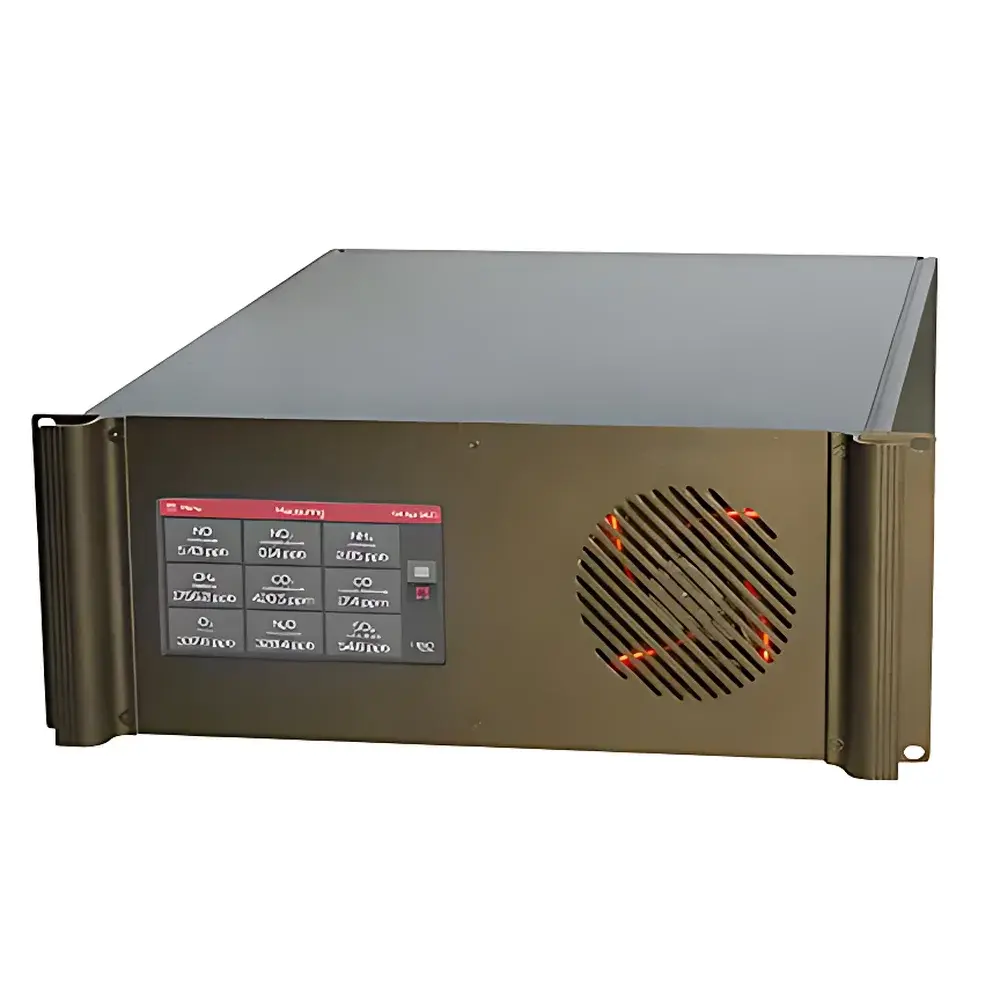
- 7-inch industrial-grade capacitive touchscreen interface supporting intuitive configuration, diagnostics, and local data review
- Modular gas selection: measurement targets can be customized per application (e.g., WMO-compliant CO/CO₂/CH₄/N₂O/H₂O suite; soil respiration-focused CH₄/N₂O/CO₂/O₂; or urban air quality NO/NO₂/SO₂/O₃)
- Ruggedized 4U 19-inch rack-mount chassis (61 cm depth, 20 kg mass) rated for outdoor deployment with IP54-equivalent environmental protection
- Power consumption ≤150 W (24 V DC or 100–240 V AC input), compatible with solar-battery hybrid power systems
Sample Compatibility & Compliance
The MIRO analyzer operates on ambient air samples drawn via standardized stainless-steel or electropolished tubing, with flow rates maintained at 0.5–2.0 L/min using integrated mass flow controllers. It complies with ISO 14644-1 Class 8 cleanroom assembly protocols and adheres to ASTM D6348–22 for gaseous pollutant measurement validation. All factory calibrations are traceable to NIST-certified standard gas mixtures, and the system supports dual-point linear verification using certified span and zero gases. For regulatory reporting applications, raw absorbance spectra and processed concentration time series include embedded metadata required for GLP/GMP audit trails. The instrument has undergone independent benchmarking within the Swiss National Air Pollution Monitoring Network (NABEL), demonstrating agreement within ±2% relative bias and <0.5 ppb root-mean-square error against reference CRDS and chemiluminescence analyzers over multi-week co-location studies.
Software & Data Management
Data acquisition and instrument control are managed through MIRO’s proprietary firmware v3.2+, featuring a real-time Linux-based OS with deterministic I/O scheduling. The onboard software provides automated baseline correction, pressure/temperature compensation (using integrated PT100 and piezoresistive sensors), and spectral fitting via least-squares multivariate regression against high-resolution HITRAN-based line lists. Export formats include NetCDF-4 (CF-1.8 compliant), CSV, and JSON-LD, all timestamped with UTC-synced GPS-derived time stamps. Remote access is supported via secure TLS 1.3-enabled web interface or MQTT protocol for integration into SCADA or cloud-based environmental data platforms. Full audit logs—including user actions, calibration events, and hardware status—are retained for ≥12 months and exportable for FDA 21 CFR Part 11 compliance when paired with validated identity management systems.
Applications
- Long-term greenhouse gas monitoring in ICOS (Integrated Carbon Observation System) and ACTRIS (Aerosols, Clouds, and Trace Gases Research Infrastructure) stations
- Eddy covariance flux measurements requiring synchronized, high-frequency CO₂/CH₄/N₂O/H₂O data with minimal latency
- Soil-atmosphere exchange studies using coupled configurations with PRI-8600 multi-channel soil respiration chambers or PRI-8800 isotopic incubation systems
- Urban and industrial air quality assessment where simultaneous NOₓ/SO₂/NH₃/O₃ monitoring improves source apportionment accuracy
- Calibration transfer experiments across mobile labs, aircraft platforms, and ground-based reference sites
- Validation of satellite remote sensing products (e.g., TROPOMI, OCO-2) through ground-truthing campaigns
FAQ
What gases can the MIRO analyzer measure simultaneously?
The standard configuration measures NO, NO₂, CO, CO₂, CH₄, N₂O, NH₃, O₃, SO₂, and H₂O. Custom combinations are available upon request, subject to laser availability and spectral interference constraints.
Is the instrument suitable for unattended field deployment?
Yes—the MIRO analyzer is designed for continuous operation in remote locations, with wide-temperature-range electronics (-20 °C to +50 °C), vibration-damped optics, and compatibility with telemetry and solar power systems.
How is calibration performed and how often is it required?
Factory calibration uses NIST-traceable standards. Field verification is recommended every 30 days using certified zero and span gases; full recalibration is typically required annually or after major maintenance.
Can the MIRO integrate with third-party ecosystem measurement systems?
Yes—it supports analog voltage outputs (0–10 V, 4–20 mA), RS-485 Modbus RTU, and Ethernet TCP/IP protocols for seamless interfacing with PRI-ECO’s PRI-8300, PRI-8400, PRI-8600, and PRI-8800 platforms.
Does the system meet WMO GAW compatibility requirements?
Yes—its performance specifications for CO, CO₂, CH₄, N₂O, and H₂O align with WMO GAW compatibility goals for Category 1 stations, including stability (<0.1% drift/month), precision (95% uptime).