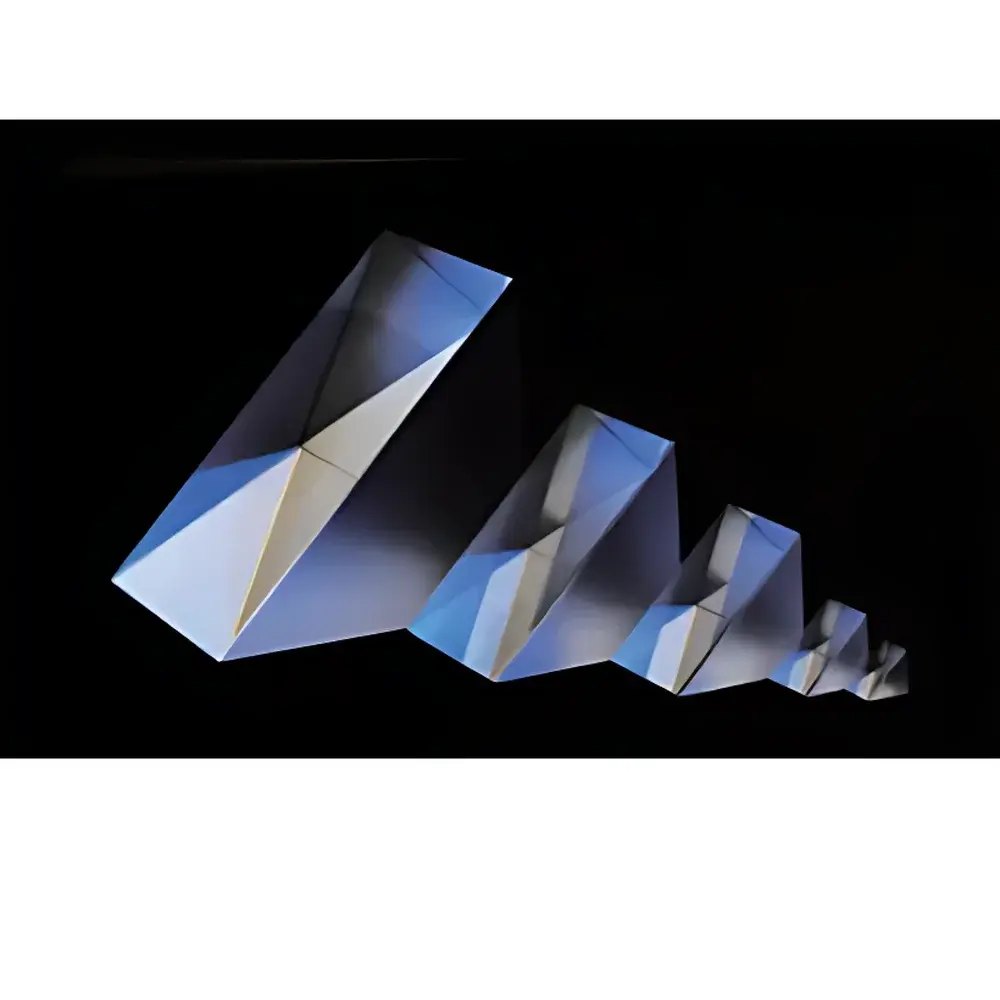
MiXran Meg1051 UV-Fused Silica Right-Angle Prism for Laser Applications

| Brand | MiXran |
|---|---|
| Model | Meg1051 |
| Material | UV-grade fused silica (SiO₂) |
| Apex angle tolerance | ±15″ (for sizes ≥10 mm), ±30″ (for 5 mm) |
| Surface flatness | λ/10 @ 633 nm |
| Coating | Broadband high-reflection dielectric coating optimized for 355 nm, 532 nm, and 1064 nm |
| Reflectance | >99.75% @ 355 nm |
| Surface quality | 10–5 scratch-dig |
| Dimensional tolerance | ±0.1 mm (edge length) |
| Clear aperture | ≥90% of nominal size |
| Damage threshold | >5 J/cm² (10 ns, 10 Hz, 1064 nm) |
Ask about pricing, availability and specifications.
Overview
The MiXran Meg1051 is a precision-engineered right-angle prism fabricated from synthetic UV-grade fused silica, specifically designed for demanding laser beam steering, retroreflection, and polarization-insensitive optical folding in ultraviolet, visible, and near-infrared laser systems. Its 90° apex angle is maintained to tight angular tolerances (±15″ for standard sizes ≥10 mm, ±30″ for 5 mm variant), ensuring minimal beam deviation and high pointing stability under thermal or mechanical stress. The prism leverages the exceptional transmission (>99.9% per cm at 355 nm), low thermal expansion coefficient (5.5 × 10⁻⁷ /°C), and radiation-hardened properties of Corning 7980-class fused silica—making it suitable for excimer laser optics, ultrafast Ti:sapphire amplifier chains, and industrial Nd:YAG laser processing setups. Unlike BK7 or SF10 prisms, the Meg1051 exhibits negligible solarization under prolonged 355 nm exposure and maintains consistent wavefront fidelity across its operational bandwidth.
Key Features
- UV-optimized fused silica substrate with OH content <1 ppm, enabling deep-UV transmission down to 185 nm and superior resistance to laser-induced damage
- Dual-wavelength broadband dielectric HR coatings deposited via ion-beam sputtering (IBS), achieving >99.75% reflectance at 355 nm, 532 nm, and 1064 nm with <0.25% integrated scatter loss
- λ/10 surface flatness (measured at 633 nm HeNe wavelength) and 10–5 scratch-dig surface quality per MIL-PRF-13830B, verified by phase-shifting interferometry
- Hermetic edge blackening applied to suppress parasitic internal reflections and stray light—critical for high-dynamic-range interferometric and LIDAR applications
- Traceable metrology: Each unit supplied with individual test report including interferometric surface map, spectral reflectance curve (200–1100 nm), and calibrated angle measurement using autocollimator traceable to NIM (National Institute of Metrology, China)
Sample Compatibility & Compliance
The Meg1051 is compatible with standard optomechanical mounts (e.g., Kinematic mounts, SM1-threaded cage systems) and integrates seamlessly into ISO-standard optical tables and breadboards. It complies with ISO 10110-7 (surface imperfections), ISO 10110-3 (surface form tolerance), and RoHS 2015/863/EU directives. While not certified to FDA or IEC 60601, its material and coating specifications meet the baseline optical safety requirements for Class 4 laser systems per ANSI Z136.1–2022 when used within specified fluence limits. No adhesives or epoxies are employed in fabrication; all bonding (if required for assembly) must follow ISO 8000-101 guidelines for traceable adhesive application records.
Software & Data Management
No embedded firmware or proprietary software is associated with the Meg1051, as it is a passive optical component. However, full spectral and geometric characterization data—including measured reflectance curves, wavefront error maps, and angle deviation reports—are delivered in standardized formats: CSV (spectral data), ZMX (Zemax-compatible surface prescription), and PDF (certified calibration report). These files support integration into optical design workflows (Zemax OpticStudio, CODE V, FRED) and quality management systems compliant with ISO 9001:2015 clause 8.5.2 (Identification and traceability). Audit trails for calibration certificates adhere to GLP principles, with retention periods aligned with customer-defined document control policies.
Applications
- Laser cavity folding and beam path reversal in Q-switched Nd:YAG (1064 nm), frequency-tripled (355 nm), and frequency-doubled (532 nm) systems
- Retroreflective alignment targets in multi-axis interferometric metrology (e.g., heterodyne laser Doppler vibrometry)
- Polarization-independent turning mirrors in ultrafast amplifier compressors and stretcher–compressor architectures
- High-stability reference optics in space-qualified lidar receivers where radiation-induced birefringence must be minimized
- UV lithography mask alignment subassemblies requiring long-term dimensional stability under intense 355 nm illumination
FAQ
Is the Meg1051 suitable for ultrafast laser applications (e.g., <100 fs pulses)?
Yes—its fused silica base material exhibits negligible group delay dispersion (GDD) below 100 fs²/mm over the 355–1064 nm range, and the IBS coating introduces <5 fs² of additional GDD per reflection, making it appropriate for chirped-pulse amplification (CPA) beam transport.
What is the maximum permissible laser fluence for continuous-wave (CW) operation at 532 nm?
At 532 nm and 10 mm beam diameter, the damage threshold is rated at 10 kW/cm² (CW, measured at 1/e² intensity profile) with active cooling; derating by 30% is recommended for uncooled mounting configurations.
Can custom coatings be applied to the Meg1051 upon request?
Yes—MiXran offers OEM coating customization including AOI-specific HR/AR stacks, polarization-selective coatings (p- or s-polarized HR), and hybrid metallic-dielectric designs for specialized harmonic separation tasks.
Are calibration certificates NIST-traceable?
While direct NIST traceability is not provided, all angular and surface flatness measurements are performed using equipment calibrated against NIM standards, and NIM provides formal equivalence documentation under the APMP MRA framework, recognized internationally via ILAC.
Does the prism include mounting hardware or kinematic adapters?
No—the Meg1051 is supplied as a bare optic only; compatible SM1-threaded prism mounts (e.g., Thorlabs PRM1Z8) and kinematic bases must be selected separately based on system-level alignment requirements.