
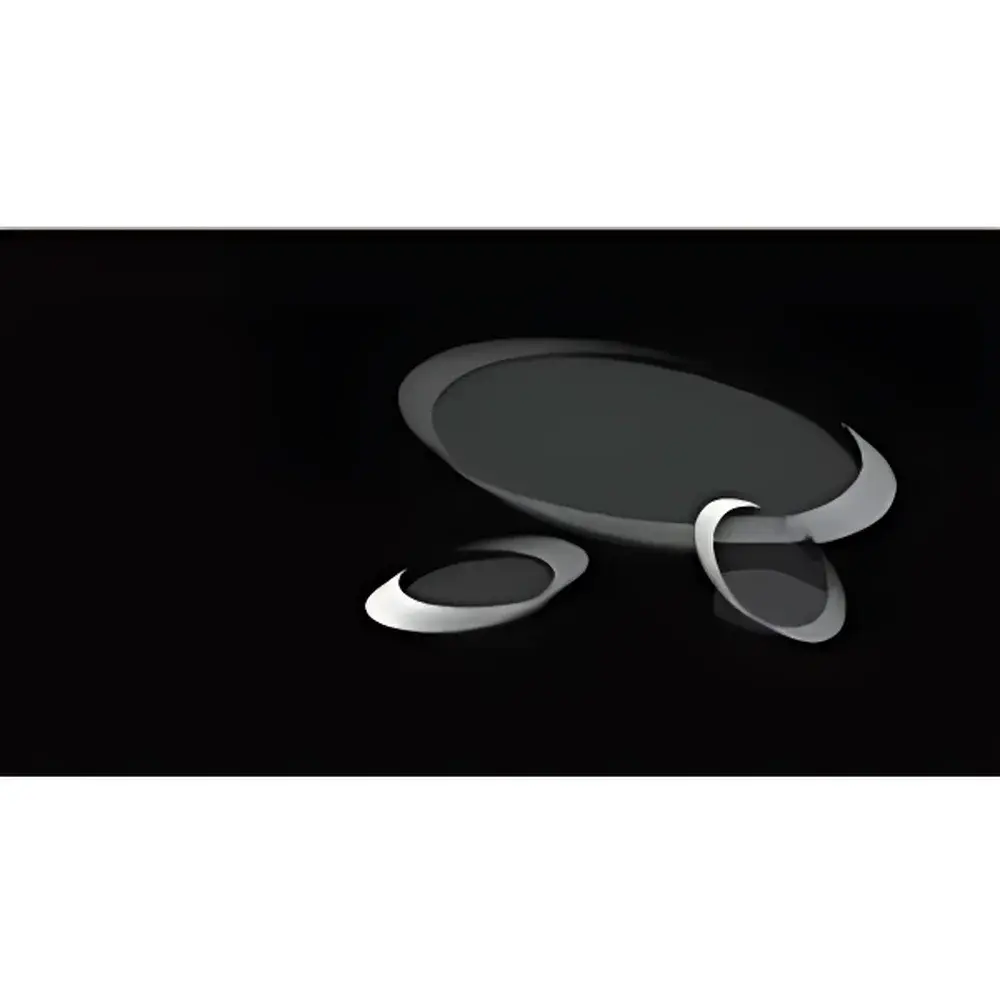
MiXran Meg1067 UV-Fused Silica Brewster Window
| Brand | MiXran |
|---|---|
| Model | Meg1067 |
| Material | UV-grade Fused Silica (SiO₂) |
| Surface Quality | 20–10 Scratch-Dig |
| Surface Flatness | λ/10 @ 633 nm |
| Coating | Uncoated (Brewster-angle optimized AR optional) |
| Clear Aperture | ≥90% of nominal dimension |
| Damage Threshold | >5 J/cm² @ 1064 nm, 10 ns, 10 Hz |
| Operating Wavelength Range | 185–2100 nm |
| Brewster Angle (in air, 532 nm) | ~56.0° |
| Tolerance on Thickness | ±0.1 mm |
| Tolerance on Diameter/Length | ±0.2 mm |
| Certification | ISO 10110-1 compliant manufacturing |
Overview
The MiXran Meg1067 UV-Fused Silica Brewster Window is a precision optical component engineered for high-transmission, polarization-sensitive laser systems operating across the deep ultraviolet to near-infrared spectrum. Designed specifically to minimize reflection loss for p-polarized light at the Brewster angle, this window enables intracavity and beam-steering applications where polarization purity, thermal stability, and minimal wavefront distortion are critical. Constructed from synthetic UV-grade fused silica (SiO₂), the Meg1067 exhibits exceptional transmission down to 185 nm, low hydroxyl content (<1 ppm), and negligible fluorescence under UV excitation—making it suitable for excimer lasers, ultrafast Ti:sapphire amplifiers, and vacuum-UV spectroscopy setups. Its λ/10 surface flatness and 20–10 scratch-dig surface quality ensure compatibility with diffraction-limited optical trains and stringent alignment requirements in interferometric and cavity-dumping configurations.
Key Features
- Optimized geometry for Brewster-angle incidence: minimizes reflectivity for p-polarized light without anti-reflection coatings
- UV-grade fused silica substrate with certified OH⁻ content <1 ppm and refractive index homogeneity Δn <5×10⁻⁶
- High laser-induced damage threshold (>5 J/cm² at 1064 nm, 10 ns pulse width, 10 Hz repetition rate)
- Thermal expansion coefficient of 5.5×10⁻⁷ /°C (20–300 °C), ensuring dimensional stability under thermal cycling
- Compliant with ISO 10110-1 manufacturing standards for optical element specification and tolerancing
- Available in five standard geometries (circular and elliptical variants) with precise thickness control (±0.1 mm) and edge tolerance (±0.2 mm)
Sample Compatibility & Compliance
The Meg1067 window supports integration into Class 100 cleanroom-compatible optical mounts and vacuum flanges (CF-35/CF-63 compatible per request). Its material composition meets ASTM F795-22 specifications for optical fused silica used in biomedical and semiconductor metrology tools. The absence of metallic contaminants and trace heavy metals (verified via ICP-MS per ASTM E1479) ensures compatibility with ultra-high-vacuum (UHV) environments (<1×10⁻⁹ mbar) and EUV lithography support systems. All units undergo 100% inspection per MIL-PRF-13830B for surface defects and wavefront error mapping using Zygo Verifire™ interferometry.
Software & Data Management
While the Meg1067 is a passive optical component, its dimensional and spectral data are fully traceable via MiXran’s component digital twin platform. Each unit ships with a QR-coded calibration certificate listing measured surface flatness, transmitted wavefront error (TWE), and spectral transmittance curves (190–2100 nm, ±0.5 nm resolution). Certificates conform to ISO/IEC 17025:2017 requirements and include uncertainty budgets for thickness and diameter measurements. For OEM integration, ASCII-based spectral data files (.csv) and Zemax-compatible .ZBF files are available upon request—supporting optical design validation under ASME Y14.5 geometric dimensioning and tolerancing (GD&T) protocols.
Applications
- Intracavity polarization control in CW and pulsed solid-state lasers (e.g., Nd:YAG, Nd:YVO₄, Ti:sapphire)
- Brewster-angled windows for high-finesse Fabry–Pérot cavities and optical parametric oscillators (OPOs)
- Beam delivery optics in synchrotron beamlines and free-electron laser (FEL) front ends
- UV photolithography alignment subassemblies requiring minimal birefringence (<5 nm/cm)
- Polarization-maintaining optical isolator input/output interfaces
- Reference optics in NIST-traceable radiometric calibration chains (e.g., for VUV spectroradiometers)
FAQ
What is the typical Brewster angle for the Meg1067 at 532 nm in ambient air?
The calculated Brewster angle is 56.0° ± 0.2°, based on the measured refractive index of 1.4602 ± 0.0003 at 532 nm.
Can the Meg1067 be coated with custom AR layers?
Yes—optional single-layer or broadband MgF₂/Ta₂O₅ multilayer AR coatings are available for specified wavelength bands (e.g., 248 nm, 355 nm, or 1064 nm), with reflectivity <0.25% per surface.
Is vacuum compatibility validated for UHV use?
All Meg1067 units undergo outgassing testing per ASTM E595; total mass loss (TML) <0.5% and collected volatile condensable materials (CVCM) <0.01%, satisfying NASA SP-R-0022A for space-qualified optics.
How is thickness tolerance verified during production?
Thickness is measured using dual-wavelength HeNe interferometry (632.8 nm and 543.5 nm) with sub-50 nm resolution, referenced to NIST-traceable gauge blocks.
Do you provide wavefront error maps for individual units?
Yes—Zygo GPI interferometric data (including PV and RMS wavefront error, Zernike decomposition) is included in the digital certificate for every shipped unit.





